Finding the exact angle between two vectors is one of those skills in linear algebra that connects geometry with computation. With a single formula you can measure how aligned two forces, velocities or directions really are, and translate that alignment into a precise number of degrees.
What formula connects the dot product with the angle between vectors?
The key relationship is this: the dot product of two vectors U and V equals the norm of U multiplied by the norm of V, multiplied by the cosine of the angle theta between them. In other words, the dot product you already know how to compute is exactly the same as multiplying the lengths of both vectors by cos(theta).
Why use cosine and not another trigonometric function? Because cosine matches our intuition of alignment: it equals 1 when vectors point the same way, 0 when they are perpendicular, and -1 when they point in opposite directions.
How does cosine capture vector alignment?
Three cases make the idea click:
- At 0 degrees, vectors are perfectly aligned and cos(theta) = 1, the maximum value.
- At 90 degrees, vectors are perpendicular and cos(theta) = 0, meaning no alignment.
- At 180 degrees, vectors are opposite and cos(theta) = -1, maximum opposition.
No other trigonometric function captures similarity this directly, which is why cosine sits at the core of the formula.
How do you isolate the angle theta from the dot product formula?
You already know how to compute almost everything in the equation: the dot product and the norms. The only unknown is the angle, so you solve for it.
First, divide both sides by the product of the norms and you get that cos(theta) equals the dot product of U and V divided by the norm of U times the norm of V. Then apply the inverse cosine (arccos) to both sides and theta becomes the arccos of that whole expression. A scientific calculator handles the final step.
What does arccos do here? It reverses the cosine so you can recover the angle in degrees once you know the ratio between the dot product and the product of the norms.
How do you apply the formula to a real example with two forces?
Imagine two people pushing a box. One applies force F1 and the other applies force F2, and you want to know the exact angle between their efforts. Define F1 = (3, 1) and F2 = (1, 2).
Step by step calculation of the angle
Work through each piece of the formula:
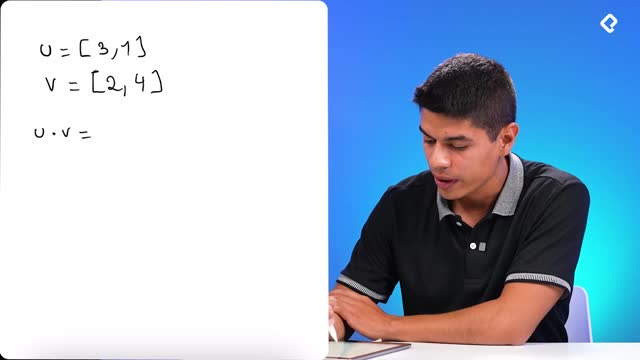
- Dot product: F1 · F2 = (3)(1) + (1)(2) = 3 + 2 = 5.
- Norm of F1: square root of 3² + 1² = 9 + 1, which gives the square root of 10.
- Norm of F2: square root of 1² + 2² = 1 + 4, which gives the square root of 5.
Now plug everything in. The angle theta equals the arccos of 5 divided by the square root of 10 times the square root of 5, which simplifies to 5 over the square root of 50. That ratio is approximately 0.77, and the arccos of 0.77 is approximately 45 degrees.
How do you verify the angle graphically?
Plot F1 at the point (3, 1) and F2 at the point (1, 2) on the plane. Visually, the two arrows clearly form a 45 degree opening.
A quick trick to double check: drop the Y component of F1 to 0 and the X component of F2 to 0. Now F1 lies on the X axis and F2 lies on the Y axis, forming a clean 90 degree angle. Since you symmetrically removed equal pieces from each side, the original angle has to be exactly half of 90, which confirms the 45 degrees.
What does the angle between two vectors actually mean?
In the box example, 45 degrees tells you the two people are collaborating and pushing in a generally similar direction, though not perfectly aligned. If the angle were 0 degrees they would push in exactly the same direction. If it were 180 degrees they would cancel each other out by pushing in opposite directions.
That is the real power of this technique: you used linear algebra to quantify the collaboration between two forces, turning a fuzzy idea like working together into a measurable number.
A practice exercise with car velocities
Try this one on your own. Two cars have velocity vectors:
- Car A: (80, 0), interpreted as 80 km/h toward the east.
- Car B: (60, 60), interpreted as 60 km/h east and 60 km/h north.
Calculate the exact angle between these two vectors and share both your process and your result in the comments. With the dot product, the norm and now the angle formula, you have a complete toolkit to analyze any pair of vectors and describe their relationship with precision.