Imagine someone describes the same arrow in space using a completely different coordinate system. The vector hasn't moved, but the numbers describing it changed. That's the essence of change of basis in linear algebra: a tool to translate vectors and transformations between coordinate languages, essential for anyone working with computer graphics, physics, machine learning, or game development.
And here comes the interesting part: once you understand it, problems that looked impossibly complex become almost trivial.
What does the vector (3,2) really mean?
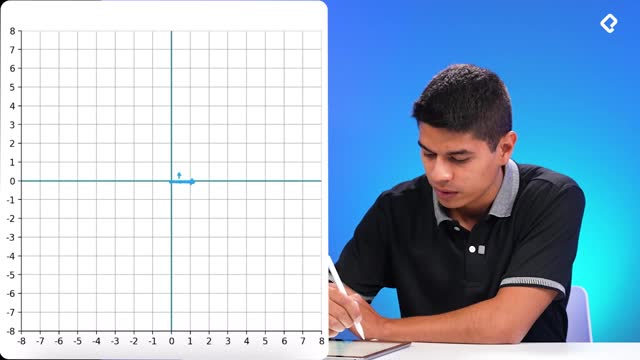
When you write the vector 3,2, you're using a hidden agreement: the standard basis formed by î = (1,0) and ĵ = (0,1). The numbers 3 and 2 are just instructions, move three units along î and two along ĵ.
In other words, 3,2 is shorthand for the linear combination 3î + 2ĵ. Those coordinates only make sense in the language of î and ĵ.
What is a basis in linear algebra? It's a set of linearly independent vectors that can generate every vector in the space through linear combinations. In R², any two non parallel vectors form a valid basis.
How do you translate a vector to another basis?
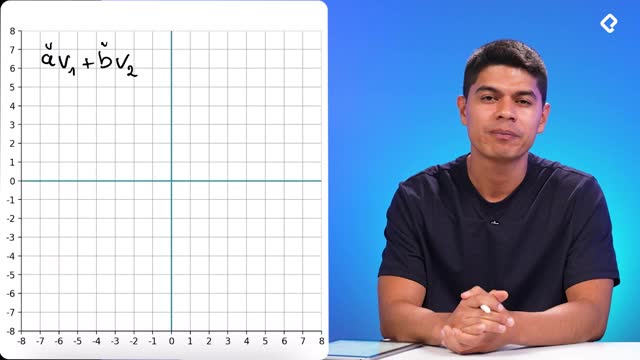
Now meet Jennifer. She decides her coordinate system uses V1 = (2,1) and V2 = (-1,1). These two vectors are linearly independent and span all of R², so they form a perfectly valid basis.
The arrow that lands at 3,2 in your system is still the same arrow. The question is: which scalars C1 and C2 satisfy C1·V1 + C2·V2 = (3,2)? Finding those scalars means finding the new coordinates of the vector in Jennifer's language.
How do you translate a transformation matrix between bases?
This is where the real power shows up. You can take an entire transformation, like a rotation, and rewrite it in another basis using a three step formula: B⁻¹ · M · B.
Here M is your transformation in the standard basis, B is the change of basis matrix whose columns are Jennifer's vectors, and B⁻¹ translates the result back into her language.
Step 1: Find the inverse of the change of basis matrix
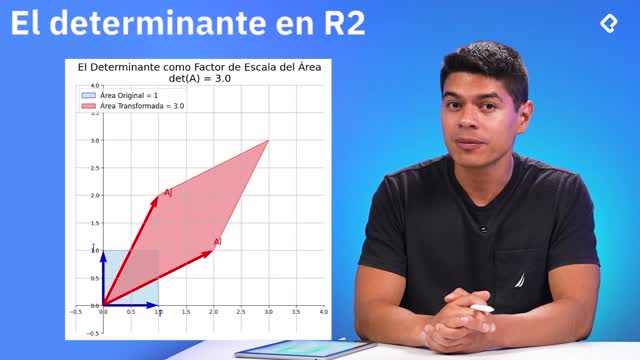
With B = (2,1,-1,1), the determinant equals 2·1 minus 1·(-1) = 3. The inverse formula is 1 over the determinant times the matrix with swapped diagonals and flipped signs on the off diagonal.
The result is B⁻¹ = (1/3, -1/3, 1/3, 2/3).
Step 2: Multiply M by B
Let M be a 90 degree counterclockwise rotation, so M = (0,1,-1,0). Multiplying M by B column by column:
- First column: 2·(0,1) + 1·(-1,0) = (-1, 2).
- Second column: -1·(0,1) + 1·(-1,0) = (-1, -1).
So M·B = (-1, 2, -1, -1).
Step 3: Multiply by B⁻¹ from the left
Factoring out the 1/3 and multiplying gives the final translated matrix:
B⁻¹·M·B = (1/3, 5/3, -2/3, -1/3).
That matrix performs the same 90 degree rotation, but spoken in Jennifer's coordinates.
How do you apply the translated matrix to a vector?
Suppose Jennifer hands you the vector (1, 2) written in her own basis. Multiplying the translated matrix by that vector gives:
- (1/3 + 5/3·2, -2/3 + -1/3·2) = (5/3 - 4/3, -2/3 - 2/3 + ...) which simplifies to (-1, 1).
That result is Jennifer's vector rotated 90 degrees, expressed entirely within her coordinate system. The geometric action is identical, only the description changes.
Why use B⁻¹·M·B instead of just M? Because M only knows how to act on standard coordinates. B translates Jennifer's vector into your language, M rotates it, and B⁻¹ translates the answer back to her.
Why is changing basis useful in real problems?
Think of a video game character moving diagonally. In the standard X and Y axes, the motion looks like 3 units right and 3 units up, two coordinates to track. But from the character's own perspective, the movement is simply forward.
If you rotate the coordinate system so one axis points where the character faces, the motion collapses to something like (4.2, 0). One number does the work of two.
- Computer graphics use change of basis to align cameras with scenes.
- Physics rewrites problems in coordinate systems that match the symmetry of the object.
- Machine learning projects data into bases where patterns become obvious.
A problem that looks tangled in î and ĵ often becomes trivial once you find a better aligned basis.
Practice exercise: translate a shear transformation
Take the shear matrix A = (1, 0, 2, 1) and translate it into Jennifer's language using the same basis vectors V1 = (2,1) and V2 = (-1,1). Once you have the translated matrix, apply it to any vector expressed in Jennifer's coordinates and share your results in the comments.
And here's a teaser: is there an ideal basis where a transformation behaves as simply as possible? The answer is yes, and those special axes are called eigenvectors, the topic of the next class.