Finding eigenvalues and eigenvectors of a square matrix comes down to one algebraic move: rewriting the equation Av = λv so you can actually solve it. If you are studying linear algebra, this is the step that connects geometric intuition with a clean, repeatable procedure you can apply to any square matrix.
Why does the characteristic equation start with Av equals lambda v?
Everything begins with Av = λv, the definition you already met. The goal is to rearrange it until lambda becomes solvable.
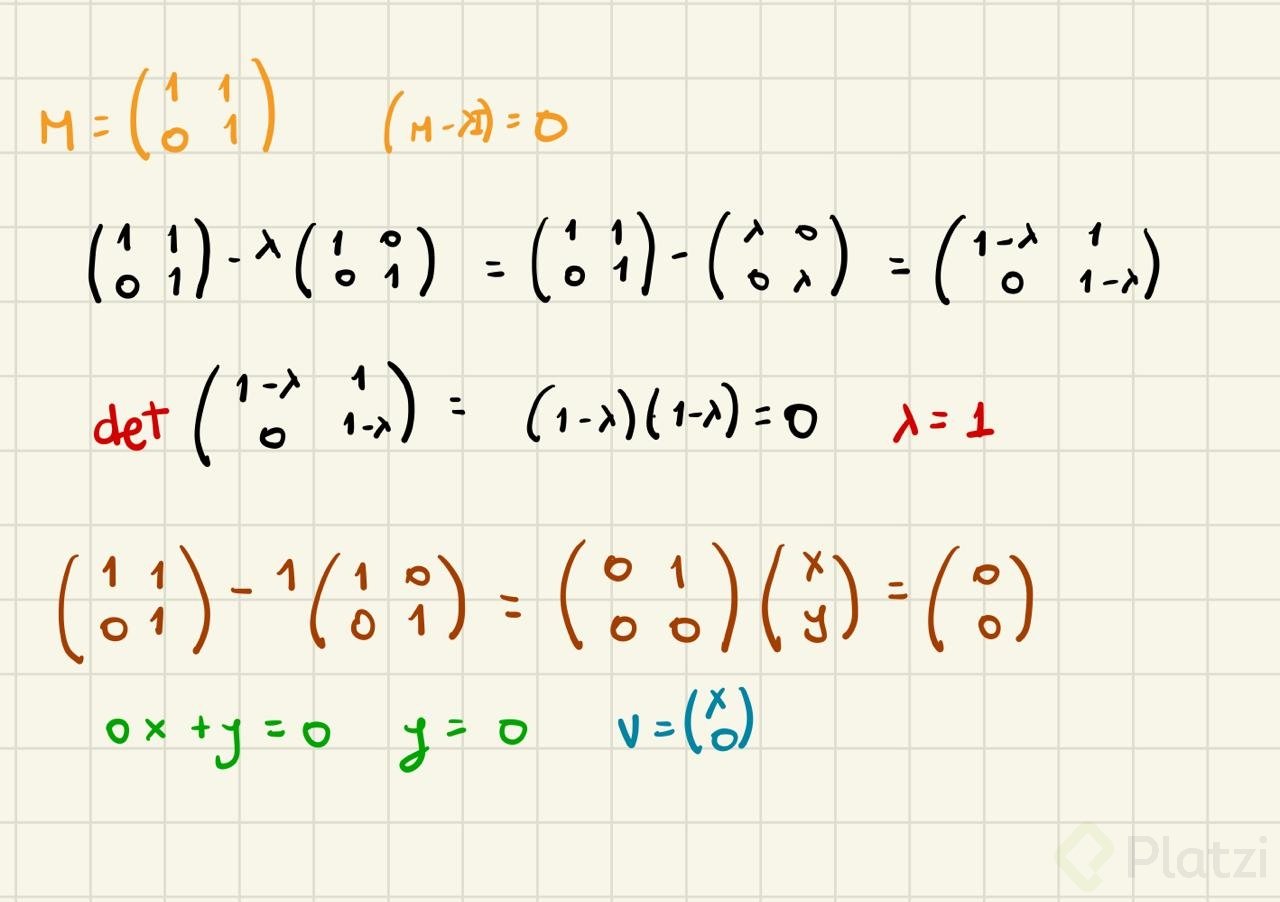
Move λv to the left and you get Av minus λv equals zero. Then factor out v: (A minus λ)v = 0. Here is where the trick appears, because you cannot subtract a scalar from a matrix directly.
That is why the identity matrix shows up. Multiplying λ by I gives you a matrix with λ on the diagonal and zeros elsewhere, which behaves like the scalar but lives in matrix form. The clean equation becomes:
(A minus λI) v = 0
What does (A minus λI)v equal zero mean geometrically? It means the eigenvector v gets crushed to the zero vector by the new matrix. The transformation collapses space, so its determinant must be zero.
From that geometric fact comes the rule that drives the whole method: det(A minus λI) = 0. Solve that equation for λ and you get the eigenvalues.
How do you compute eigenvalues for a 2x2 matrix step by step?
Let's apply it to A with rows (3, 0) and (1, 2). First, build A minus λI:
- Row 1: 3 minus λ, 0.
- Row 2: 1, 2 minus λ.
Now take the determinant. For a 2x2 matrix you multiply the main diagonal and subtract the other diagonal: (3 minus λ)(2 minus λ) minus (1)(0). The second term is zero, so the characteristic polynomial is simply (3 minus λ)(2 minus λ) = 0.
The roots jump out: λ equals 3 and λ equals 2. Those are your two eigenvalues.
What is the characteristic polynomial? It is the polynomial you get from det(A minus λI). Its roots are the eigenvalues of A.
How do you find the eigenvector for each eigenvalue?
With the eigenvalues in hand, plug each one back into (A minus λI)v = 0 and solve the system.
Eigenvector for lambda equals 3
Substitute λ = 3. The matrix A minus 3I becomes:
- Row 1: 0, 0.
- Row 2: 1, minus 1.
With v written as (x, y), the system reduces to a single useful equation: x minus y = 0, which means x equals y. Wait, look again at the rows from the transcript: the first row gives 0x + 0y = 0 (always true) and the second gives x minus y. Pick any nonzero value, say x = 1, y = 0 from the worked example, and you have an eigenvector. The first eigenvector pairs with eigenvalue 3.
Eigenvector for lambda equals 2
Now substitute λ = 2. The matrix becomes:
- Row 1: 1, 0.
- Row 2: 1, 0.
The system collapses to x plus y = 0, so y equals minus x. Choose x = minus 1 and y = 1, and the second eigenvector is (minus 1, 1), associated with eigenvalue 2.
This is the same pair you saw in the earlier animation about eigenvectors and eigenvalues, where these two directions stayed on their own span while the rest of the space stretched.
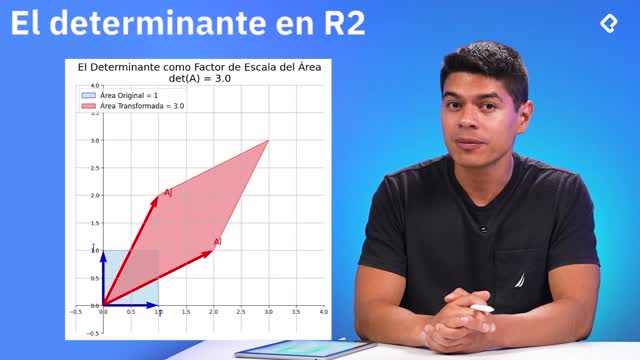
What does it look like when the determinant collapses to zero?
The animation makes the algebra visible. As λ slides, the matrix A minus λI deforms the plane. When the area enclosed by the basis vectors hits zero, the space collapses to a line, the determinant is zero, and you have landed on an eigenvalue.
In that example, the animation shows two collapse points:
- One at eigenvalue 1, where the plane flattens into a line.
- Another at eigenvalue 4, after the orientation flips and the determinant turns negative before crossing zero again.
That visual reinforces why det(A minus λI) = 0 is not an arbitrary trick. It is the algebraic signature of a singular matrix, the moment the transformation loses a dimension.
Key concepts you should keep from this lesson
A few ideas carry the whole procedure and are worth holding onto:
- The identity matrix I lets you subtract a scalar from a matrix by turning λ into λI.
- A matrix is singular when its determinant is zero, which is exactly when nonzero eigenvectors can exist.
- The characteristic equation det(A minus λI) = 0 produces a polynomial whose roots are the eigenvalues.
- Each eigenvalue plugged back into (A minus λI)v = 0 gives a system whose nonzero solutions are the eigenvectors.
- Eigenvectors are defined up to a scalar, so you can pick convenient values like x = 1 to write them cleanly.
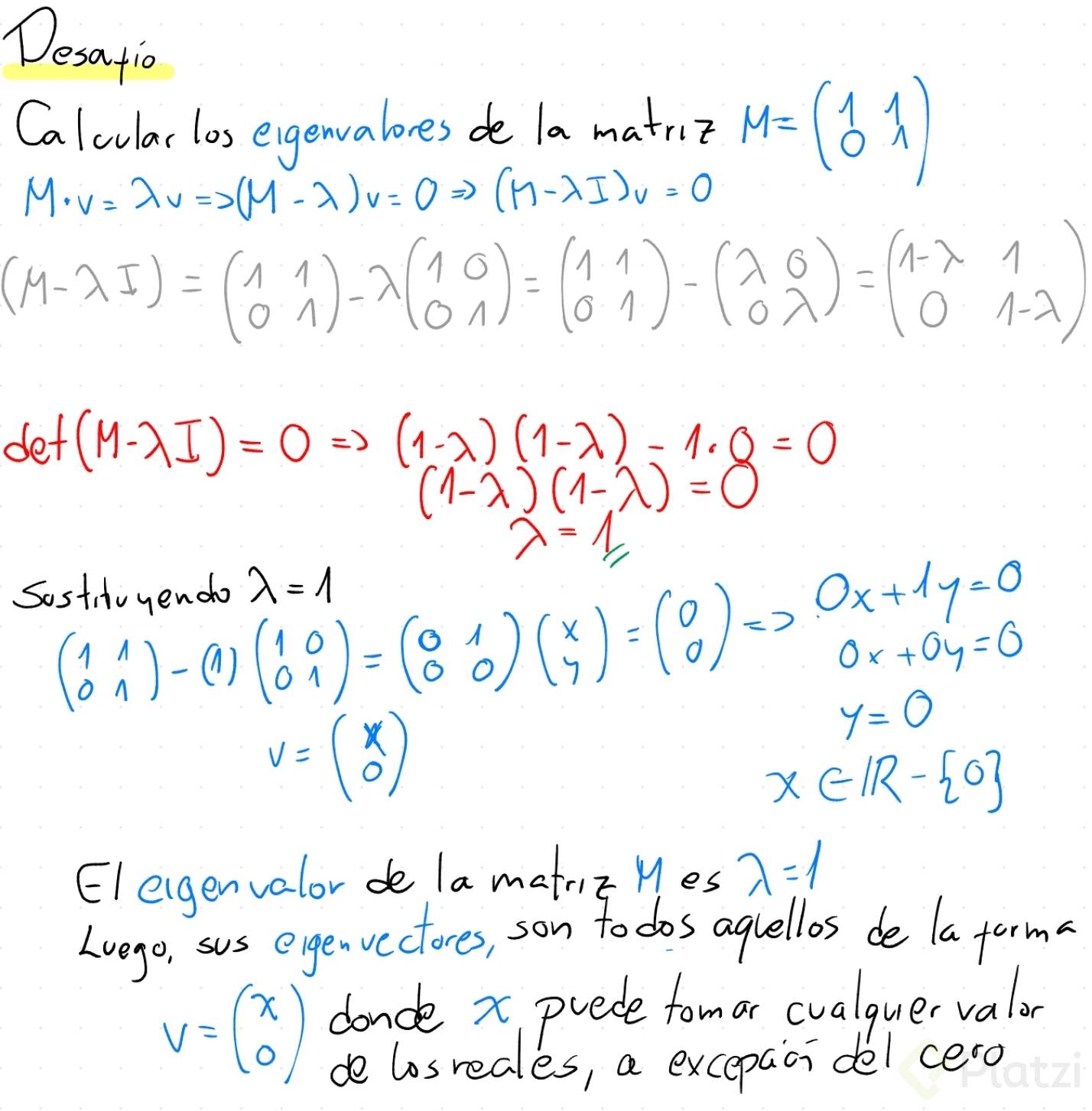
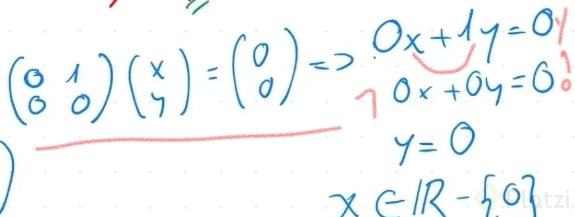
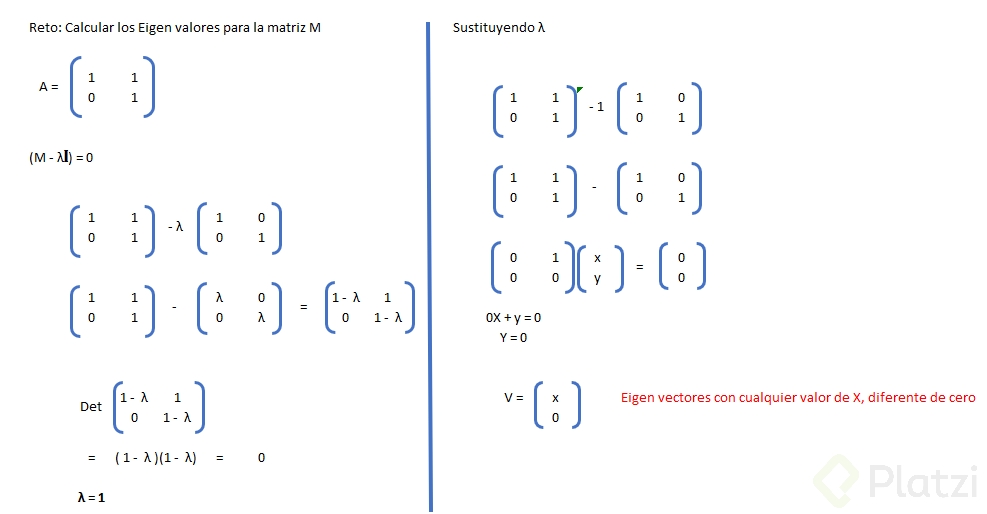
Now try it yourself with the shear matrix M with rows (1, 0) and (1, 1). Compute its eigenvalues and eigenvectors and share what you got in the comments. In the next class you will learn how to rewrite a matrix in the language of its own eigenvectors.