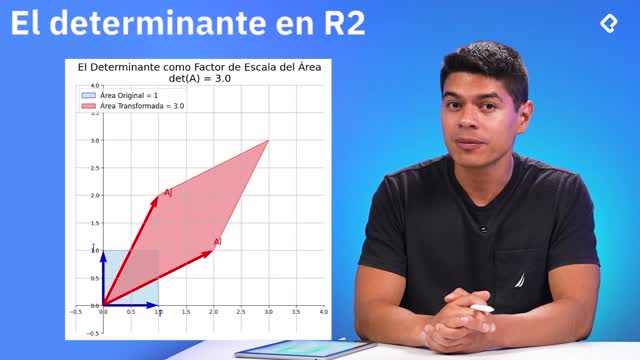
Knowing whether a matrix is invertible saves you from chasing solutions that do not exist. The determinant works as a quick diagnostic: if it is different from zero, the transformation can be reversed and the system has a unique solution. If it equals zero, the transformation crushes the space and information is lost forever.
Why does a zero determinant break invertibility?
Think of a transformation that flattens a 2D plane into a single line. Many different input vectors end up stacked at the same point. If you tried to reverse the process from that point, there would be no way to know which original vector to return to.
That loss of information is exactly why a flattening transformation has no undo button. A square matrix is invertible if, and only if, its determinant is different from zero. This rule is one of the cornerstones of linear algebra and works as a diagnostic before any heavier calculation.
What does it mean when the determinant is zero? It means the matrix collapses the space into a lower dimension, like turning a plane into a line. The transformation loses information and cannot be reversed.
How do I check if a matrix is invertible with the determinant?
The logic splits into two clear scenarios you can apply to any square matrix.
- If the determinant of A is different from zero, the matrix has an inverse, the transformation can be reversed, and the system AX = B has a unique solution.
- If the determinant of A equals zero, the matrix has no inverse, the transformation loses information, and the system AX = B has either infinite solutions or none.
A rotation that preserves area
Take the matrix A = [[0, 1], [-1, 0]], which rotates the space 90 degrees counterclockwise. Its determinant is (0)(0) - (1)(-1) = 1. Since the determinant is non-zero, the matrix is invertible. Visually, you can return to the original state by rotating -90 degrees. No information was lost.
A matrix that flattens the plane
Now consider B = [[1, 0], [0, 0]]. The determinant is (1)(0) - (0)(0) = 0. This transformation squashes the entire plane onto the X-axis, erasing the Y-axis information. You cannot un-flatten what is already flat, so this matrix is not invertible.
How do I calculate the inverse of a 2x2 matrix?
For a 2x2 matrix written as [[a, b], [c, d]], the inverse follows a compact formula: multiply 1 divided by the determinant by a new matrix where you swap the main diagonal (d goes where a was, a goes where d was) and negate the other two entries (b becomes -b, c becomes -c).
What is the formula for the inverse of a 2x2 matrix? It is 1 over the determinant times the matrix [[d, -b], [-c, a]]. If the determinant is zero, the inverse does not exist.
Let us run an example with A = [[3, 2], [1, 1]]. First, the determinant: (3)(1) - (2)(1) = 1. Since it is non-zero, you can continue. Apply the formula: swap the diagonal to get 1 and 3, negate the other entries to get -2 and -1, and multiply by 1 over 1. The result is the inverse [[1, -2], [-1, 3]]. You can verify it by multiplying the inverse by the original matrix: if you get the identity matrix, the calculation is correct.
How do I solve a linear system using the inverse?
This is where the determinant and the inverse work together. The determinant confirms that a unique solution exists, and the inverse delivers it.
Take the system 3X + Y = 5 and 2X + Y = 4. Break it into the form AX = B:
- A = [[3, 2], [1, 1]], the matrix of coefficients.
- X = [X, Y], the unknowns.
- B = [5, 4], the results.
First, check invertibility. The determinant of A is (3)(1) - (2)(1) = 1, so the system has a unique solution. Next, calculate the inverse of A using the same swap-and-negate rule: A inverse equals [[1, -2], [-1, 3]].
Finally, since X = A inverse times B, compute the product: (1)(5) + (-2)(4) = 5 - 8 = -3 wait, recompute carefully with the values from the lesson: the result is X = 1 and Y = 2. You have recovered the original vector that, once transformed by A, produced B. As a check, multiply A by X and confirm you get B back.
Key skills and concepts from this lesson
These are the ideas worth taking with you into the next module.
- Determinant as a diagnostic tool [00:50]: a fast way to know if a matrix is invertible before doing heavier work.
- Geometric meaning of a zero determinant [00:20]: the transformation flattens space into a lower dimension and loses information.
- Invertibility rule [01:10]: a square matrix is invertible if and only if its determinant is different from zero.
- Rotation example [01:50]: the matrix [[0, 1], [-1, 0]] has determinant 1 and rotates 90 degrees counterclockwise.
- Flattening example [02:40]: the matrix [[1, 0], [0, 0]] has determinant 0 and collapses the plane onto the X-axis.
- Formula for the inverse of a 2x2 matrix [03:20]: 1 over the determinant times the matrix with swapped diagonal and negated off-diagonal entries.
- Solving AX = B with the inverse [04:30]: X = A inverse times B, valid only when the determinant is non-zero.
Try the verification multiplications at home and share your results in the comments. Did you get the identity matrix and the original B vector?