A vector in linear algebra is an ordered list of numbers that describes objects with multiple characteristics, unlike a scalar which only carries a single magnitude. Understanding vectors matters because they power everything from physics simulations to video game engines, and they are the foundation for every operation you will perform later in this field.
What is the difference between a scalar and a vector?
A scalar is just a number. Today's temperature at 25 degrees, a product priced at 10 dollars, or your age: each one is a single value that represents a magnitude on a scale [0:08].
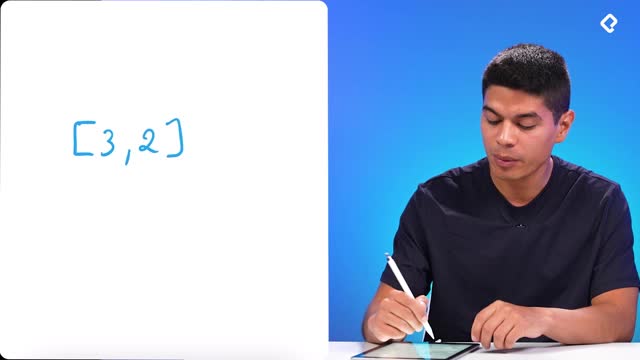
A vector, on the other hand, is an ordered list of numbers used to describe something with several features at once. The order is critical: the list (3, 2) is not the same as (2, 3). If the first number represents the quantity of products and the second the price, swapping them changes the meaning entirely [0:38].
What is a component in a vector? Each number inside a vector is called a component. The total number of components tells you the dimensional space where that vector lives.
A vector with two components lives in R², a flat plane. A vector with three components lives in R³, the same three dimensional space you move through every day. The letter R is capitalized because it stands for the set of real numbers [1:08].
How do you interpret a vector geometrically?
A vector is more than a list. Geometrically it has two valid readings, and you should keep both in mind.
Is a vector a point or an arrow?
The first interpretation treats a vector as a point in space. The vector (3, 2) is the coordinate you reach by moving three units along the X axis and two along the Y axis. It is a fixed location.
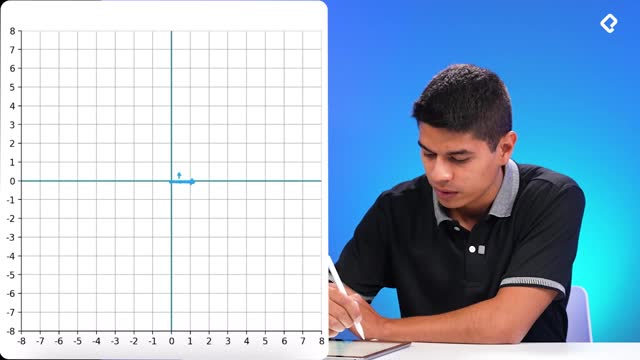
The second interpretation, the one you have probably heard before, treats a vector as an arrow that starts at the origin (0, 0) and ends at that point. Drawing the arrow for (3, 2) reveals two key properties: a direction, pointing up and to the right, and a magnitude, which is the diagonal length of the arrow itself [1:55].
Why use arrows instead of points? Arrows let you model real world things that have both magnitude and direction, like the velocity of a car traveling 80 km/h northeast, or a character's movement in a video game.
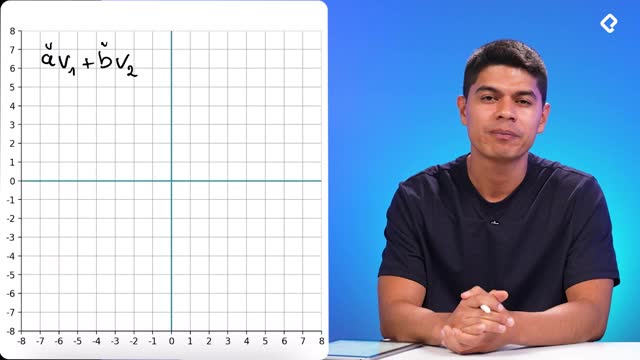
In linear algebra you will mostly think of vectors as arrows because that view gives a richer intuition for the operations ahead. When working with many vectors at once on a plane, it is cleaner to draw them as points, but technically both views describe the same object [3:00].
How do you graph vectors in R² and R³?
Practice locks in the intuition. Try graphing these three vectors in R² before checking the answers:
- U = (-1, 3).
- V = (4, 1).
- W = (2, -1).
For U, move one unit left on X and three up on Y, then draw the arrow from the origin. For V, move four right and one up. For W, move two right and two down. Each arrow starts at (0, 0) and ends at its coordinate, giving you three vectors with distinct directions and magnitudes [3:45].
How does a vector work in three dimensions?
The logic carries over to R³ with one extra component for the Z axis. Picture three axes: X pointing forward, Y diagonal, and Z vertical. The vector V = (3, 4, 5) means three units on X, four on Y, and five on Z. Locate that point in space, then draw the arrow from the origin to it [4:50].
A real world example helps cement the idea. The position of a drone can be captured with a vector of three components: longitude, latitude, altitude. Each component answers a different question about where the drone is, and together they pin it down precisely in space [5:35].
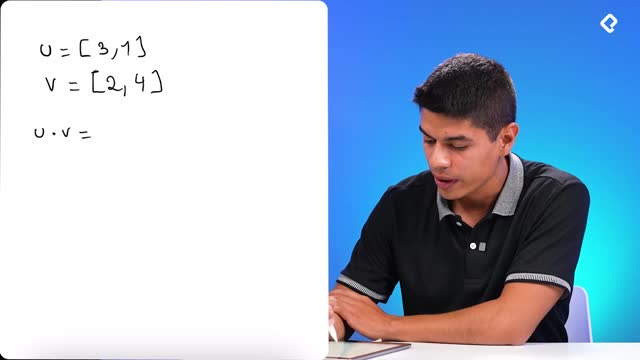
With this foundation in place, the next step is learning the operations that bring vectors to life: addition, subtraction, and scalar multiplication. These are not just calculations, they are geometric actions that let you move and reshape objects in space. Drop your three component vector example in the comments and tell me what each part represents.