When a system of equations has no solution, linear algebra gives you a powerful workaround: the orthogonal projection. This tool helps you find the closest possible vector inside the column space of A when the vector b lives outside of it, turning an unsolvable problem into the best possible approximation.
¿What is an orthogonal projection and why does it matter?
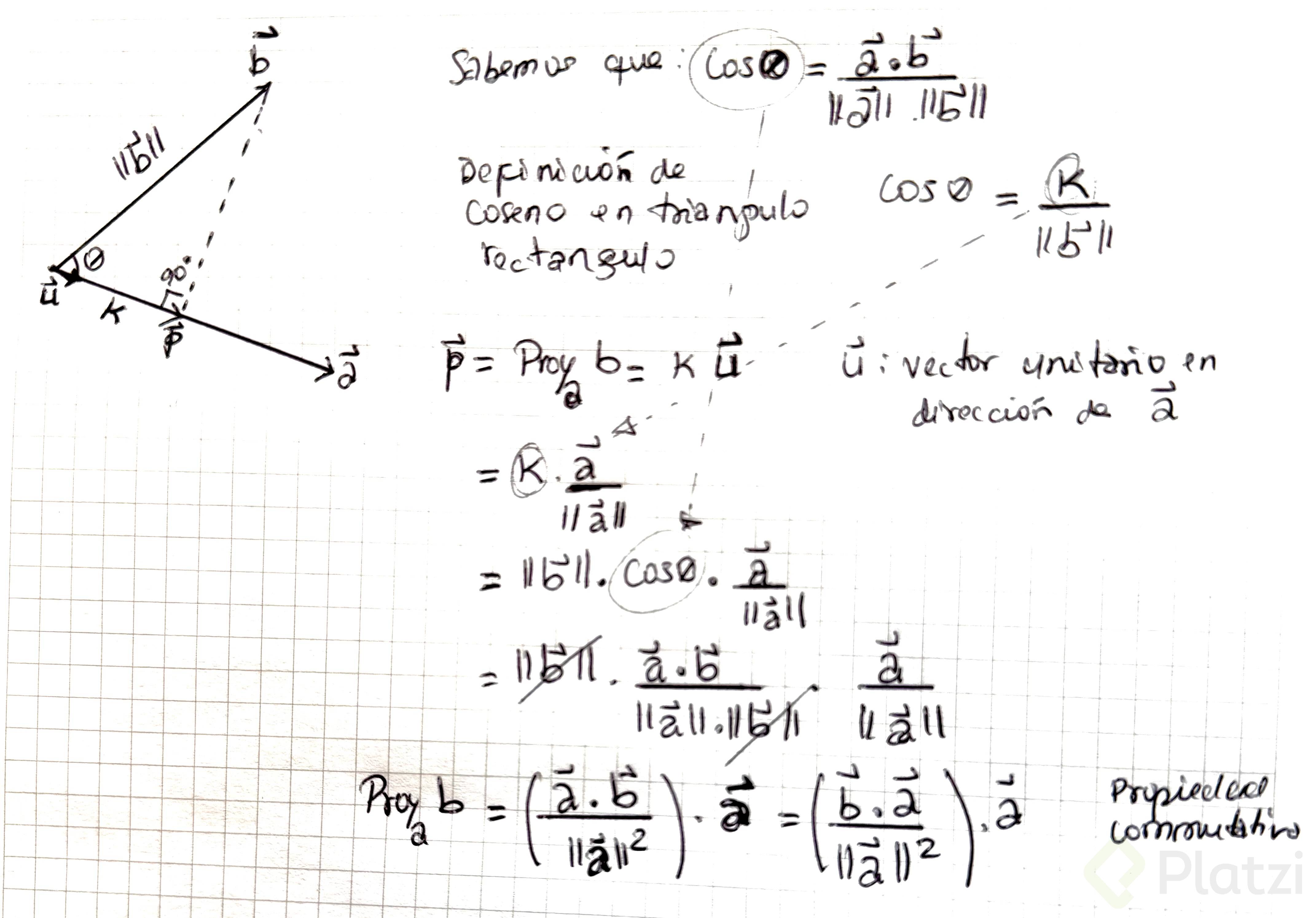
Think of projection as a shadow. If you shine a light perpendicular to a line A, the shadow that vector b casts onto that line is its projection. That shadow is a new vector, and it has a special property: it is the closest point on the line to the original vector b.
This matters because when Ax = b has no solution, b is outside the column space of A. You cannot build it from the columns of A. But you can build the next best thing: the projection of b onto that column space. That projection becomes your best approximate answer.
¿What does it mean that b is outside the column space of A? It means b cannot be written as a linear combination of the columns of A, so the system has no exact solution and you need an approximation.
¿How do you calculate the projection of b onto a?
The formula uses tools you already know from the dot product and the norm [1:38]. The projection of b onto a equals the dot product of b and a, divided by the squared norm of a, all multiplied by the vector a.
The steps are:
- Calculate the dot product between b and a.
- Calculate the norm of a and square it.
- Divide the dot product by the squared norm to get a scalar.
- Multiply that scalar by vector a to get the final projection.
That scalar inside the parentheses tells you how much of a you need to land on the shadow. The final multiplication scales the vector a until it matches that shadow exactly.
¿How does it work with a simple example?
Take b = (2, 3) and a = (4, 0), and project b onto a [2:33].
- Dot product of b and a: 2·4 + 3·0 = 8.
- Norm of a squared: √16 squared cancels back to 16.
- Scalar: 8 / 16 = 1/2.
- Final projection: (1/2)·(4, 0) = (2, 0).
Graphically, vector a runs along the x axis to (4, 0), vector b points up to (2, 3), and the projection lands at (2, 0). That point is the closest spot on a's line to b, exactly where a perpendicular drop from b touches a.
¿How do you use projection to solve a system without solution?
Remember the system from the previous class: x + y = 2 and x + y = 4 [5:01]. The coefficient matrix A has identical columns, so its column space collapses into the single direction (1, 1). The result vector b = (2, 4) sits outside that line, which is why the system fails.
The fix is to project b onto the column space of A.
- Dot product of b and a: 2·1 + 4·1 = 6.
- Norm of a squared: (√(1+1))² = 2.
- Scalar: 6 / 2 = 3.
- Projection: 3·(1, 1) = (3, 3).
The point (3, 3) lives inside the column space and is the closest point to b = (2, 4). That is your best approximate solution. When you plot it, you can see vector b reaching to (2, 4), the column space stretching as the line y = x, and the projection landing right where a perpendicular from b meets that line.
¿Why is the projection the best approximation? Because among all the vectors you can actually build inside the column space of A, the projection minimizes the distance to b. No other vector in that space gets closer.
¿What skills and concepts should you take away?
A few ideas anchor everything you just did:
- Column space of A: the set of all vectors you can build by combining the columns of A. If b is not there, no exact solution exists [4:43].
- Dot product: the operation that measures alignment between two vectors and feeds the projection formula [2:48].
- Norm of a vector: the length of the vector, calculated as the square root of the sum of its squared components [3:09].
- Projection formula: (b·a / ‖a‖²)·a, the recipe to get the shadow of b on a [1:55].
- Best approximation: the projection is the point inside the column space closest to b, your replacement for an exact solution [0:55].
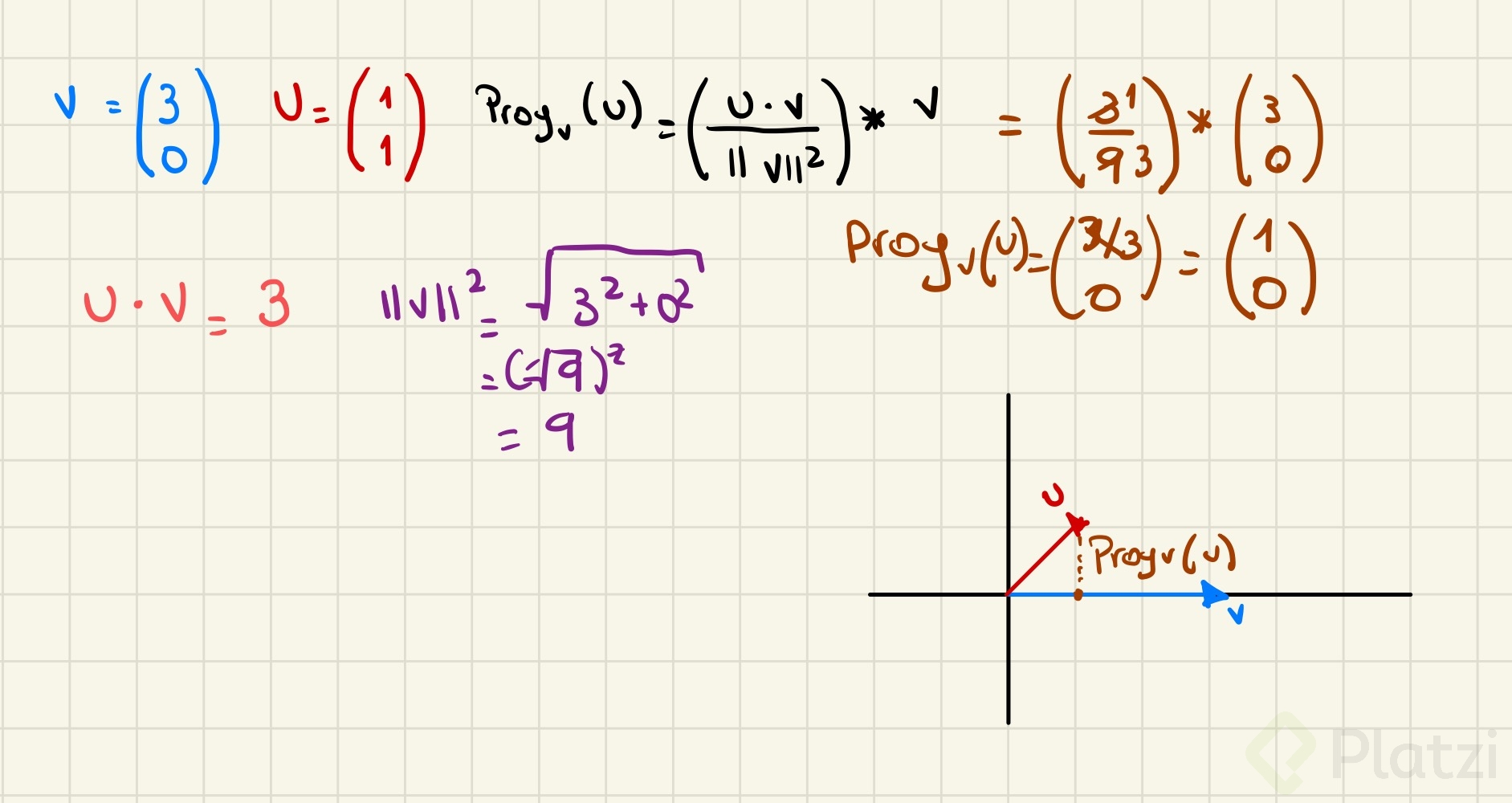
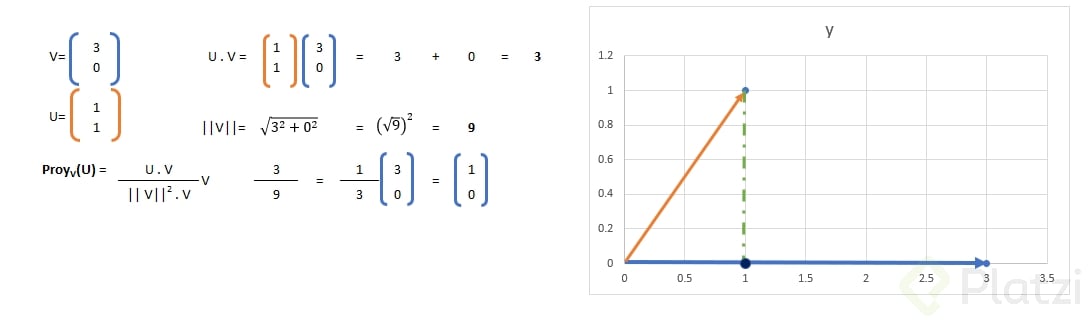
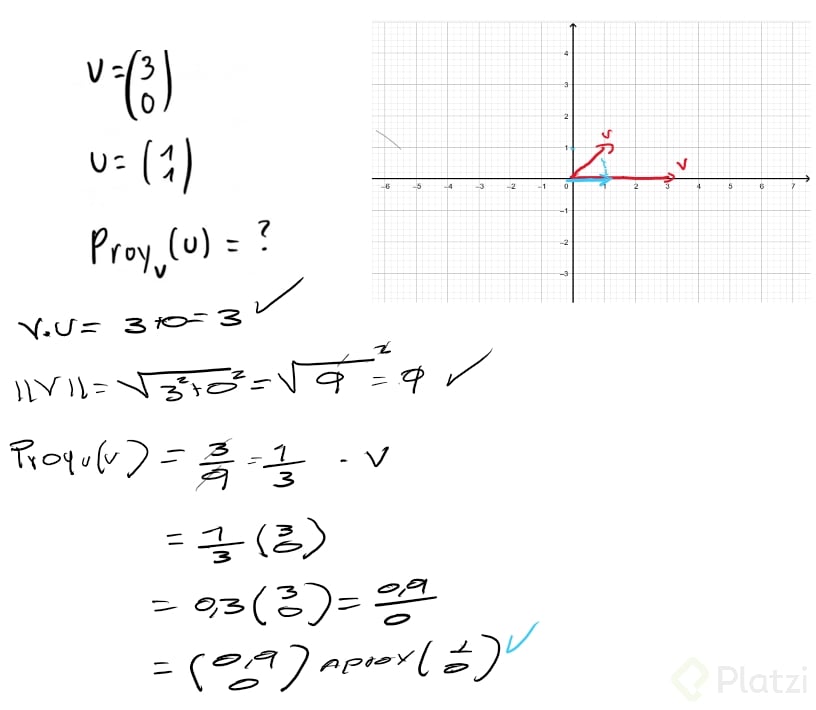
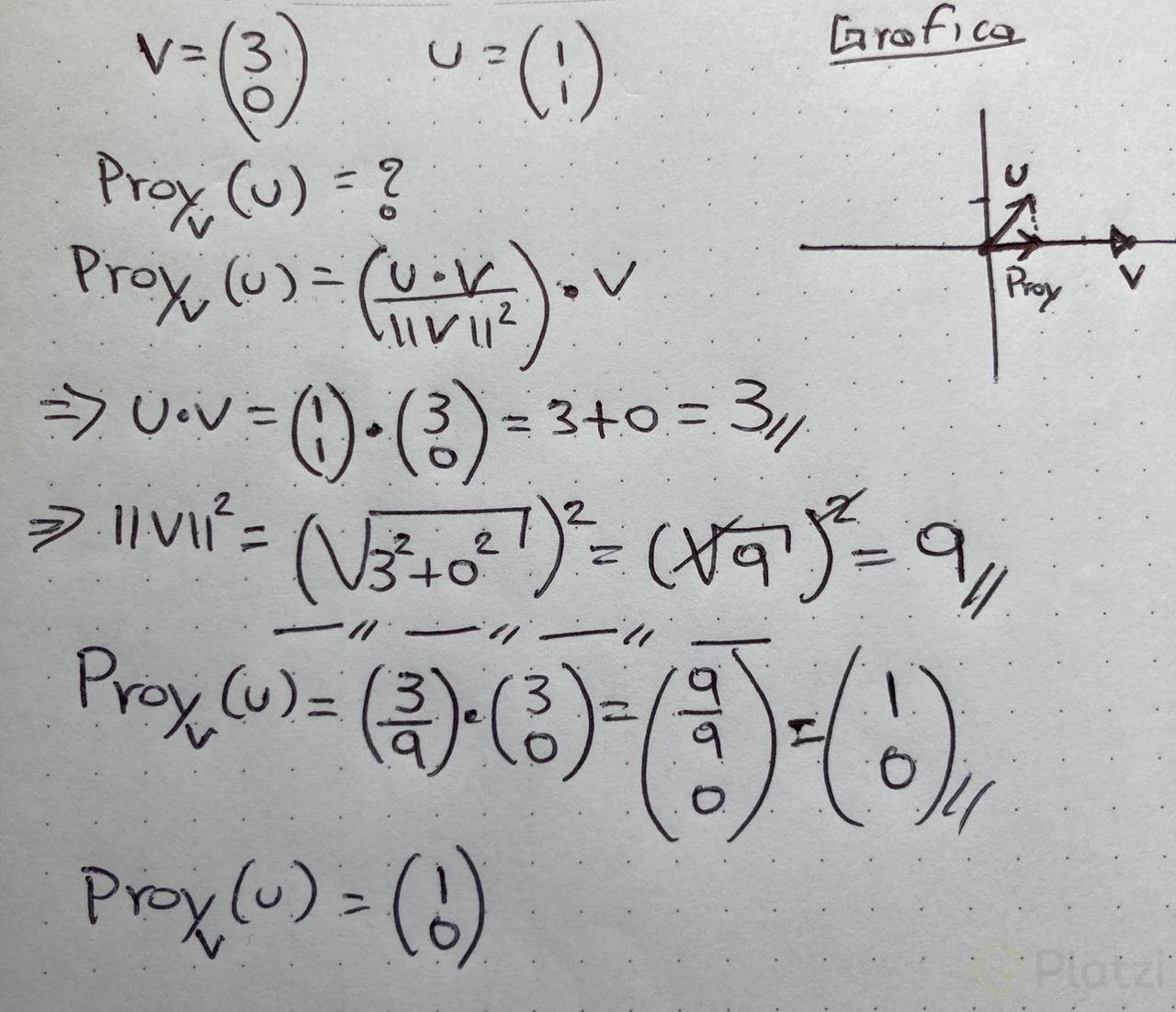
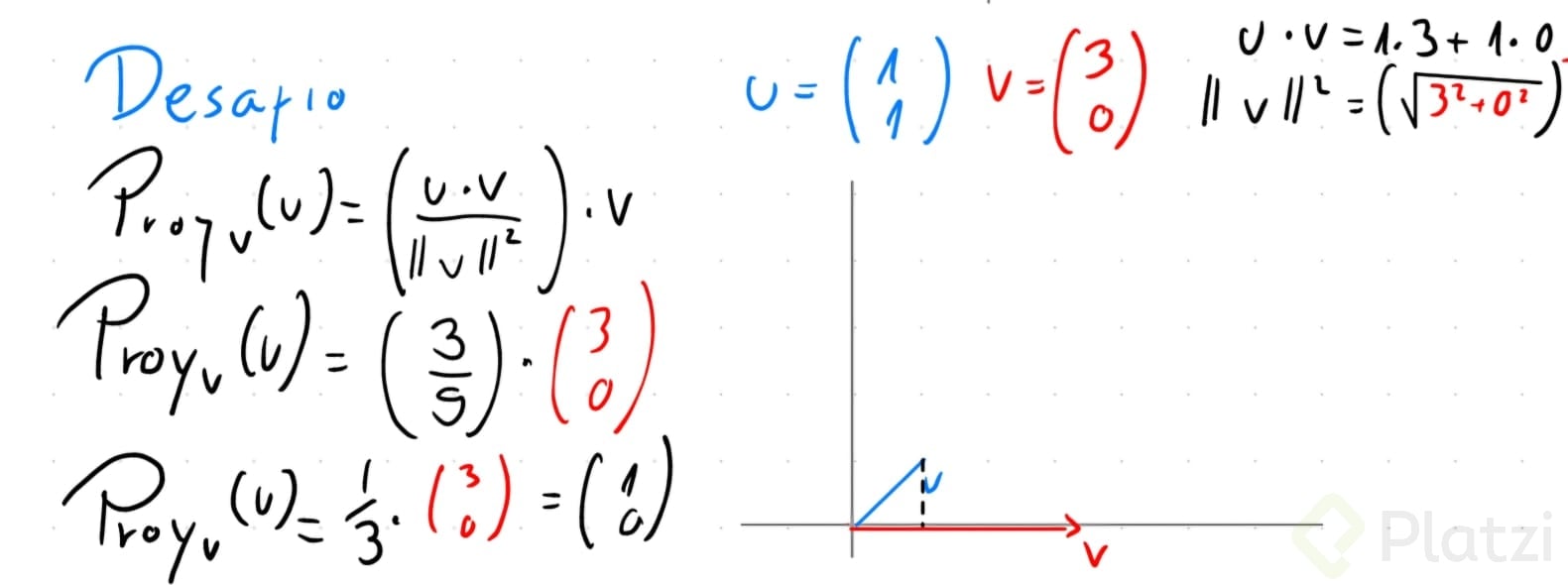
Now it's your turn. Take vector V = (3, 0) and vector U = (1, 1), calculate the projection of U onto V, and drop your result in the comments.