The determinant of a matrix is the single number that tells you whether a linear transformation can be reversed and how much it stretches or shrinks space. If you are studying linear algebra, machine learning foundations, or 3D graphics, understanding this value will help you decide when a matrix is invertible and what it does geometrically.
What does the determinant mean geometrically?
The most powerful way to read a determinant is geometric: it is the scale factor of a transformation. In other words, it measures how much a matrix expands or contracts the space it acts on.
In a 2D space, the determinant equals the area produced by the transformation. The base vectors i and j form a unit square with area 1. When you apply a matrix A, that square becomes a parallelogram, and its new area is exactly the determinant of A [01:00].
- If det(A) = 3, the transformation tripled the original area.
- If det(A) = 0.5, the space contracted to half the original.
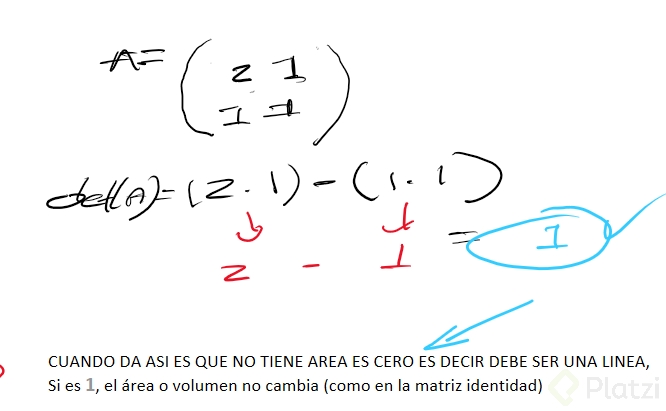
- If det(A) = 0, the square collapsed into a line.
In 3D, the same idea scales up. The vectors i, j and k form a unit cube with volume 1, and after the transformation that cube becomes a parallelepiped, a 3D version of the parallelogram. The determinant is the volume of that new shape [02:10].
What does it mean if the determinant is zero? It means the matrix flattened the space into a lower dimension. A square becomes a line, a cube becomes a plane or a line, and you lose information you cannot recover. That is why the matrix has no inverse.
The sign also matters. A negative determinant means the orientation of the space was flipped, like looking at a mirror image.
How do you calculate the determinant of a 2x2 matrix?
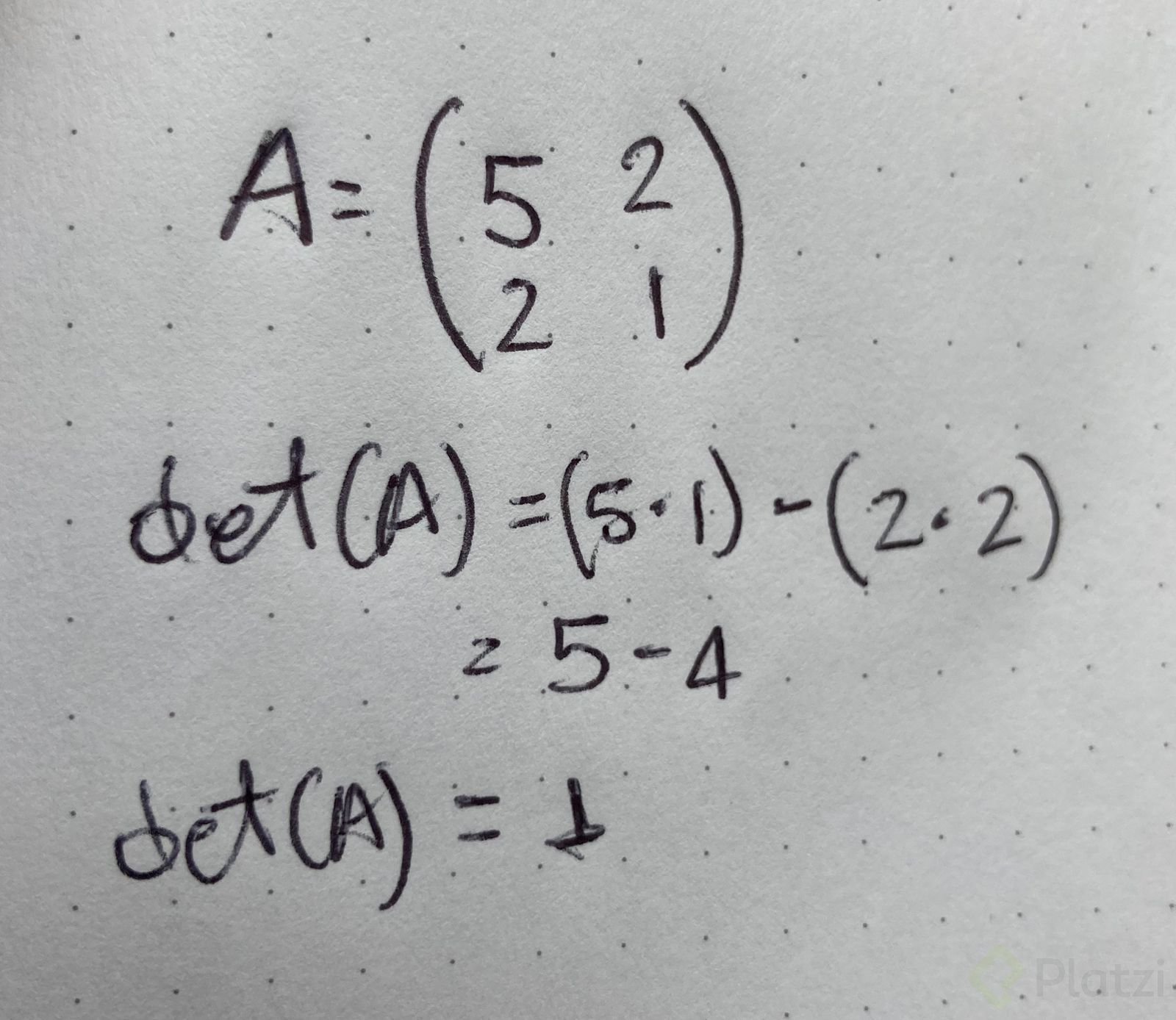
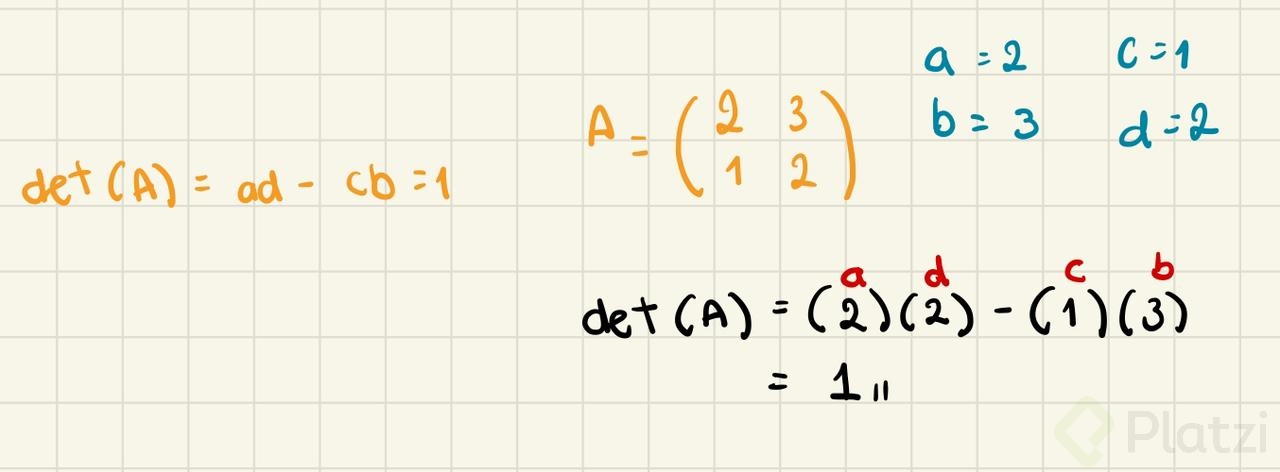
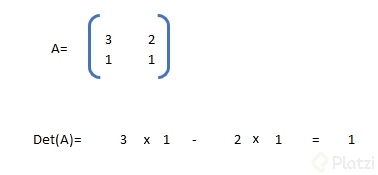
For a 2x2 matrix with entries a, b, c, d, the rule is simple: multiply the main diagonal and subtract the product of the other diagonal. The formula is det(A) = a·d − c·b [03:30].
Take the matrix with values 2, 1, 1, 2. The determinant is (2·2) − (1·1) = 4 − 1 = 3. That tells you the matrix triples the area of any figure it transforms.
Now look at the matrix with values 1, 2, 2, 4. Its determinant is (1·4) − (2·2) = 4 − 4 = 0. The second column is just twice the first, so the matrix flattens the plane into a line. This kind of matrix is called a singular matrix, and it cannot be inverted.
When is a matrix singular? When its determinant is zero. That happens when its columns are linearly dependent, meaning one is a multiple of the other.
How do you calculate the determinant of a 3x3 matrix using Sarrus rule?
For a 3x3 matrix you use the Sarrus rule, which works by augmenting the matrix with copies of its first two columns and then handling the diagonals [05:20].
The steps are:
- Write the original 3x3 matrix and append its first two columns to the right.
- Multiply the three diagonals going from left to right and add those products.
- Multiply the three diagonals going from right to left and add those products.
- Subtract the second sum from the first.
Let's run an example with the matrix that has values 1, 0, 2 in the first row, 3, 2, 1 in the second, and 2, 1, 5 in the third.
After augmenting with the first two columns, the diagonals from left to right give 1·2·5 + 0·1·2 + 2·3·1 = 10 + 0 + 6 = 16. The diagonals from right to left give 0·3·5 + 1·1·1 + 2·2·2 = 0 + 1 + 6 wait, recompute: 2·1·1 = 2, plus the others. The class result is 16 − 7 = 9, which means the volume of the transformed cube is 9 [07:40].
What properties of the determinant should you remember?
These rules show up constantly when you work with matrix products, transposes and inverses, so it pays to memorize them.
- The determinant of the identity matrix is 1. It makes sense because the identity does nothing to the space.
- The determinant of a product equals the product of determinants: det(A·B) = det(A)·det(B).
- The determinant of the transpose equals the determinant of the original matrix: det(Aᵀ) = det(A), because the area or volume does not change when you flip rows and columns.
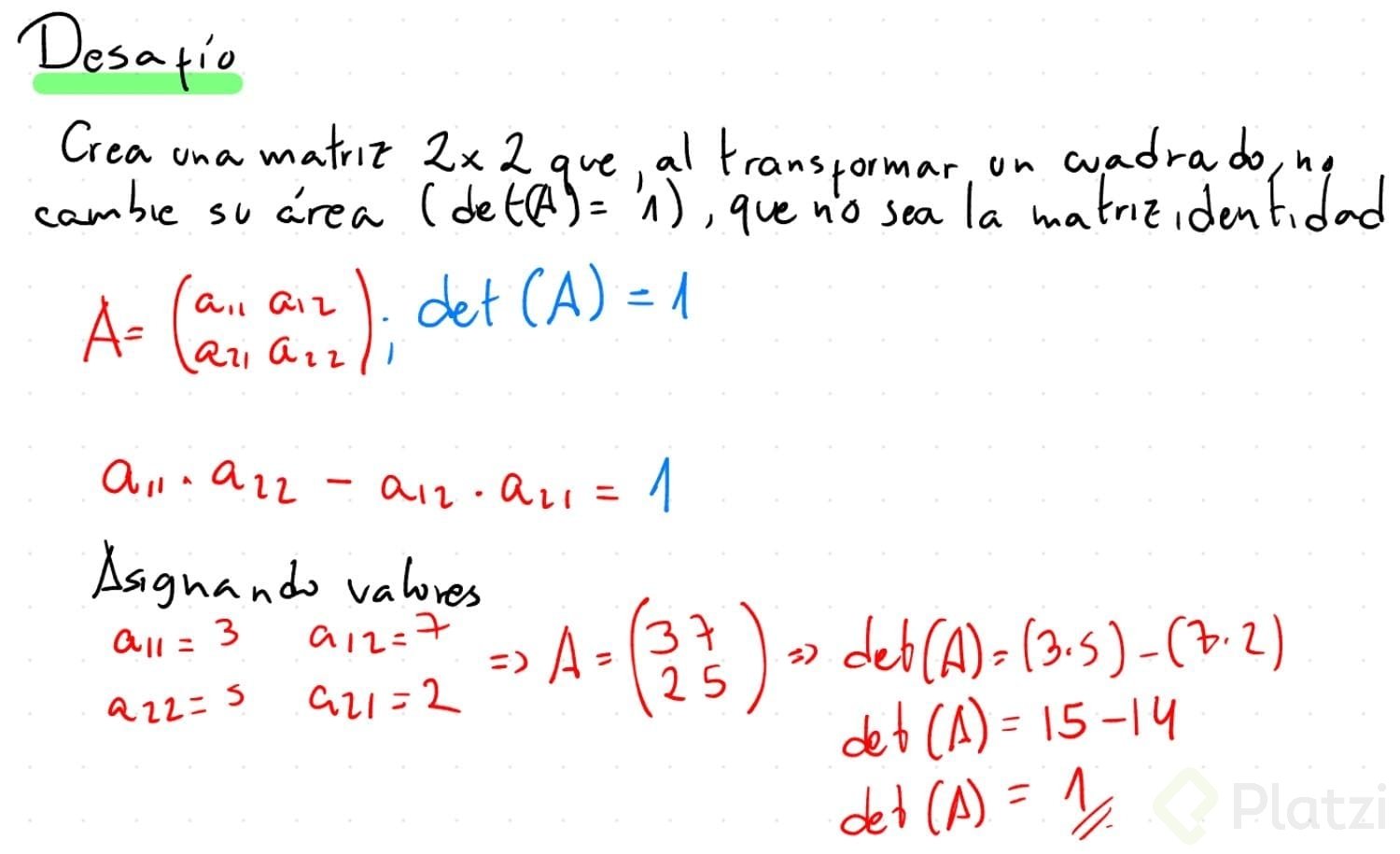
A quick exercise to lock this in: build a 2x2 matrix that transforms a square without changing its area, meaning its determinant equals 1, but that is not the identity matrix. Share your matrix in the comments and tell me what transformation it performs.