Can and Can't for Job Interviews
Contenido del curso
Talk About You and Others

Talk About Now

Recursos
Resumen
Knowing how to express what you are able or unable to do is essential in professional settings, especially during job interviews. The modal verb can is one of the most practical tools in English for communicating your skills with confidence and clarity.
How do you use can to express ability?
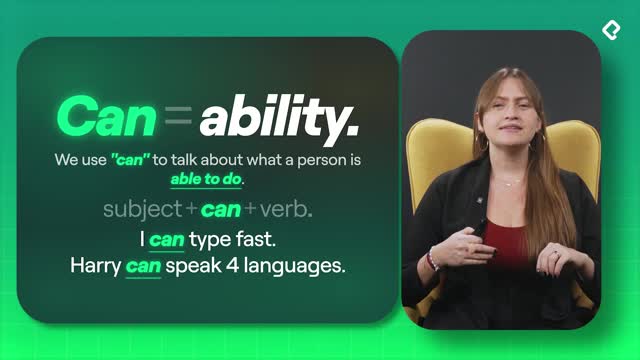
The word can is used to talk about what a person is able to do [0:22]. The structure is straightforward: subject + can + verb. Notice that the verb always stays in its base form, even with third-person subjects. For example:
- I can type fast.
- Harry can speak four languages.
In the second sentence, the verb speak does not take an S, because can is a modal verb and it removes the need for conjugation [0:37].
How do you pronounce can naturally?
Pronunciation matters. In natural speech, can is reduced to a quick, almost unstressed sound: /kən/ [0:50]. Practice saying these sentences with the reduced form:
- I can work under pressure.
- I can follow instructions.
- I can communicate clearly.
These phrases are especially useful during job interviews, where you want to highlight your abilities clearly and professionally [1:05].
How do you talk about things you cannot do?
To express the negative, use can't or cannot [1:12]. The contraction can't is far more common in spoken English. When pronouncing it, pay attention to the nasal ending: /kænt/ [1:18]. The structure is: subject + can't + verb.
- Tom can't program using Python.
- We can't fix this problem.
- He can't use Excel.
How do you form short answers with can?
When someone asks a yes/no question with can, respond with a short answer [1:40]:
- Can you talk to clients? Yes, I can.
- Can she write emails in Chinese? No, she can't.
Short answers sound natural and keep the conversation flowing.
What does a real interview using can sound like?
A conversation between Anthony and an interviewer shows how can and can't work in a realistic professional context [1:56]. Here are the key points from the dialogue:
- Anthony can speak both English and Spanish, and he can write reports in both languages.
- He can use Trello and Asana, but he can't use Jira [2:16].
- He can present to large groups, but he can't design slides very well [2:28].
- He can use basic Excel, but he can't use advanced formulas yet [2:38].
- He can learn fast [2:46].
Notice how Anthony balances what he can and can't do honestly. This is a strong interview strategy: acknowledge limitations while showing willingness to grow.
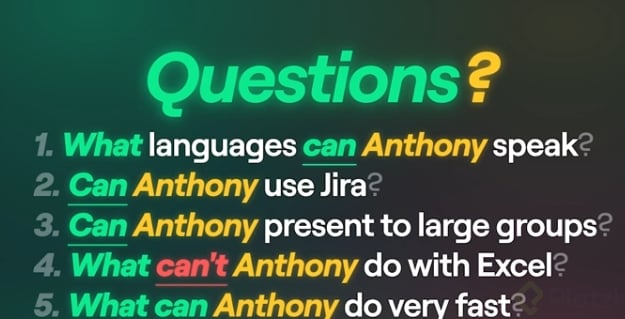
After listening to the conversation, five comprehension questions help reinforce understanding [2:55]:
- What languages can Anthony speak? He can speak English and Spanish.
- Can Anthony use Jira? No, he can't.
- Can Anthony present to large groups? Yes, he can.
- What can't Anthony do with Excel? He can't use advanced formulas.
- What can Anthony do very fast? He can learn very fast.
Try writing your own sentences using can and can't to describe your professional skills, and share them in the comments.