Love, Like, Hate at Work: Right Words Matter
Contenido del curso

Talk About You and Others



Talk About Now


Recursos
Resumen
Understanding how to express what makes you happy or unhappy at work is essential for professional communication. Whether you enjoy your schedule or struggle with long meetings, choosing the right verb makes your message clear and appropriate. This lesson covers four key verbs for talking about preferences and shows you how to use them naturally in workplace conversations.
How do you express strong positive preferences with "love" and "like"?
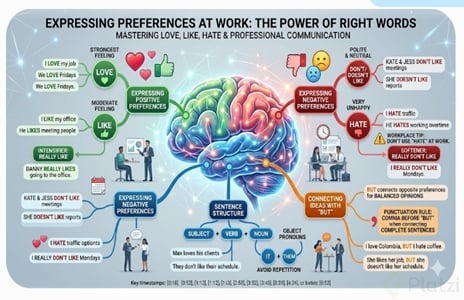
When something makes you very happy and it is your absolute favorite, you use love. It carries the strongest positive feeling among these verbs. For example: I love my job or We love Fridays [0:18].
On the other hand, like is used when something is good and you enjoy it, but it is not necessarily your favorite. It suggests a moderate positive feeling:
- I like my office. It can improve, but it is still good.
- He likes meeting new people. He does not love it, but he enjoys it.
To show a stronger feeling without jumping all the way to "love," you can add the word really before like. This intensifier signals that the feeling is above normal [0:52]. For instance: Danny really likes going to the office. He likes it more than the average person would.
How should you express negative preferences at work?
When something is not good for you but not terrible either, you say don't like or doesn't like [1:12]. This is a polite and neutral way to express a negative preference:
- Kate and Jess don't like meetings.
- She doesn't like long reports.
You can also use dislike, which has the same meaning. However, it is not as common in everyday conversation as don't like [1:24].
The verb hate describes something that makes you very unhappy. It is a very strong feeling: I hate traffic or He hates working overtime [1:40]. However, there is an important workplace tip here: don't use "hate" at work. Instead, soften it with really don't like [1:52]:
- I really don't like Mondays.
- He really doesn't like working overtime.
This sounds much more professional and appropriate.
What is the correct sentence structure for preference verbs?
All four verbs — love, like, dislike, and hate — are regular verbs, so they follow the same simple pattern: subject + verb + noun [2:08].
- Max loves his new clients.
- They don't like their schedule.
- He likes the app. → He likes it.
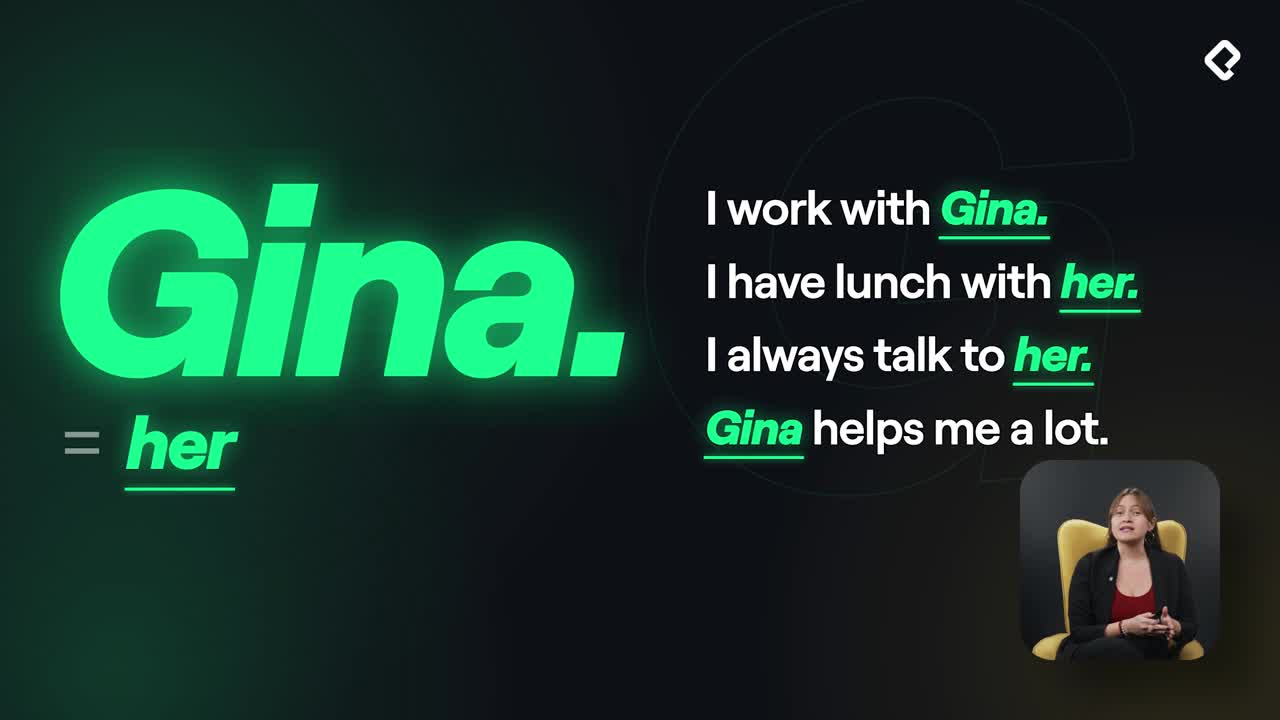
Notice the use of object pronouns in that last example. When the object has already been mentioned, replace it with pronouns like it, them, him, or her to avoid repetition [2:20].
How do you connect opposite preferences with "but"?
The word but connects two opposite ideas in a single sentence [2:30]. This is very useful when you want to share a balanced opinion:
- I love Colombia, but I hate coffee.
- She likes her job, but she doesn't like her schedule.
- We don't like our office, but we love the location.
There is one punctuation rule to remember: when but connects two complete sentences — each with a subject, a verb, and a complement — you place a comma before but [2:52].
How can you practice expressing preferences?
Think about your real job or a job you imagine. Write four sentences using love, like, don't like, and hate. Then connect two of them with but [3:08]. For example: I love to work at the office, but I hate traffic. Share your sentences and check whether others agree with your preferences.