
Present Continuous for Actions Happening Now
Contenido del curso

Talk About You and Others



Talk About Now

Recursos
Resumen
Stop for a second. What are you doing right now? You're reading this, you're learning English, and that simple action is the perfect entry point to understand the present continuous tense. This guide breaks down when to use it, how to build it correctly, and which signal words tell you it's the right choice.
What is the present continuous tense in English?
The present continuous describes actions happening at this exact moment, not routines or habits. If present simple is your tool for I work every day, present continuous is your tool for I am working right now.
Think of it as a snapshot of the present. You press pause on the day, and whatever someone is doing in that frozen frame is what the present continuous captures [00:08].
What is the difference between present simple and present continuous? Present simple talks about routines and habits. Present continuous talks about actions happening right now, at this very moment.
How do you form present continuous sentences?
The formula is short and predictable. You only need three pieces working together in the right order.
- Subject (I, you, he, she, it, we, they).
- Verb to be in present (am, is, are).
- Main verb with -ing.
For example: He is writing a book. Or: They are creating a design [00:30]. Native speakers almost always use contractions, so he is becomes he's and they are becomes they're. Using contractions makes you sound more natural and less robotic.
How do you add -ing to verbs correctly?
Not every verb takes -ing the same way. There are two small spelling rules worth memorizing.
- Verbs ending in e: drop the e and add -ing. Organize becomes organizing, make becomes making, write becomes writing.
- Short verbs with the consonant + vowel + consonant pattern: double the last consonant and add -ing. Run becomes running, sit becomes sitting, get becomes getting [00:50].
That double consonant trick saves you from common spelling mistakes that make your writing look unpolished.
How do you make negative sentences in present continuous?
To say something is not happening, you simply add not between the verb to be and the -ing verb. The structure becomes: subject + am/is/are + not + verb*-ing*.
- She isn't working.
- They aren't typing.
- We aren't paying attention.
- I'm not writing, I'm teaching [01:15].
Again, contractions matter. Is not becomes isn't, are not becomes aren't, and I am not becomes I'm not. They keep your speech fluid.
Which signal words indicate present continuous?
Certain words act like flags telling you the present continuous is the right choice. They anchor the action to now.
- Right now: I'm writing the report right now. If you put it at the start, add a comma: Right now, he's in a meeting.
- Now: She's sending the email now.
- At the moment: Jason is talking to the client at the moment [01:40].
You can also use look and listen as live cues. Look, they're starting the meeting. Listen, she's talking to you. These words pull attention to an action happening in real time.
When should I use present continuous instead of present simple? Use present continuous when the action is happening at the moment of speaking. Use present simple for habits, routines, or general truths.
What are common signal words for present continuous? Right now, now, at the moment, look, and listen. They all point to actions unfolding in the present.
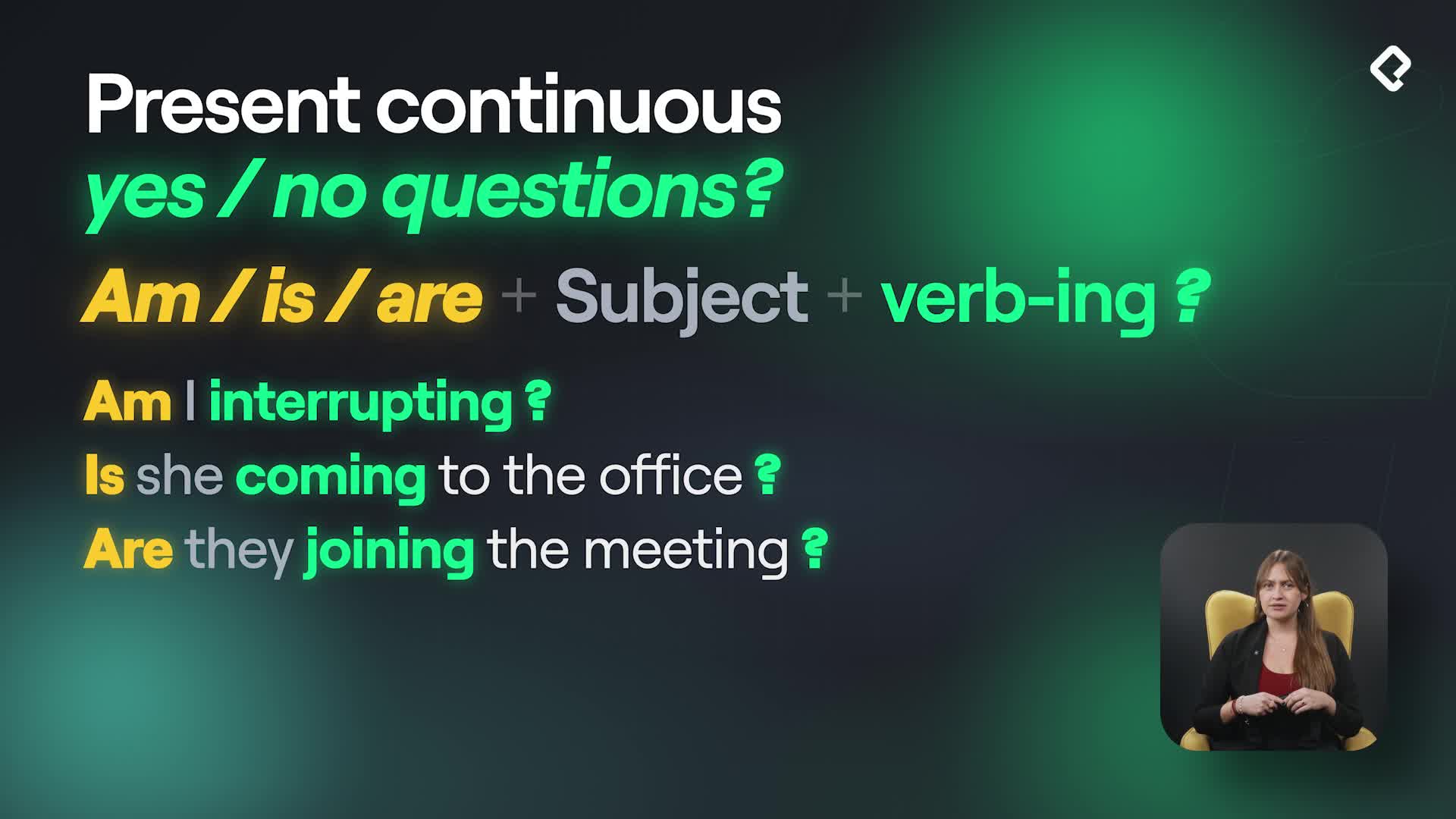
Now that you can build affirmative and negative sentences, the next step is forming questions. Try writing three sentences about what you're doing today using present continuous and share them in the comments.