Present Simple for Daily Work Routines
Contenido del curso


Talk About You and Others





Talk About Now

Recursos
Resumen
Understanding how to talk about your daily work routine is one of the most practical skills you can build in English. Whether you write emails, call clients, or attend meetings, the present simple tense is the tool you need to describe habits, routines, and things you do repeatedly.
How do you form the present simple tense?
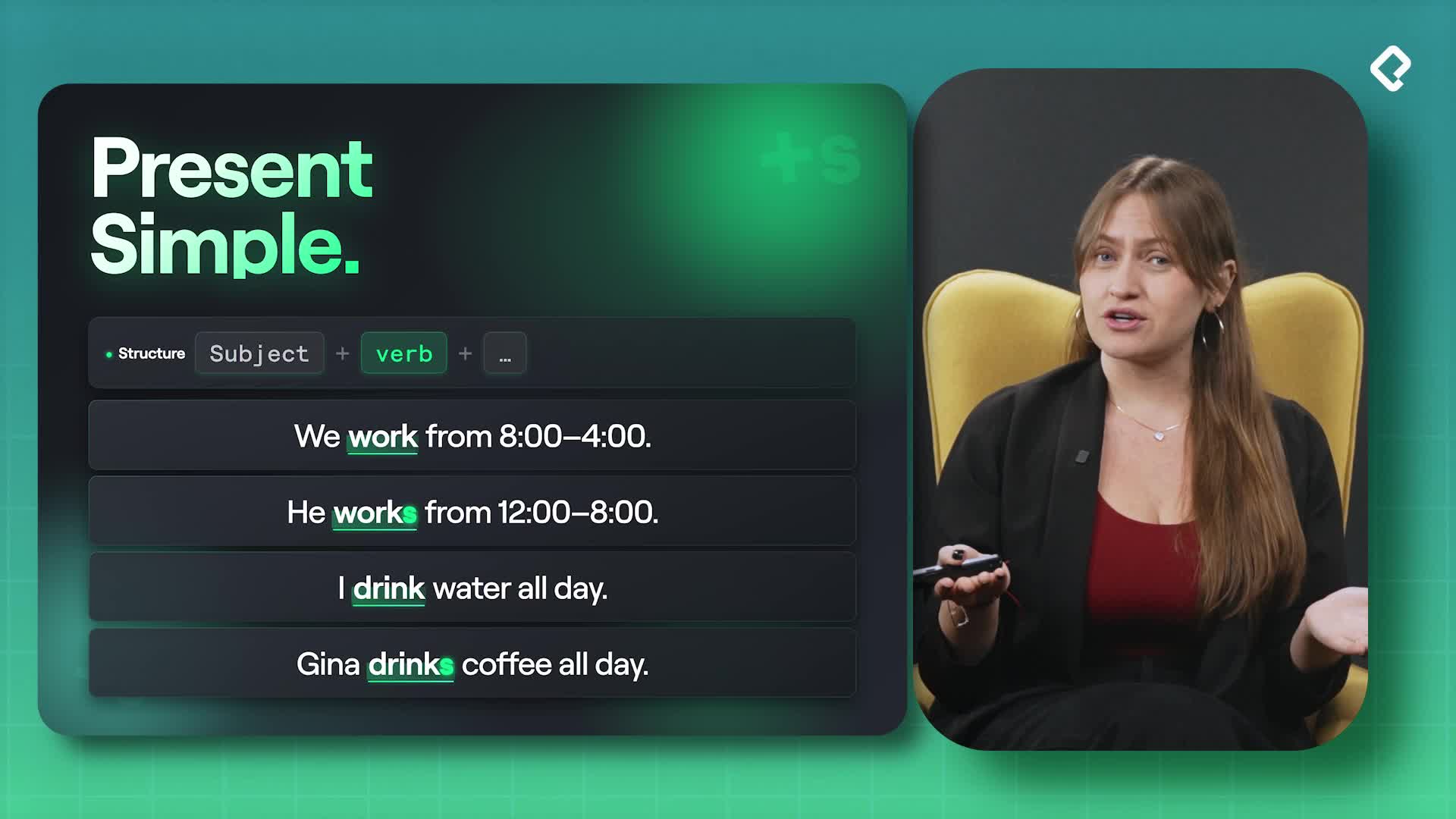
The structure is straightforward: subject + verb + complement. This tense is used when talking about actions that happen every day, hobbies, or habits [0:23]. Here are some clear examples:
- We work from 8:00 to 4:00.
- I drink water all day.
- He works from 12:00 to 8:00.
- Gina drinks coffee all day.
Notice something important in those last two examples. When the subject is third person (he, she, it, or a person's name), you need to add an S to the verb [1:00]. This small detail makes a big difference in correct English.
What are the spelling rules for third person S?
Not every verb simply gets an S at the end. There are specific spelling rules you must follow [1:14]:
- Most verbs: just add S. Join becomes joins, send becomes sends, organize becomes organizes.
- Verbs ending in S, SH, CH, X, or O: add ES. Pass becomes passes, watch becomes watches, finish becomes finishes.
- Verbs ending in a consonant + Y: change the Y to I and add ES. Study becomes studies, carry becomes carries, try becomes tries.
- Irregular verbs: some change completely. Have becomes has, do becomes does, and go becomes goes [1:55].
How do you make negative sentences in present simple?
To express something you don't do, follow this structure: subject + do/does + not + base form of the verb + complement [2:08]. You can also use the contractions don't and doesn't, which are much more common in everyday speech.
Look at these two sentences:
- You don't attend meetings on Friday.
- He doesn't attend meetings on Fridays.
An essential rule to remember here is that when you use doesn't, you do not add an S to the main verb [2:37]. The auxiliary does already carries the third person marker, so the verb stays in its base form: attend, not attends.
What do real-life examples look like?
Practicing with relatable sentences helps you remember the structure naturally [2:55]:
- Every day, I ask God why I have to work.
- My coworker arrives late every morning.
- I don't check my phone at work.
- My coworker doesn't really work on Fridays.
- My manager asks for a report every week.
These examples mix affirmative and negative forms so you can see both structures in action. Pay attention to how third person subjects like my coworker and my manager require that extra S in affirmative sentences, but not when paired with doesn't.
Now put your knowledge into practice. Try completing fill-in-the-blank exercises and share your results in the comment section to get feedback from the community.