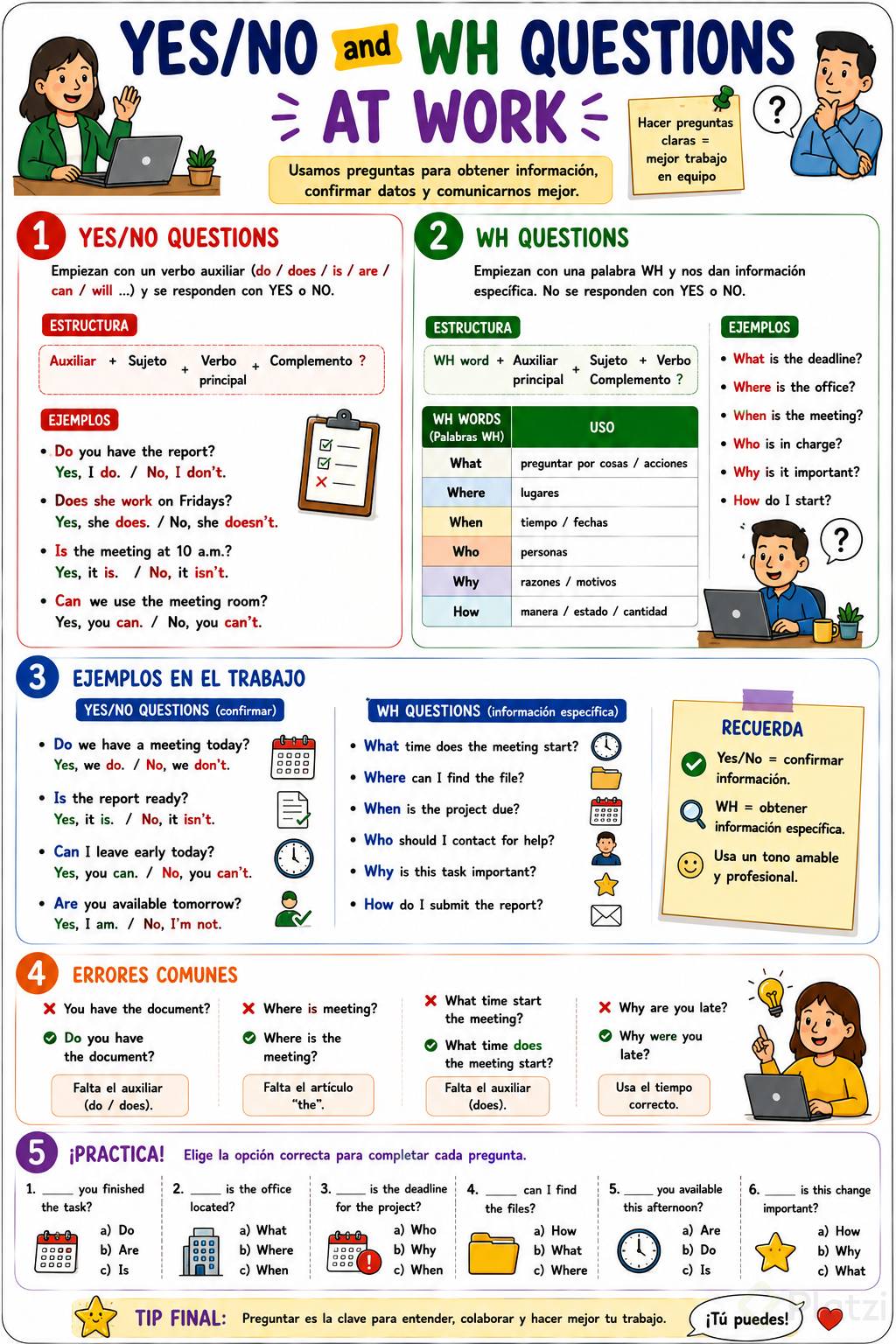
Yes/No and WH Questions at Work
Contenido del curso

Talk About You and Others





Talk About Now


Recursos
Resumen
Asking and answering questions correctly is one of the most practical skills you can build for everyday work conversations in English. Whether you need to confirm something with a coworker or request specific details about a project, mastering yes/no questions and WH questions in the present simple will make your communication clearer and more confident.
How do you form yes/no questions in present simple?
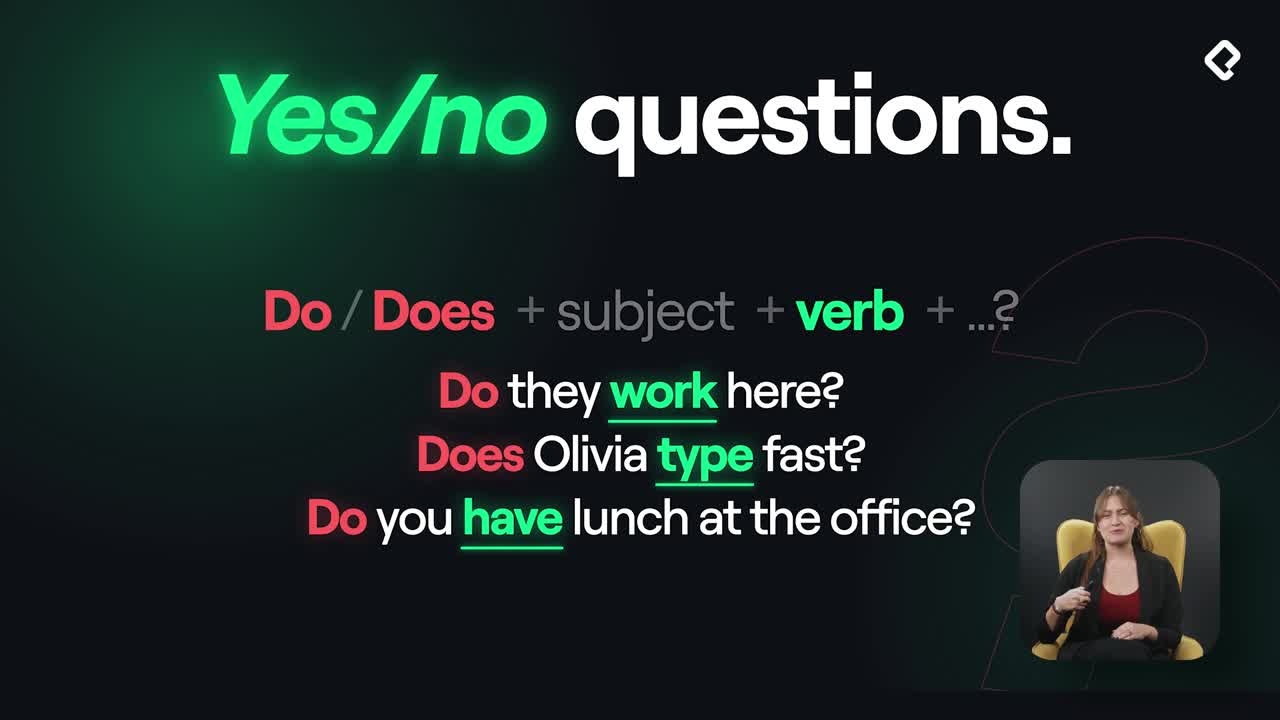
Yes/no questions are those where the only possible answer is yes or no. The structure is straightforward: do or does + subject + verb + complement + question mark [0:08]. Here are some examples:
- Do they work here?
- Does Olivia type fast?
- Do you have lunch at the office?
Notice that does is used with third-person singular subjects (he, she, it), while do is used with all other subjects (I, you, we, they).
How do you answer yes/no questions correctly?
The most common way to respond is with a short answer [0:28]. You simply say:
- Yes, + subject + do/does.
- No, + subject + don't/doesn't.
For example, if someone asks "Do you use a computer at work?" you respond with "Yes, I do." You could say "Yes, I do use a computer at work," but that long form is not very common in natural conversation [0:38].
Let's look at a few more practical examples:
- Does Diego work from home? No, he doesn't [0:55].
- Do they wear a uniform? Yes, they do [1:05].
- Does Caro teach English? Yes, she does [1:13].
What are WH questions and when should you use them?
Beyond simple yes/no answers, WH questions allow you to ask for more specific information [1:20]. They start with a question word and follow this pattern: WH word + do/does + subject + verb + complement + question mark [2:16].
Here are the main WH words and what each one asks about:
- What asks about things or information. What do you do? I'm a teacher [1:30].
- Where asks about a place. Where do you eat lunch? At the cafeteria [1:39].
- When asks about time or date. When do you start work? At 9 o'clock [1:47].
- Who asks about people. Who do you work with? I work with Gina, Caro, Jess, and John [1:55].
- Why asks about a reason. Why do you study English? Because I want to get a promotion [2:03].
- How asks about manner or way. How do you go to work? I go to work by bus [2:11].
What are some workplace examples of WH questions?
These questions are extremely useful in professional settings. Consider these scenarios [2:22]:
- Who do you report to?
- When does the meeting start?
- How do you update the app?
Notice how the WH word always comes at the beginning, followed by do or does, the subject, and then the base form of the verb. This order stays the same regardless of which WH word you choose.
How can you practice these questions right now?
The best way to internalize these structures is by using them in real contexts. Try answering these questions honestly [2:36]:
- Do you talk a lot with your coworkers?
- Do you listen to music while you work?
- What do you never do at work?
- Who talks the most in your team?
- How do you feel on Monday mornings?
Pay attention to whether each question needs a short yes/no answer or a detailed WH response. Reading how others answer and then asking them follow-up questions is an excellent way to reinforce both question forms at the same time. Share your answers and start a conversation!