Frequency Adverbs That Sound Natural
Contenido del curso




Talk About You and Others





Talk About Now




Recursos
Resumen
Expressing how often you do something is one of the most practical skills in everyday English. Frequency adverbs let you communicate habits, routines, and patterns with precision, and mastering them will make your speech sound natural and confident.
What are frequency adverbs and what do they mean?
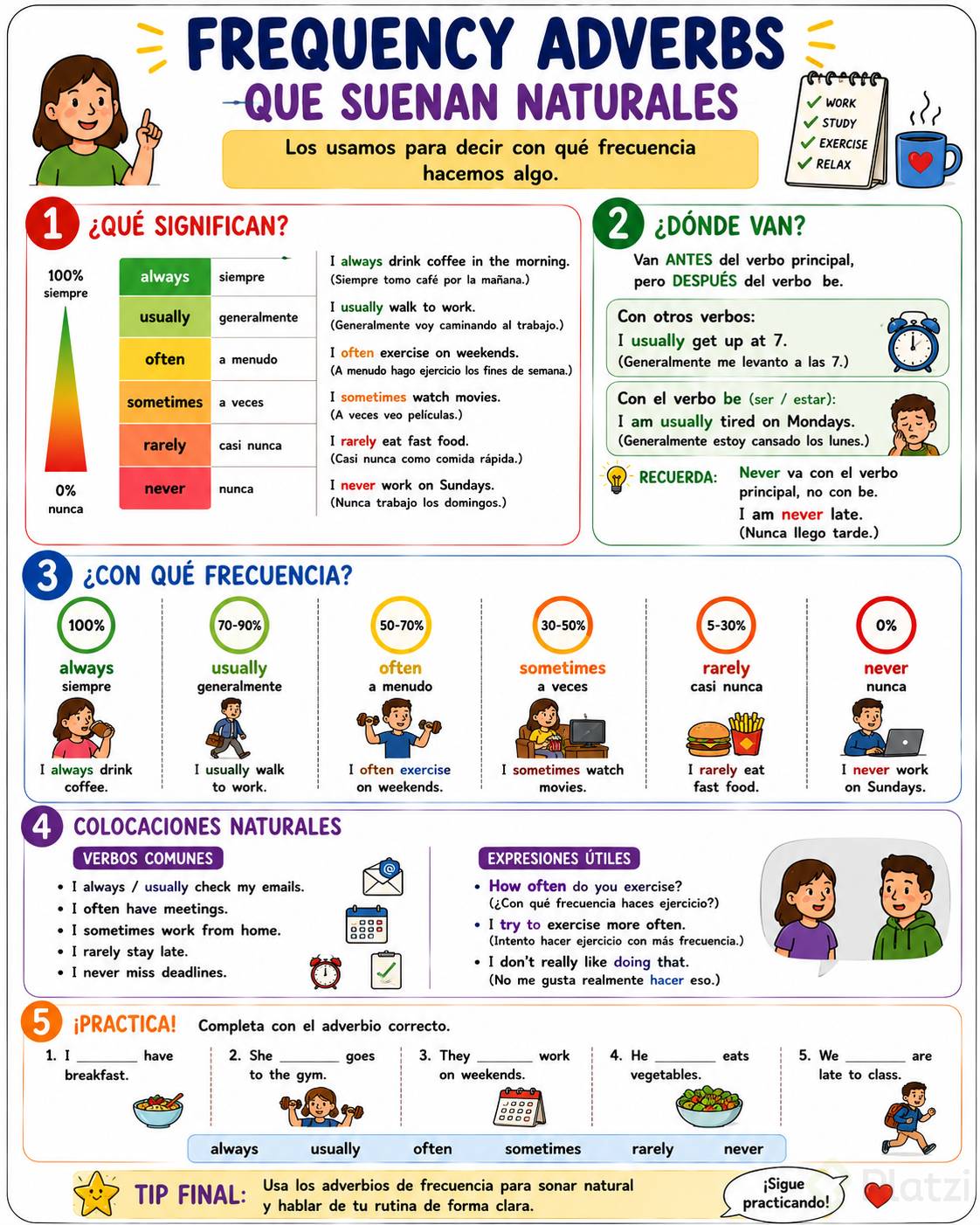
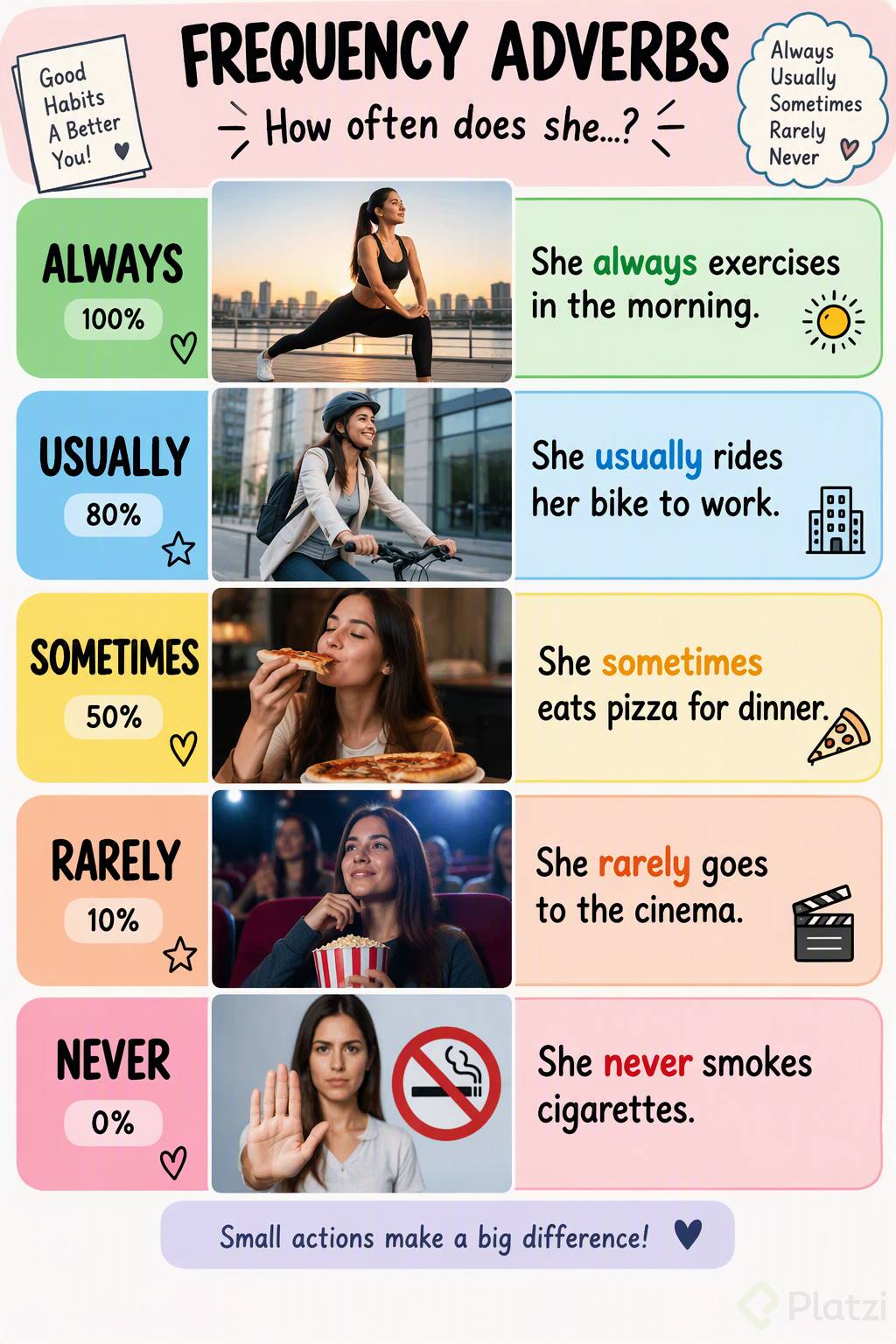
Frequency adverbs tell us how often an action happens. Each one represents a different percentage of the time [0:02]:
- Always — 100% of the time.
- Usually — about 80% of the time.
- Sometimes — about 50% of the time.
- Rarely — about 30% of the time.
- Never — 0% of the time.
Thinking of them on a scale from 0% to 100% helps you choose the right word every time.
Where do frequency adverbs go in a sentence?
Placement matters. In affirmative sentences, the structure is straightforward [0:22]:
Subject + frequency adverb + verb + complement.
Here are clear examples from real workplace and daily-life contexts [0:30]:
- Gina always drinks coffee. — She drinks it every single day, morning and afternoon.
- Will and Lena usually go to the gym after work. — They go Monday, Tuesday, Thursday, and Friday.
- Ian sometimes programs meetings on Fridays. — One Friday he does, the next he doesn't.
- I rarely forget to check my emails. — It happens only a few times.
- We never answer calls on the weekends. — Zero exceptions.
Notice how the adverb always sits between the subject and the main verb. This is the golden rule for simple tenses.
How do frequency adverbs work in negative sentences?
You can use frequency adverbs in negative sentences too, but not all of them [1:15]. The structure changes slightly:
Subject + don't / doesn't + frequency adverb + verb + complement.
Valid examples:
- Gina doesn't always drink coffee. — Just in the morning, maybe the afternoon.
- Will and Lena don't usually go to the gym after work. — They go in the morning instead.
Which frequency adverbs cannot be used in negative sentences?
This is where many learners make mistakes. Three adverbs do not work with negative forms [1:37]:
- Ian doesn't sometimes program meetings on Fridays. — Incorrect. He either does or he doesn't.
- I don't rarely forget to check my emails. — This simply doesn't make sense.
- We don't never answer calls on weekends. — This creates a double negative, which is grammatically wrong in standard English.
The takeaway: sometimes, rarely, and never should only appear in affirmative sentences. Only always and usually pair naturally with don't or doesn't.
How can you practice frequency adverbs effectively?
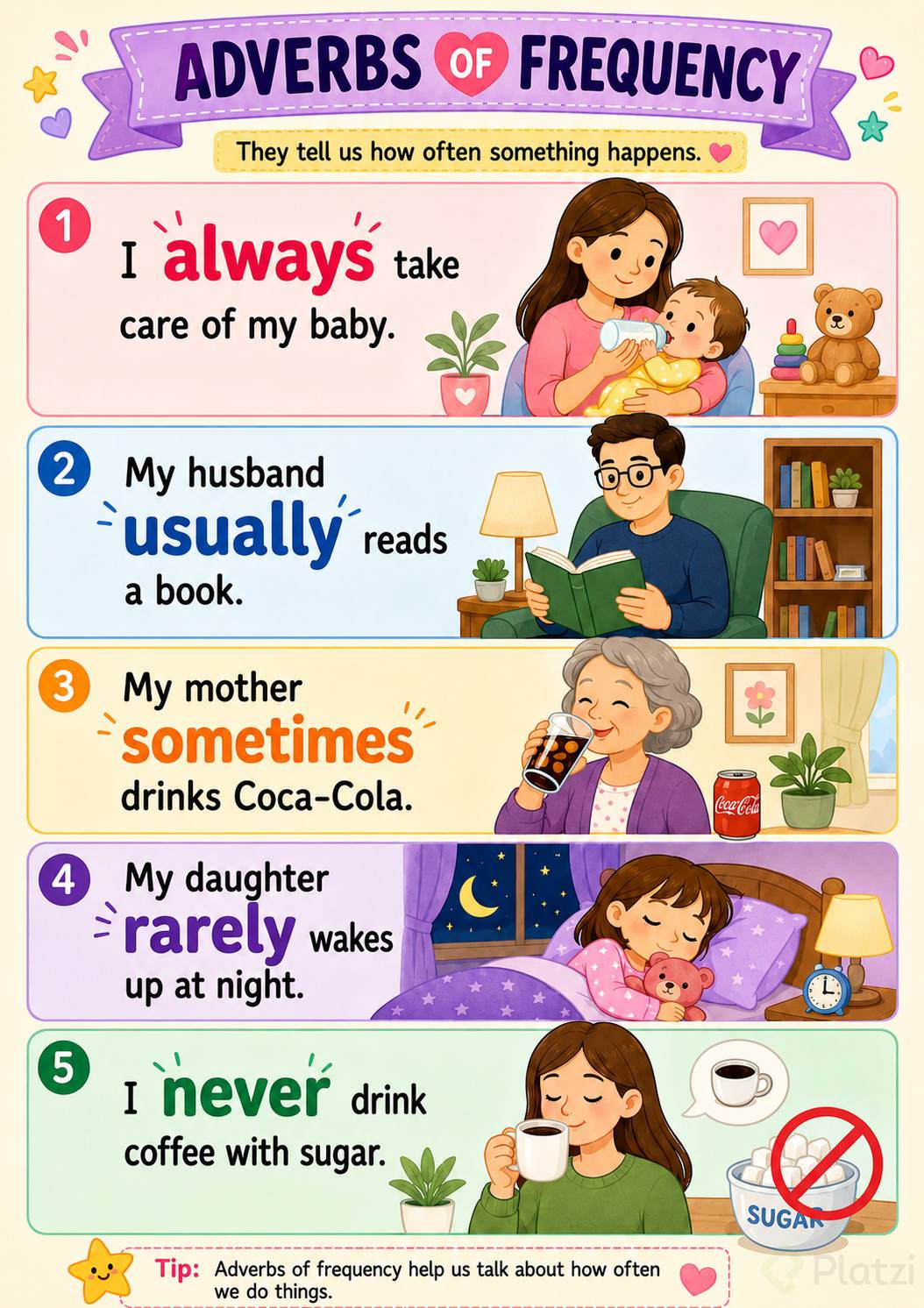
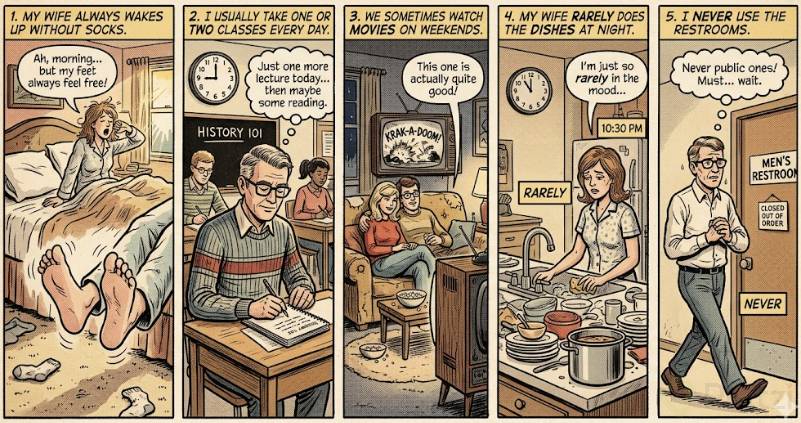
The best way to internalize these adverbs is to create your own sentences [2:07]. Write one sentence for each adverb — always, usually, sometimes, rarely, and never — using real situations from your life.
For a creative twist, take those sentences to an AI image-generation tool like ChatGPT or Gemini and turn them into visuals. Seeing your sentences illustrated reinforces vocabulary and makes practice memorable.
Share your images and sentences in the comment section — it's a great way to learn from others and get feedback on your writing.