El uso de "Have got" en Inglés Británico
Contenido del curso

Describing What Is in Your Office


Talking About Things and People at Work


Talking about what you have

El uso de "Have got" en Inglés Británico
Resumen
If you've ever wondered why some English speakers say "I've got a new laptop" instead of "I have a new laptop," the answer lies in a key difference between British English and American English. Understanding have got is essential for anyone learning English, especially in professional and everyday contexts where ownership and possession come up constantly.
What does "have got" mean and when do you use it?
Have got is the British English equivalent of have in American English. We use it to express ownership or possession of something [0:14]. The meaning is identical — the structure is simply different.
With the pronouns I, you, we, they, the structure is:
- Subject + have got + complement.
Examples from a workplace setting [0:30]:
- We have got a meeting at 9:00.
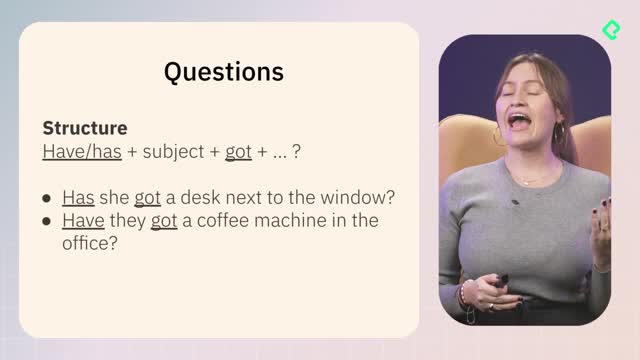
- They have got a coffee machine in the office.
For third person singular — she, he, it — we switch to has got [0:42]:
- She has got a desk next to the window.
- He has got important information.
How do contractions work with "have got"?
Contractions make spoken English sound more natural and fluid. With have got, you can shorten the auxiliary verb [1:02]:
- I**'ve** got a new email.
- You**'ve** got a meeting.
- We**'ve** got new desks.
- They**'ve** got a present.
The same applies to has got [1:18]:
- She**'s** got a question.
- He**'s** got a promotion.
- It**'s** got an update.
Notice that "she's got" looks exactly like the contraction for "she is," so context is crucial to understanding the meaning.
How do you form negative sentences with "have got"?
To express something you don't possess, add not between have/has and got [1:33]. The structure becomes:
- Subject + have/has not got + complement.
In practice, we almost always use the contracted forms:
- Haven't got (for I, you, we, they).
- Hasn't got (for she, he, it).
Can you spot the correct negative form?
Consider this sentence [1:55]: "I ___ a new laptop. I need to buy a new one."
The options are:
- I haven't got.
- I have got.
- I hasn't got.
The correct answer is "I haven't got a new laptop" because the subject is I, which pairs with haven't — never with hasn't [2:13].
Now try another one [2:22]: "He ___ a company email. Today is his first day."
- He have got.
- He haven't got.
- He hasn't got.
The correct answer is "He hasn't got a company email" because he is third person singular and requires hasn't got [2:40].
Quick reference for choosing the right form
- I / you / we / they → have got / haven't got.
- She / he / it → has got / hasn't got.
- Contractions are preferred in spoken and informal written English.
- The meaning is the same as have in American English.
Mastering have got will make your British English sound more authentic and help you recognize it instantly in meetings, emails, and conversations. Try building your own sentences using both affirmative and negative forms — what have you got on your desk right now? Share your examples and keep practicing!