Cómo Decir Fechas en Inglés
Contenido del curso

Describing What Is in Your Office



Talking About Things and People at Work


Talking about what you have

Cómo Decir Fechas en Inglés
Resumen
Knowing how to express dates correctly is one of the most practical skills you can build in English. Whether someone asks about your birthday, a meeting, or simply what day it is, you need to combine months and ordinal numbers in the right structure. Here is everything you need to master this essential topic.
How do you ask and answer "What's today's date?" [0:01]
The question "What's today's date?" is the standard way to ask for the current date. There are two correct ways to respond:
- It's the (ordinal number) of (month). Example: It's the 5th of June.
- It's (month) (ordinal number). Example: It's June 5th.
Remember that "it is" can be contracted to "it's" in everyday speech. Both structures are equally correct and widely used.
What are the 12 months of the year? [1:07]
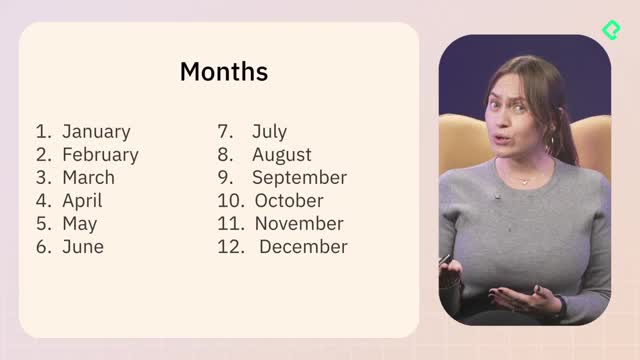
Before forming dates, you need to know every month by name:
- January, February, March, April.
- May, June, July, August.
- September, October, November, December.
Practicing pronunciation is key. Pay special attention to February, which many learners find tricky.
What is the difference between cardinal and ordinal numbers? [2:26]
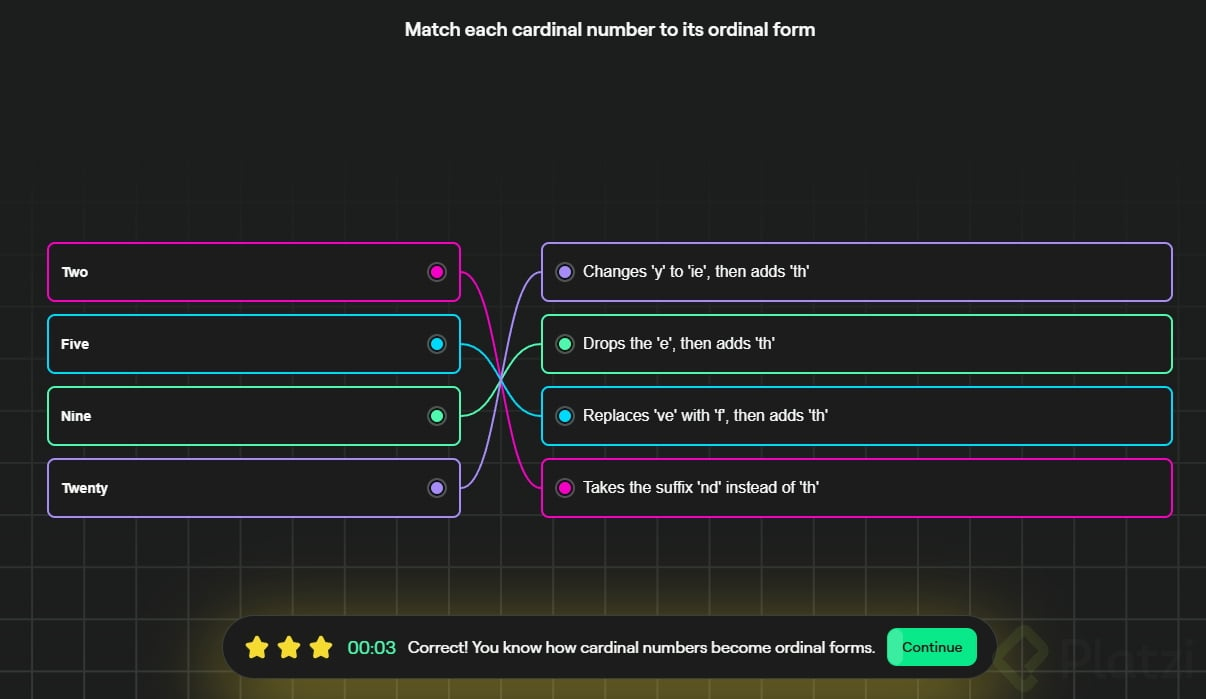
Cardinal numbers are the ones you use to count: one, two, three, ten, sixty. Ordinal numbers indicate position or sequence and are the ones you need for dates: first, second, third, fifth, tenth.
The general rule is simple: add "-th" to the end of the cardinal number. However, three important exceptions exist:
- One becomes 1st (first).
- Two becomes 2nd (second).
- Three becomes 3rd (third).
From four onward, you add -th: 4th, 6th, 7th, 8th, 9th, 10th.
How do spelling changes work for ordinal numbers? [3:17]
Some numbers require small spelling adjustments before adding the suffix:
- Five ends in -ve. Remove the -ve, add -f, then add -th → 5th (fifth).
- Nine ends in -e. Remove the -e, then add -th → 9th (ninth).
- Twelve ends in -ve. Remove the -ve, add -f, then add -th → 12th (twelfth).
- Twenty ends in -y. Change the -y to -ie, then add -th → 20th (twentieth).
Numbers from 13 to 19 simply take -th with no extra changes: 13th, 14th, 15th, 16th, 17th, 18th, 19th.
How do ordinal numbers work above twenty? [4:33]
Whenever one, two, or three appear as the last digit, the special endings return:
- 21 → 21st. 22 → 22nd. 23 → 23rd.
- 31 → 31st. 32 → 32nd. 33 → 33rd.
For all other numbers, just add -th: 24th, 25th, 34th, 35th. Since months have a maximum of 31 days, these patterns cover every possible date.
How do you talk about events and specific dates? [5:29]
When you want to know the date of a meeting, party, or event, the question is "When is the meeting?" and you answer using the preposition "on":
- It's on the 5th of June.
- It's on June 5th.
Look at a practical example [5:58]: When is my birthday? If the calendar shows October 15, you say:
- It's on the 15th of October.
- It's on October 15th.
Another example: a date marked on January 31 becomes "It's on the 31st of January" or "It's on January 31st." You may also hear "January the 31st," which is equally correct.
Now that you know how to express any date, put it into practice. What's today's date? Write it in the comments using both structures and see how natural it feels.