
Usando 's para Posesivos
Contenido del curso

Describing What Is in Your Office



Talking About Things and People at Work

Talking about what you have
Usando 's para Posesivos
Usando 's para Posesivos
Contenido del curso

Jeremy Roberts Manayay Lucana

Adriana Victoria Peña
Profesor
Carolina Echeverria

Charles Castillo Rosas

Edgard Daniel Aguilar Lazo
Edgard Daniel Aguilar Lazo

Enrique Figueroa Rios

Diego Andres Castillo Cardenas

kharina umana
Jatzel Rivas de Q.

Jhon Gómez

Edgar Ramirez
Jacqueline Guadalupe López de Pleitez

Aylin Sofía Arias Palacios
Neysi Patricia Alvarado Linares

Jonathan Linares
Jonathan Linares

MARIANELA NICOLE CRUZ GARCÍA

Maria Alejandra Villavicencio Taya
Maria Alejandra Villavicencio Taya

Diana Gabriela Reyes García
Where is the playground?, I don't know :( Teacher
Hola Jeremy, Gracias por avisarnos. Lo estamos gestionando.
Nora's a nurse (is)
Nora's pencil (possessive)
Mis apuntes 🌱
This is a jacket. This is John's jacket.
This is a backpack. This is John's backpack.
This is a scarf. This is John's scarf.
These are headphone. These are John's headphones.
This is a suitcase. This is Vicki's suitcase.
This is a water bottle. This is Vicki's water bottle.
This is a tablet. This is Vicki's tablet.
These are sunglasses. These are Vicki's sunglasses.
Possessive's
Structure: Name + 's + object.
John's phone. Gina's clean desk. Noah's long email.
Possessive 's vs. Is.
John's a teacher. → John is a teacher. (verb)
John's new phone. → The phone belongs to John. (possession)
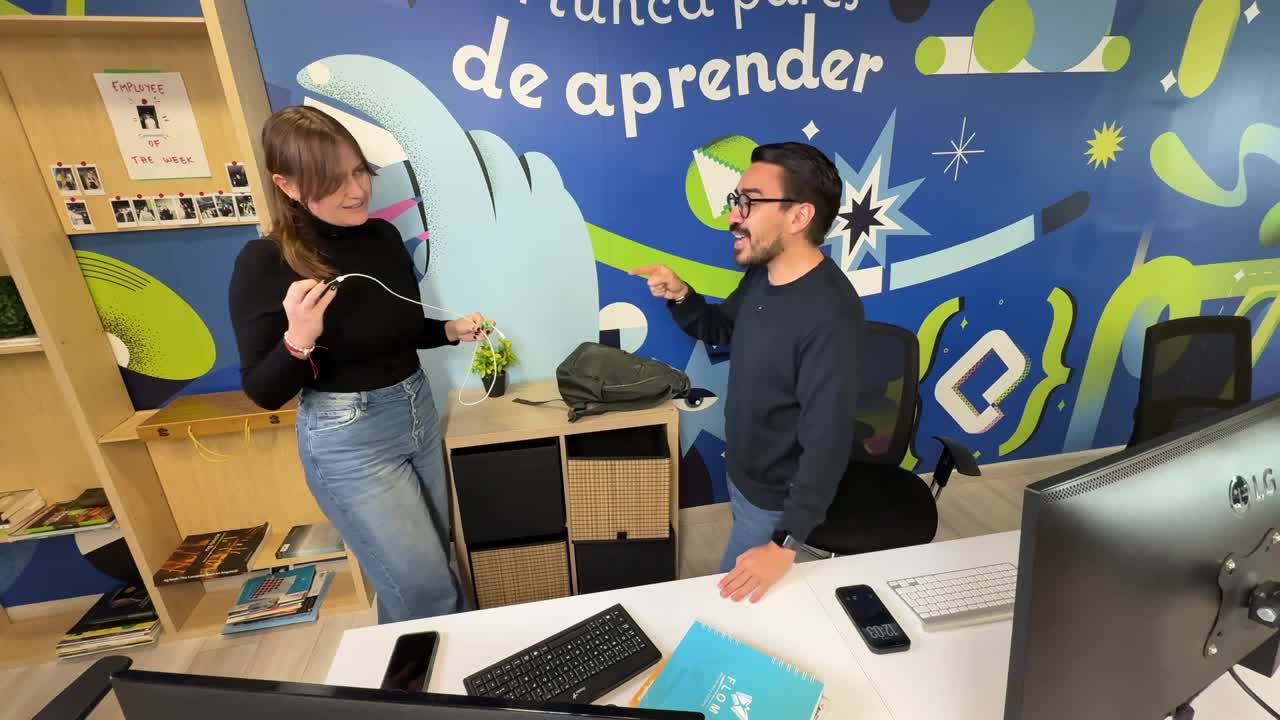
Whose is this?
Structure. Whose + [object] + is/are + this/these?
Whose chair is this? Whose headphones are these?
Teacher, where is the playground?
How do I ask about ownership?
To find out who owns an item, the most direct and natural way is to use the question word "whose". You place it right before the object you are asking about. For example, if you find a laptop on a desk, you simply ask, "Whose laptop is this?"
If the object is plural, like keys, you adjust the verb: "Whose keys are these?" You can also structure it by putting the object at the end, though it's slightly less common in casual speech: "Whose is this laptop?"
In a workplace setting, this is incredibly useful for returning lost items or figuring out who is using shared equipment. Just remember that whose sounds exactly like who's (who is), but they have completely different meanings. Always use whose for possession!
Vicky’s playground is hard to find. I can’t find it.
This is a Jacket / This is Jhon’s jacket
Why is "mine" different from "my"?
The difference comes down to whether you want to name the object or replace it entirely to avoid repeating yourself.
"My" is a possessive adjective. It must be followed by a noun. You use it to introduce the object: "This is my pen." It acts like a label attached to the item.
"Mine", on the other hand, is a possessive pronoun. It stands completely alone and replaces the noun. You use it when both you and the listener already know what object you are talking about. Instead of saying, "That is my pen," you can just point and say, "That is mine."
Think of mine as a shortcut. In a fast-paced conversation at work, if someone asks, "Whose charger is this?", replying "It's mine" is much faster and more natural than saying "It is my charger."
Jacqueline's books. Wendy's restaurant. Mateo's Phone. The sunglasses belongs to Edwin.
"¿Para usar 's es solamente para posesivos?"
Buena pregunta, no siempre es posesión; a veces se camufla como una contracción del verb to be.
Piensa en esta frase: John's happy. ¿Dirías que la felicidad le pertenece a John, o que John está feliz?
Why is "mine" different from "my"?
The difference comes down to whether you want to name the object or replace it entirely to avoid repeating yourself.
"My" is a possessive adjective. It must be followed by a noun. You use it to introduce the object: "This is my pen." It acts like a label attached to the item.
"Mine", on the other hand, is a possessive pronoun. It stands completely alone and replaces the noun. You use it when both you and the listener already know what object you are talking about. Instead of saying, "That is my pen," you can just point and say, "That is mine."
Think of mine as a shortcut. In a fast-paced conversation at work, if someone asks, "Whose charger is this?", replying "It's mine" is much faster and more natural than saying "It is my charger."
When should I use "whose"?
You should use "whose" whenever you need to establish a connection of possession or relationship between a person and an object, place, or even another person. It acts as the possessive form of "who".
In practical terms, use it when you see an abandoned coffee mug in the office ("Whose mug is that?") or when trying to identify a colleague's manager ("Whose team are you on?").
A great trick is to think of it as the question equivalent of "my," "your," or "their." If the answer to your question would be "It's my report" or "It's Sarah's desk," then whose is the exact word you need to start your question. It instantly signals to the listener that you are trying to solve a mystery of ownership.
What happens if multiple people own it?
When an item belongs to a group of people, the way you ask the question with "whose" doesn't change at all! You still ask, "Whose project is this?" or "Whose office is that?"
What changes is the answer. To show that multiple people share ownership, you use plural possessive pronouns like "ours" (if you are part of the group) or "theirs" (if you are talking about a different group).
For example, if someone asks about a shared presentation, you would say, "It's ours" (meaning it belongs to me and my team). If it belongs to the marketing department down the hall, you would say, "It's theirs." This keeps your communication efficient and clear without needing to list every single person's name.
You can also add adjectives between the apostrophe S and the object to give more detail [1:07]:
Whose tablet is this?
Maria's tablet Maria's clean door Maria's new phone Maria's
Can I use "whose" for people?
Yes, absolutely! While we often use "whose" to talk about objects (like laptops, pens, or cars), it is perfectly correct and very common to use it to ask about relationships between people.
In a professional environment, you might use it to understand the company structure. For example, you could ask, "Whose manager is David?" or "Whose clients are these?" In personal situations, you might ask, "Whose brother is he?"
The word doesn't strictly mean "ownership" like buying a product; it represents association or belonging to a specific group, family, or team. So whenever you need to figure out how someone is connected to someone else, whose is your go-to tool.