
Cómo Decir la Hora en Inglés
Contenido del curso

Describing What Is in Your Office

Talking About Things and People at Work

Talking about what you have
Cómo Decir la Hora en Inglés
Resumen
Knowing how to tell the time is one of the most practical skills you can build when learning English. From asking a coworker about a meeting to checking your schedule, time expressions come up constantly in everyday conversations. Here you will find the essential structures to ask and give the time with confidence.
How do you ask and tell the time in English?
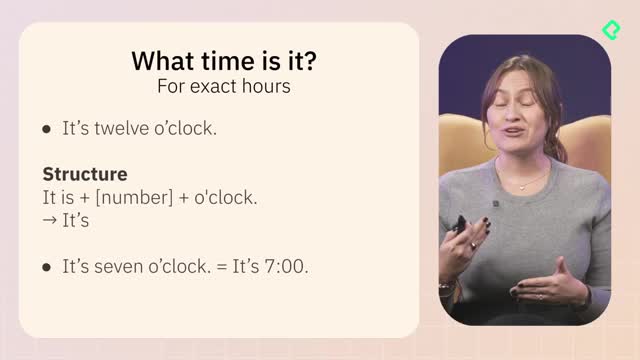
When you want to know the current time, the question is simple: "What time is it?" [0:10]. To answer, you follow a clear pattern depending on whether you are giving an exact hour or including minutes.
For exact hours, the structure is: it is + number + o'clock. For example:
- It's 12 o'clock.
- It's 7 o'clock.
Remember that "it is" can be contracted to "it's" [0:34], which sounds more natural in spoken English. You can also write the time using a colon, like 7:00, but you cannot combine both formats. Saying "it's 7:00 o'clock" is incorrect [0:43].
When the time includes minutes, the structure becomes even simpler: it's + the number. That's it [0:55].
- It's 1:45.
- It's 9:30.
- It's 11:43.
- It's 8:15.
How do you ask about the time of an event or meeting?
When you need to know the scheduled time for something specific, you ask: "What time is the meeting / the party / the event?" [1:16]. The answer adds the preposition "at" before the time.
- For exact hours: it's at + number + o'clock. Example: It's at 1 o'clock.
- For times with minutes: it's at + number. Example: It's at 7:45 [1:36].
What are the parts of the day in English?
Time expressions often include a part of the day to add clarity [1:47]. Here is how they break down:
- In the morning: 5:00 AM to 12:00 PM.
- In the afternoon: 12:00 PM to 6:00 PM.
- In the evening: 6:00 PM to 9:00 PM.
- At night: 9:00 PM to 5:00 AM.
Notice that morning, afternoon, and evening all use "in the", while night uses "at" [2:40]. This is a small but important difference.
You can combine the time and the part of the day like this:
- It's at 7:45 in the morning [2:33].
- It's at 1:00 in the afternoon.
- It's at 9:30 at night [2:48].
How do you ask what time someone does something?
To ask about someone's routine, use the structure: what time + do/does + subject + base verb + complement [2:58].
- What time does she pay? She pays at 3:00.
- What time do you finish work? At 5:30 in the afternoon [3:12].
You can answer with a full sentence or a short form. Both are correct and commonly used.
What does a real conversation about time sound like?
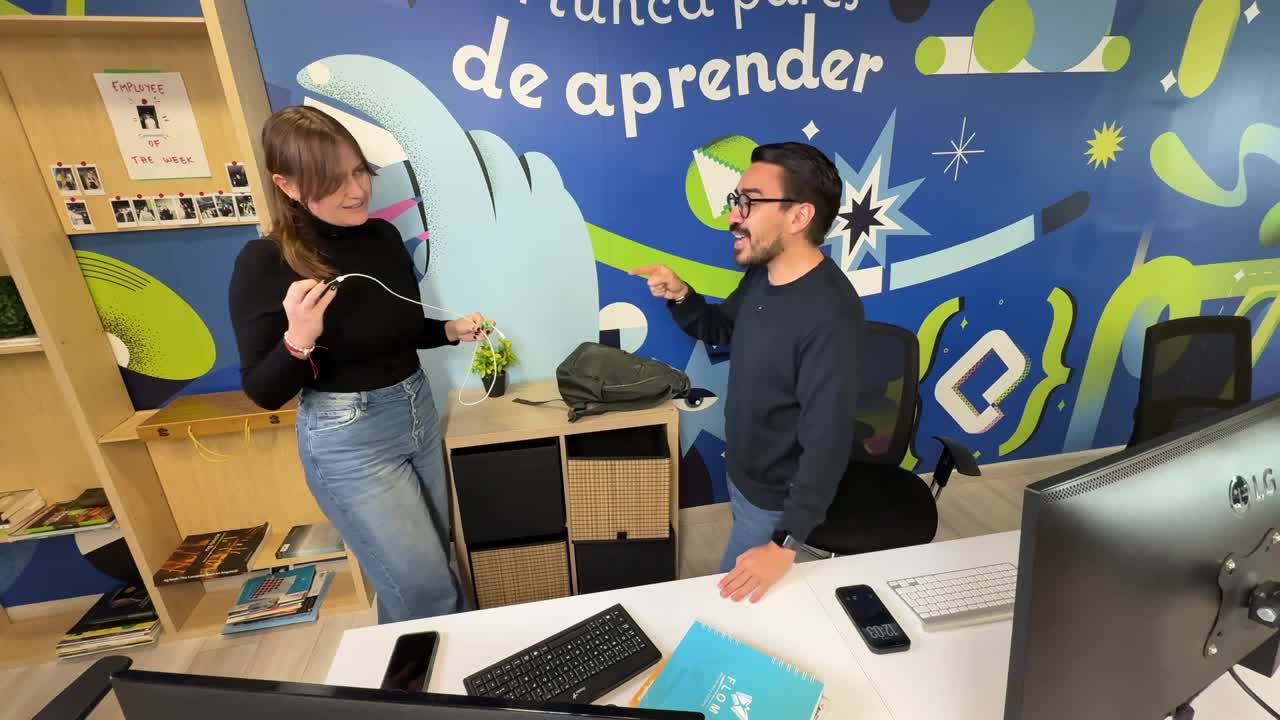
A practical dialogue between two coworkers shows these structures in action [3:22]. Here are the key details:
- Rodrigo starts work at 8:30 in the morning.
- Julia starts work at 9:00.
- Rodrigo's first meeting is at 10:00.
- Julia's first meeting is at 2:30 in the afternoon.
- Rodrigo finishes work at 6:00.
- Julia finishes at 7:00.
Pay attention to how both speakers use "what time do you..." to ask about routines and "at + time" to give their answers. Practicing with dialogues like this one helps you internalize these patterns quickly.
Try answering the practice questions provided in the resources to test how much you understood from the conversation. What time do you start your day? Share your answer and keep practicing.