





Diego Manso Padilla
Me está encantando esta profesora !!!!!
Practicar idioms en inglés con historias cortas es una de las formas más efectivas de fijar expresiones que suenan naturales en conversaciones reales. Aquí trabajarás con cuatro modismos comunes en entornos laborales y aprenderás a distinguirlos según el contexto, no por su traducción literal.
La dinámica es simple: escuchas una historia breve sobre un jefe y su asistente, identificas los idioms y luego respondes preguntas de comprensión para confirmar que entendiste el significado de cada uno.
¿Qué idioms aparecen en la historia del jefe y Joe?
La narración gira en torno a una reunión laboral donde el jefe quiere escuchar opiniones sobre un proyecto. Cada expresión cumple una función específica dentro del relato.
¿Qué significa chew the fat en inglés? Es tener una conversación relajada e informal, sin un objetivo serio. Equivale a charlar o platicar sin prisa.
¿Cómo distinguir flap his gums de chew the fat?
Aunque ambos idioms hablan de conversar, el matiz cambia. Chew the fat tiene un tono neutro o positivo, sugiere una charla agradable. Flap his gums implica hablar de más, a veces sin aportar valor.
En la historia, el jefe convocó la reunión para chew the fat, mientras que Joe quería flap his gums. La diferencia está en la intención: uno busca diálogo, el otro busca protagonismo verbal.
¿Cuándo uso talking to a brick wall? Cuando intentas comunicarte con alguien que no responde ni considera tu punto de vista. Es la frustración de no ser escuchado.
¿Qué responder en el ejercicio de comprensión?
El ejercicio plantea cuatro afirmaciones con dos opciones cada una. Estas son las respuestas correctas según el contexto de la historia:
Fíjate en cómo cada respuesta depende de identificar la función del idiom dentro de la frase, no de traducirlo palabra por palabra.
¿Por qué practicar idioms con historias mejora tu inglés?
Los idioms rara vez tienen sentido si los traduces literal. Chew the fat no tiene nada que ver con masticar grasa, y flap his gums no describe un movimiento físico. Su significado vive en el uso cultural.
Escuchar una historia te obliga a inferir el significado por contexto, que es exactamente lo que harás en una conversación real con hablantes nativos. Esa habilidad de comprensión contextual es la que separa a alguien que sabe vocabulario de alguien que entiende el idioma.
Descarga el worksheet en la sección de recursos y sigue practicando. Cuéntame en los comentarios qué idiom te costó más identificar.
Diego Manso Padilla
Me está encantando esta profesora !!!!!

Juan David Giraldo Patiño
Example of little story using phrasal verbs:
4 years ago, I wanted to take a walk alone so, I headed to the closest park from my house. I feel better there to think than at home.
When I wanted to come back started to rain cats and dogs so, I had to look for a place to cover me from the the rain. I got into a coffee shop where I ordered cold chocolate snowy, suddenly a ginger hair woman showed up next to me drinking an express heat coffee...I'm not a flapping one's gums man to interact with marvelous women but, by that exact time I felt a gift of gab.. I fell in loved with her presense. Before to start to talk to her I thought about an interesting topic to chew the fat. She seemed like a person who really liked to dish out.
I chose immigration, maybe because it had been happed too much those last weeks but, once I greeted her I felt like talking to a brick wall. She ignored me at all, I didn't know the reason, her dark glasses didn't let me to know her facial expressions.
Then, the man who attended me told me that she was deaf and dumb. I felt weird in that moment I didn't know how to react. Since that day I realized how much bleesed I was. I had the ability to interact with others and be a great with other persons and most of the time I didn't want to be kind.
Nowadays, I love the takeaway from that day. Now, I love to interact and be kind with people.

Boris Turcios

Laura Chavez
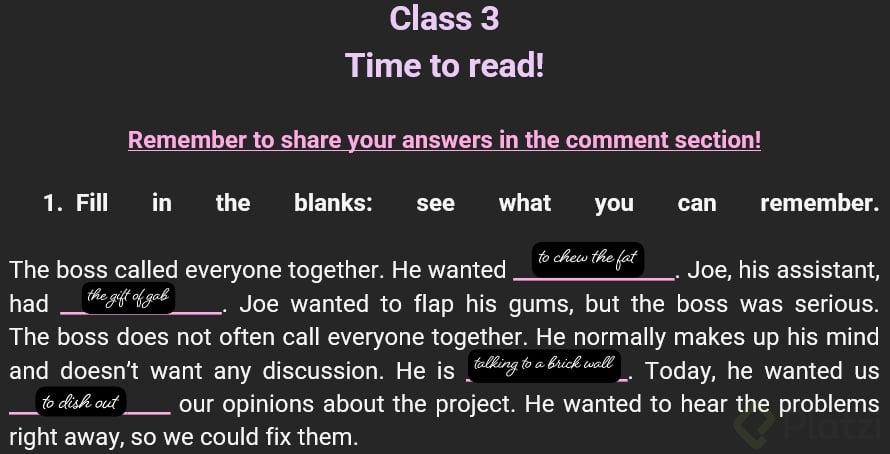
Chew the fat. Flap his gums Talking to a brick wqll Dish out

CINDY VANESSA HERRERA MORA
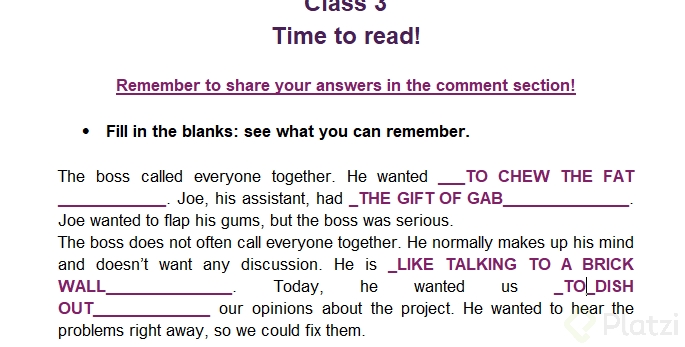
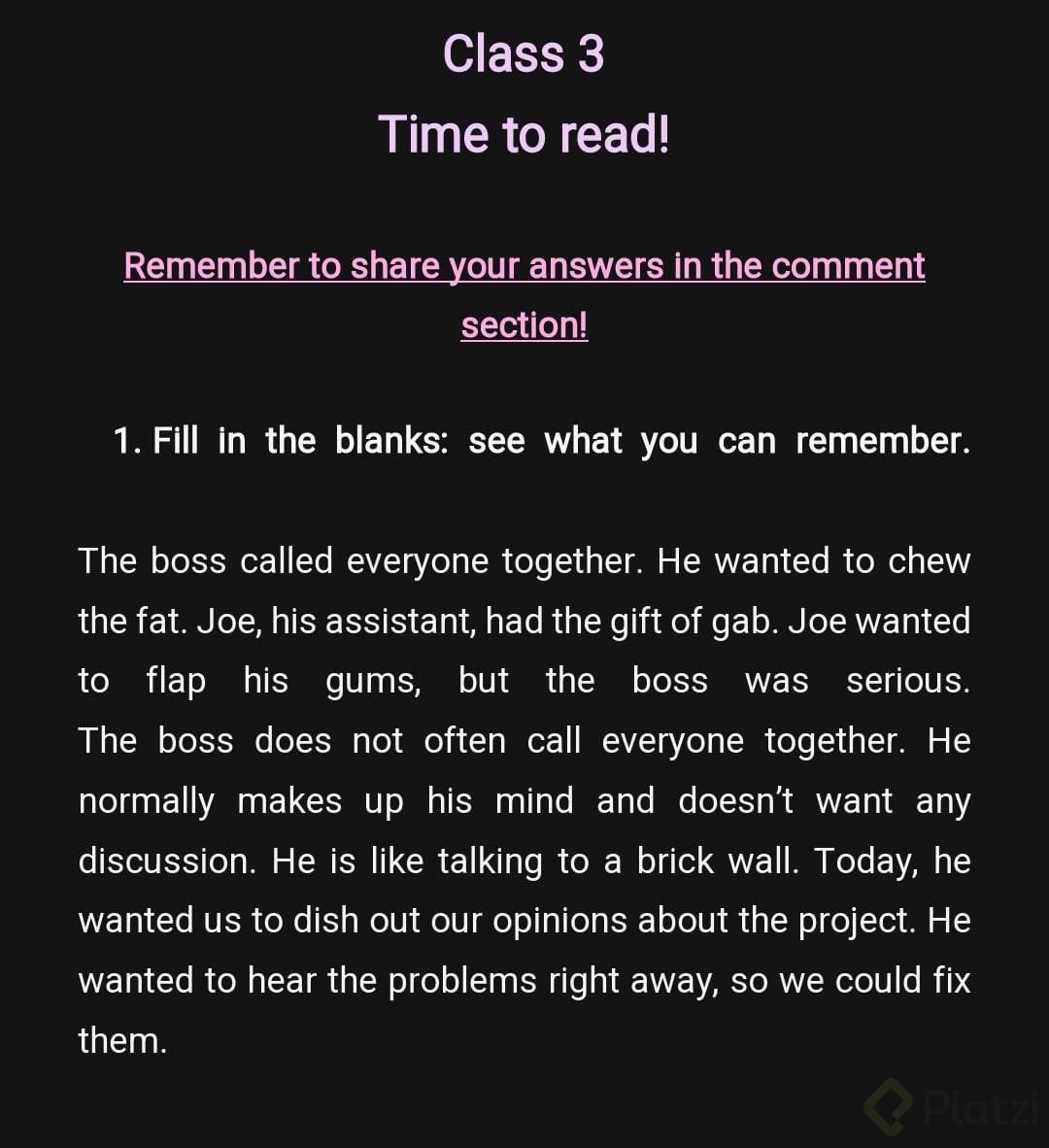
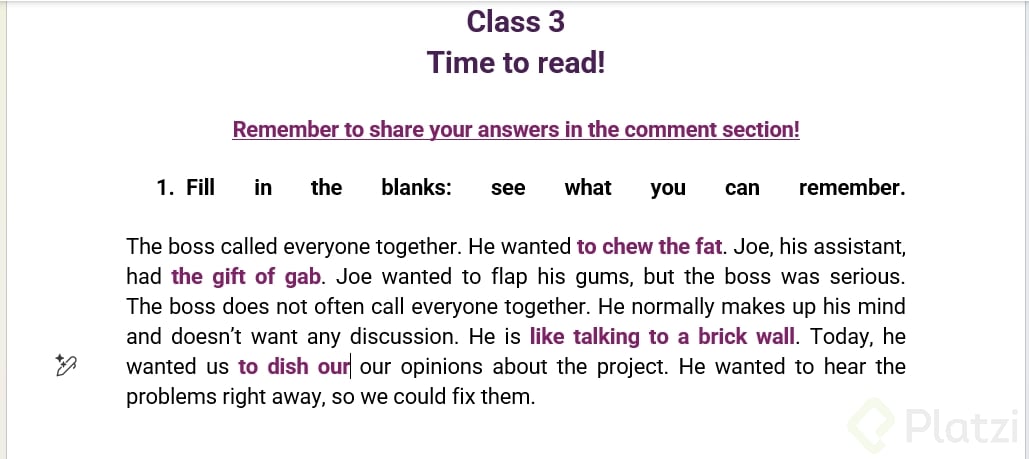
The boss called everyone together. He wanted chew the fat. Joe, his assistant, had gift of gab. Joe wanted to flap his gums, but the boss was serious. The boss does not often call everyone together. He normally makes up his mind and doesn’t want any discussion. He is like talking to a brick wall. Today, he wanted us to dish out our opinions about the project. He wanted to hear the problems right away, so we could fix them.

Nicolas Alpargatero
I missed the "to" after the "wanted", but I think it was a good practice.
Ana Marcela Ruiz García

Camilo Andrés Villegas Roche
I feel improving! thank you Platzi and all the teachers, I really feel like I can chew the fat on many subjects in English now. this is a great school, hope I can get the gift of gab soon.
karla coldriver
SINCE EVERYONE DISHES OUT THEIR REASONS FOR THE FAILURES AND HOW TO RECOVER FROM THE BAD STAGES
I WOULD LIKE TO MAKE UP MY MIND WITHOUT FEELING WRONG
MY COUSINS CHEW THE FAT ABOUT THE CARIBBEAN WEATHER
Mary applied the advice the IA gave her, so now she has the gift of the gab

JULIA LEONOR TRIAY TORRES
dish out
JULIA LEONOR TRIAY TORRES
A) talking to a brick wall
JULIA LEONOR TRIAY TORRES
a) chew the fat
Laura Chavez
Interesting...

John Edwin Romero Aguilar

Saira Stephanie Melgar Abrego

Carlos Ezequiel Tovar Jovel
I loved this class, helped me to learn the idioms so easy!

LUIS ALFREDO ARAUJO MARTINEZ

Andrés Llerena

Sofía Bustamante Agudelo
My homework:
The boss called everyone together. He wanted to chew the fat_. Joe, his assistant, had the gift of gab. Joe wanted to flap his gums, but the boss was serious. The boss does not often call everyone together. He normally makes up his mind and doesn’t want any discussion. He is like talking a brick wall. Today, he wanted us to dish out_ our opinions about the project. He wanted to hear the problems right away, so we could fix them.
STUDY STICKERS — Time to Read (Common Reading Expressions) ========================================================== ⏰ IT’S TIME TO READ Meaning: The moment to start reading has arrived. Use: To begin a reading activity. Example: It’s time to read a new book. ---------------------------------------------------------- 📖 PICK UP A BOOK Meaning: Start reading casually. Use: Leisure or relaxed reading. Example: I pick up a book on weekends. ---------------------------------------------------------- 📚 GET INTO A BOOK Meaning: Become interested or absorbed in a book. Use: Focused reading. Example: Once I got into the book, I couldn’t stop. ---------------------------------------------------------- 🌌 LOSE YOURSELF IN A STORY Meaning: Become fully immersed and forget everything else. Use: Deep enjoyment of reading. Example: I lost myself in the story. ---------------------------------------------------------- 🔍 READ BETWEEN THE LINES Meaning: Understand hidden or implied meaning. Use: Critical thinking. Example: You need to read between the lines. ---------------------------------------------------------- 🔊 READ OUT LOUD Meaning: Say the words while reading. Use: Pronunciation and practice. Example: The student read out loud. ---------------------------------------------------------- 🏃♂️ SKIM THROUGH Meaning: Read quickly for main ideas. Use: Fast review. Example: I skim through emails. ---------------------------------------------------------- 🔎 PORE OVER Meaning: Read carefully and in detail. Use: Deep study. Example: She pored over the report. ========================================================== MEMORY TIP ---------- ⏰ Start → it’s time to read / pick up a book 📚 Focus → get into a book / lose yourself in a story 🔍 Understand → read between the lines 🔊 Speak → read out loud ⚡ Fast → skim through 🧐 Detail → pore over