







Sandra Milena Rojas Herrán

Felipe Bernardo González Barranco

Daniel Solano
Los phrasal verbs o verbos compuestos en inglés combinan un verbo con una preposición para crear un significado totalmente nuevo, y aquí aprenderás cinco de los más útiles para conversaciones cotidianas: talk over, speak up, open up, ramble on y tune out. Si estás empezando a hablar inglés con más naturalidad, dominar estas estructuras te ayuda a sonar como un nativo.
¿Qué es un phrasal verb y por qué cambia tanto el significado?
Un phrasal verb es un verbo acompañado normalmente de una preposición que, juntos, generan un significado diferente al del verbo original. Por ejemplo, get significa obtener y out significa fuera, pero get out puede usarse para pedirle a alguien que se vaya o incluso para expresar incredulidad, como cuando alguien te cuenta algo increíble y respondes "¡Venga ya!".
¿Por qué los phrasal verbs son difíciles de aprender? Porque un mismo verbo puede tener varios significados según la preposición que lo acompañe y el contexto. No siempre puedes traducir literalmente sus partes.
La clave está en aprenderlos en contexto, con ejemplos reales, y no memorizar listas sueltas.
¿Cuáles son los 5 phrasal verbs que debes conocer?
Estos cinco phrasal verbs aparecen mucho en conversaciones, blogs y series, y cada uno tiene un matiz emocional o comunicativo distinto.
Talk over, speak up y open up: hablar con intención
Cada uno de estos verbos implica una forma distinta de comunicarte. No es lo mismo discutir un tema a fondo que dar tu opinión o abrirte emocionalmente.
Speak up y open up se confunden con frecuencia, pero la diferencia está en el contenido: uno expresa opiniones, el otro expone sentimientos.
Ramble on y tune out: cuando la conversación se vuelve pesada
Estos dos phrasal verbs describen situaciones incómodas pero muy comunes en clases, reuniones o conversaciones largas.
¿Cuál es la diferencia entre ramble on y tune out? Ramble on describe a quien habla sin sentido, mientras que tune out describe a quien deja de escuchar. Uno es la causa y el otro suele ser la consecuencia.
¿Cómo practicar los phrasal verbs con ejemplos reales?
La mejor forma de fijarlos es resolviendo ejercicios de elección y creando tus propias frases. Mira estos ejemplos prácticos para verificar si los entendiste.
Si fallaste alguno, no te preocupes. Repasa el ejemplo, repítelo en voz alta y construye una frase con tu propia experiencia. Esa es la parte que de verdad fija el vocabulario en tu memoria.
¿Cómo memorizar phrasal verbs sin olvidarlos? Úsalos en frases personales, no aisladas. Crea ejemplos sobre tu vida diaria y dilos en voz alta varias veces a la semana.
Ahora te toca a ti: escribe tus propios ejemplos con talk over, speak up, open up, ramble on y tune out, y compártelos en los comentarios para practicar con la comunidad.
Sandra Milena Rojas Herrán
Felipe Bernardo González Barranco
Daniel Solano

Breiner Álvarez
Felipe Bernardo González Barranco

David Ferney Plata Briceño

Paula Milena Jaramillo Osorio

Erika De La Luz Castellanos

Gabriel Obregón

Jackelyn Julissa

Diego Mauricio Zuluaga Rodríguez

Orlando Galdamez Guevara
Jackelyn Julissa
Ana Marcela Ruiz García
Ana Marcela Ruiz García
Juan Pablo Barbaran

Aymara Camarena

Camilo Andrés Villegas Roche
Estefany Dayana Alpuche Magaña

Diana Vera Canetaco

JULIA LEONOR TRIAY TORRES
Maria Aracely Coreas de Diaz

Alejandro Argumedo Moreno
++Phrasal verbs:++
talk over → we thoroughly discuss something
speak up → let your opinion and beliefs be known
open up → show your emotions or talk about your emotions
ramble on → talking for a long time in a boring and rather confused way
tune out → to ignore
Thank you!!
Thanks Sandra!
"English makes no sense." Stephen King 😂
Hahaha
We have calculated the new budget for the venue which we'll rent the next month, so we need to talk over about how we'll use this money.
Sometimes isn't good to speak up your opinions. People may get offended and this isn't intelligent most of the time.
It's good to know who to want to open up to. And also, it is good to know who to listen to.
The international news have been rambling on the same topic, I think I will stop reading them, I'm getting bored.
We'd like to have a remote control and tune them out every single time they start being rude with the audience.
Phrasal verbs
Talk over:
We need to talk over the budget before making any decisions.
Speak up:
Don't be afraid to speak up if you have something to say.
Open up:
She finds it difficult to open up to new people.
Ramble on:
I try not to ramble on during presentations, but sometimes I can't help it.
Tune out:
I often tune out during long meetings.
tune out rambling on open up talk it over speak up
My examples:
---
tune out - The coach kept yelling from the sidelines, but the star player tuned out the noise and focused on his free throw.
El entrenador seguía gritando desde la línea lateral, pero la estrella del equipo ignoró el ruido y se concentró en su tiro libre.
---
ramble on - The referee rambled on for five minutes explaining the foul, and everyone in the arena lost interest.
El árbitro parlotearon sin parar durante cinco minutos explicando la falta, y todos en la arena perdieron el interés.
---
open up - After the tough loss, the captain finally opened up to his teammates about his anxiety before big games.
Después de la dura derrota, el capitán finalmente se abrió con sus compañeros sobre su ansiedad antes de los partidos importantes.
---
talk over - The team talked over their defensive strategy during halftime to stop the opponent's fast break.
El equipo discutió a fondo su estrategia defensiva durante el descanso para detener el contraataque del oponente.
---
speak up - The rookie had to speak up in the huddle when he noticed the play diagram was wrong.
El novato tuvo que alzar la voz en el tiempo muerto cuando notó que el diagrama de la jugada estaba equivocado.
My mom is speaking up about her interests.
We were talking over the new project.
She doesn’t open up to strangers.
My sister was talking a lot, so I tuned her out.
My brother was rambling on, and I didn’t understand anything.
phrasal verbs:
talk over: to discuss about any topic.
speak up: let your opinions be known.
open up: let your feelings or emotion be known.
ramble on: talking for a long time about boring topics and explaining in a confused way.
tune out: to ignore or stop paying attention.
When there is a problem at work, I like to talk it over with the whole team so we can see what went wrong and how to improve. We encourage everyone to speak up; their opinions are important! They are allowed to open up about how certain situations made them feel and how to prevent similar scenarios from happening again. Sometimes there are bad comments from customers but we shouldn't tune them out, we should analyze them so we can be better. Unless they are rambling on about stuff that's out of our control (like people complaining it was raining every day they stayed at the hotel, sorry we can't control the weather!).
I'm not a person who likes to open up to just anybody, even with my husband; however, when I write I feel different. I feel like I can talk about anything -even nonsense- or just ramble on. When I don't have another choice, I have to speak my mind and tune out bad thoughts.
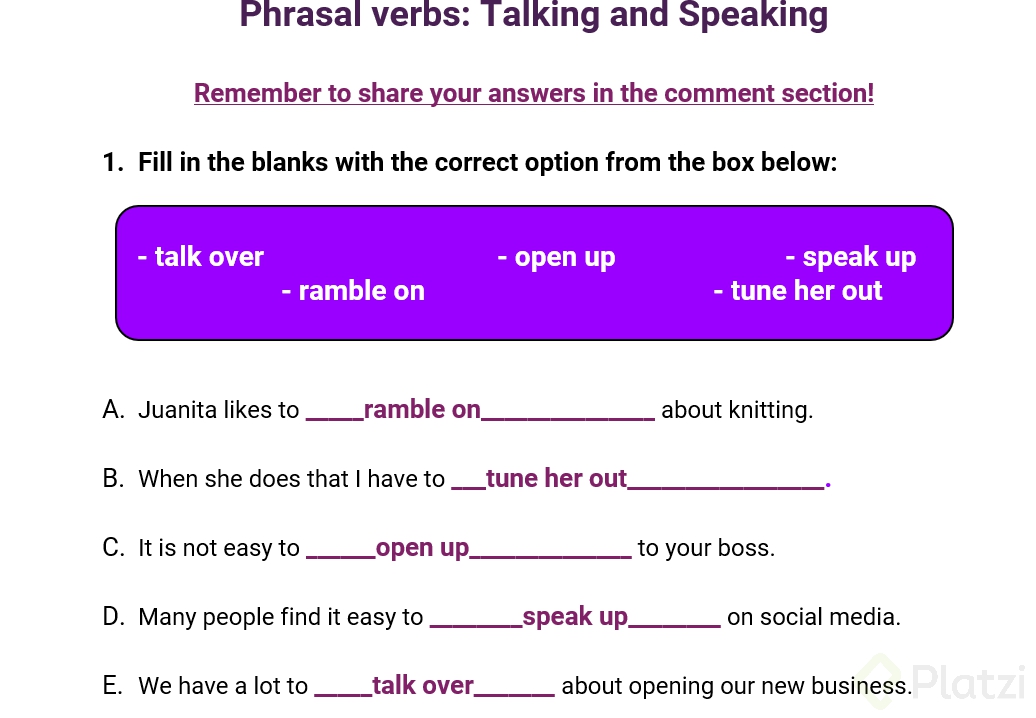
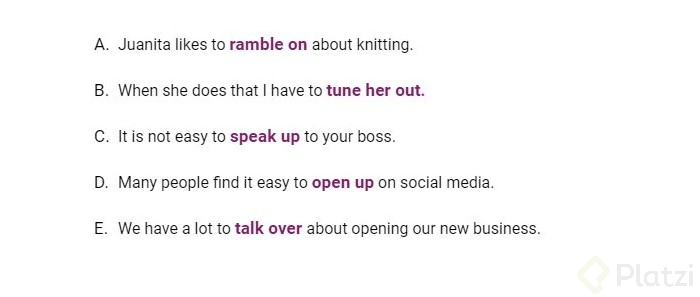
A.Juanita likes to ramble on about knitting.
B.When she does that I have to tune her out.
C.It is not easy to speak up to your boss.
D.Many people find easy to open up on social media.
E.We have a lot to talk over about opening our new business.
I'm busy right now, we'll talk it over later
I was watching a stream, but the person started to ramble on about other topics, so I decided to tune him out.
To be a great leader, you have to speak up, but also let your subordinates open up