Why brands stick in memory, not just ads
Contenido del curso


Procesos de Pensamiento


Conoce tu consumidor
- 8

Cinco técnicas cualitativas para entender al consumidor
05:31 min - 9

Choosing the Right Consumer Research Method
05:45 min - 10

Como criar questionários quantitativos eficazes
06:30 min - 11

Cómo hacer una entrevista en profundidad paso a paso
08:06 min - 12

Cómo grabar y desgrabar una entrevista a profundidad
08:46 min - 13

Cómo organizar un grupo focal paso a paso
04:51 min - 14

Estudio de casos: cómo validar una idea sobre tu consumidor
06:09 min - 15

¿Qué es neuromarketing?
00:01 min - 16

Por que compramos pelo valor simbólico, não pelo produto
10:49 min - 17

Contexto sociocultural: por qué define tu mensaje de venta
02:33 min - 18

NVivo y saturación: así se leen los focus group
05:39 min
Encuentra lo que estás buscando


Conozcamos el consumidor Latinoamericano


Tendencias para el futuro


Mentoría Expert
Recursos
Resumen
Understanding psychological processes in branding helps you grasp why we notice some ads and ignore others, why certain logos stick, and what drives us to buy. This is for marketers, designers, and anyone curious about the psychology behind consumer behavior.
We filter thousands of stimuli every day, yet a single ad can stop us in our tracks. The reason lies in a handful of mental mechanisms that shape how we think, remember, and act when exposed to a brand.
How does attention shape what we notice in advertising?
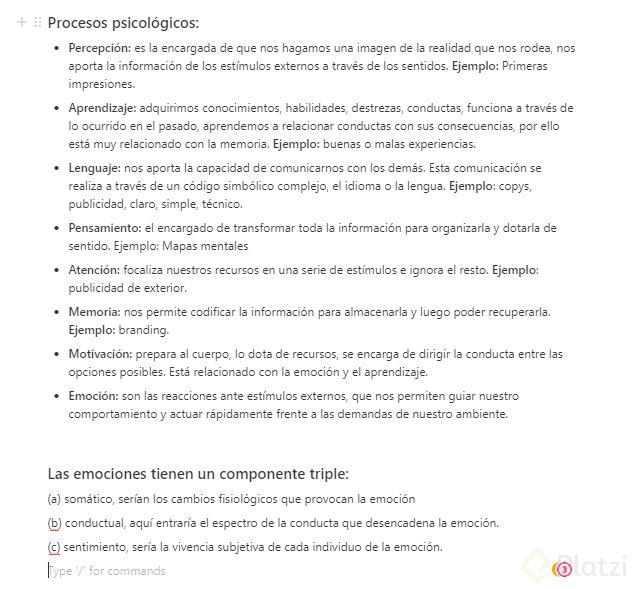
Attention focuses our resources on a series of stimuli and ignores the rest [00:07]. Think about outdoor advertising: you walk through your city surrounded by countless ads, and you become an expert filter. Most of them never reach you.
But sometimes an ad breaks through. It might be the color, what it evokes in you, or the heuristic tied to your memory. Suddenly you focus on that message and tune everything else out.
A great illustration of this is crowded markets full of noise, where vendors shout "Buy something, ma'am, special offer, come this way" [00:40]. In Colombia these are called San Andresitos. These chaotic spaces trigger exactly that expert filtering process, forcing your brain to sort signal from noise.
What does attention do in marketing? It concentrates your mental resources on specific stimuli while ignoring everything else. That is why a bright color or an emotional trigger can make one ad stand out among hundreds.
This example came from Nadim, who teaches a course on graphic humor and cartooning here on Platzi [01:02].
Why is memory so important for brand recall?
Memory allows us to encode information so we can store it and retrieve it later [01:25]. It works like a file or folder on your computer: you take a concept, save it, and create a shortcut to access it whenever you need it.
This is the process at play every time you are exposed to a brand. Try a quick exercise: name 10 car brands right now. How many come instantly to mind?
The first five or six are what we call spontaneous recall [01:55]. The rest usually surface only when someone prompts you: "Do you know this brand? What about this other one?"
What is spontaneous recall? It is the group of brands, usually five or six, that come to mind immediately without any prompting. It measures how strongly a brand lives in your memory.
Here is where branding gets interesting. Picture a slide full of logos with no brand names on them. You still recognize them, and you might feel a stronger connection to some because they trigger memories [02:35]. That is the whole point of branding: someone sees your brand and instantly knows the product or service behind it.
What role do motivation and emotion play in buying?
Motivation prepares us or equips us with the resources to generate a behavior [02:55]. It connects directly to emotion and to learning. The course points to a scene from the movie Jerry Maguire, where Dickie Fox illustrates motivation through profound insights that push you to take action [03:15].
Emotion is the final psychological process. It refers to the reactions we have to external stimuli that guide our behavior and let us act quickly in response to our environment [03:35].
Emotions have three components that work together:
- Somatic component: physiological changes triggered by emotion, like your hair standing on end or your pupils dilating when you like something [03:55].
- Behavioral component: the behavior the emotion produces, such as the impulse purchases sparked by a sales promotion [04:05].
- Feeling component: the subjective experience tied to the emotion that pushes the individual to act [04:15].
Why do we buy things on impulse? Because emotions combine physical reactions, learned behaviors, and subjective feelings. A sales promotion can trigger all three at once, driving you to buy without much thought.
Together, these processes explain how we think and why we do what we do. Attention decides what we notice, memory decides what sticks, and motivation plus emotion decide whether we act.
What do you call those noisy, offer-shouting markets in your city or country? Drop it in the comments so we can compare notes.