Curso de Innovación para Emprendimiento

Context Map Canvas for Your Business Idea

Curso de Innovación para Emprendimiento

Contenido del curso

Context Map Canvas for Your Business Idea

Resumen

Every business idea lives inside a context, and ignoring that context is one of the fastest ways to watch a promising concept collapse. If you want to build something that survives real market conditions, you need a structured way to look at what surrounds your idea. The context map canvas is that tool, and paired with an understanding of megatrends, it gives you a clear read on where your business could thrive or stumble.

What is a context map canvas and why does it matter?

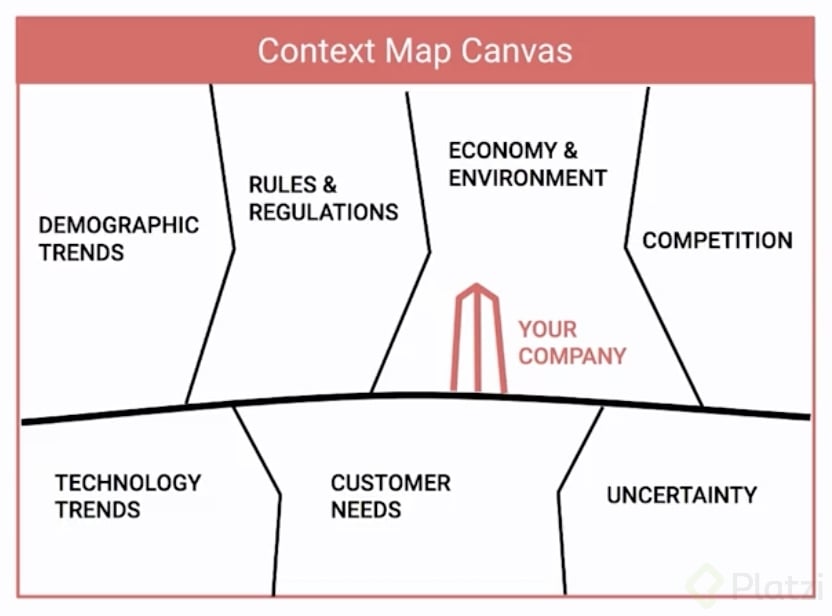
A context map canvas is a visual framework that walks you through seven external factors shaping your business idea. Instead of guessing what could impact your project, you map each element deliberately so nothing important stays in your blind spot.

What is a context map canvas? It's a strategic tool that maps seven external forces around your idea: demographic trends, rules and regulations, economy and environment, competition, technology trends, customer needs, and uncertainty.

How do you use each part of the canvas?

Each section pushes you to answer a specific question about your environment. Think of it as a checklist that forces honesty about what you know and what you don't.

  • Demographic trends: what cultural or societal shifts are happening in your client segment that could impact your idea.
  • Rules and regulations: which permits, laws, or upcoming regulations you need to consider before building.
  • Economy and environment: how you'll impact them and how they'll impact you. Both directions matter.
  • Competition: where the industry is heading and how those shifts could reshape your position.
  • Technology trends: what tech you could ride as an advantage, and what tech could threaten you.
  • Customer needs: how your customer's expectations are evolving right now.
  • Uncertainty: the big unknowns you can't predict but need on your radar [01:47].

Mapping these forces doesn't just clarify what's out there. It also surfaces disagreements and unknowns, so you can watch which scenario actually plays out instead of being caught off guard.

What is a megatrend and how does it shape your strategy?

A megatrend is much bigger than a passing fad. Forget fashion or seasonal hype. We're talking about long-term shifts that move entire economies.

What is a megatrend? It's a major movement or pattern at a macro and global level that will have a transformative impact on economies, business, and society in the future [02:56].

Which megatrends should you keep on your radar?

Different organizations track different megatrends depending on their focus, but some patterns show up across almost every serious analysis. One example set includes:

  • Climate change.
  • Digitalization.
  • Aging population.
  • Shift in global economic power.
  • Connected consumers.
  • Shifting energy markets.

Another angle comes from Trend Hunter, a source worth exploring in depth. They break megatrends into more granular movements like reduction, where people are hunting for simplicity, convergence, where consumers want to co-create with their favorite brands, and divergence, where personalization becomes the expectation for every product or service [04:03].

The idea isn't to memorize every trend. It's to pick the ones that actually touch your concept and study them closely.

How do you apply trends to a specific industry?

Let's ground this with a real example: the beverage industry. If you were developing a drink concept, two clear trends would demand your attention.

The first is social media influence on beverage decisions. Among people who drink non-carbonated beverages, 47% say what their family and friends post on social media helps them discover new drinks, and 31% say groups and communities influence what they choose [05:16]. That's not a soft signal. That's a channel strategy waiting to happen.

The second is the rise of health-conscious consumption. Of non-carbonated beverage drinkers, 36% check ingredients when buying a drink for the first time, and 30% often choose the diet option [05:52]. If you launch a sugary drink without a health angle, you're swimming against a strong current.

How do I know which trends matter for my idea? Start with your industry, look for hard data points like percentages and consumer behavior stats, and filter for the ones that either open an opportunity or pose a real threat to your concept.

The point is simple: trends and context give you either a tailwind or a headwind. Your job is to figure out which one you're facing and adjust before the market forces the answer on you.

What's the context around your idea right now? Drop your thoughts in the comments and share which trend you think will impact your project the most.