Contenido del curso
Listening to your user
Creating valuable ideas
Considering the outside world
Recap
Putting your ideas to the test
Going from idea to business
Getting people on board
Innovating in the real world
What Innovation Really Is (It's Not Tech)

Resumen
Innovation is not about fancy technology or complex engineering. It's about solutions that generate real value for the user, and once you understand that shift, you start seeing opportunities everywhere: in your kitchen, in your remote control, even in a tangled mess of home office cables.
What does innovation really mean?
Most people picture innovation as something sophisticated, expensive and full of cutting edge tech. But that image often gets in the way of actually innovating. If a solution adds real value to someone, it counts as innovation, no matter how simple it looks.
Think about adapting a remote control so your grandma can actually use it. You are removing buttons, not adding them, and that simplification is innovation. The same goes for a creative fix that solves a specific problem or repurposing everyday objects to organize the cables under your desk while you work from home.
What is innovation in simple terms? Innovation is any solution that creates real value for a user. It can be a product, a process, a service or even a small tweak that removes complexity and solves a real problem.
Lower your bar. Open your definition. That mindset shift is where useful innovation actually begins.
Why do companies innovate: panic or purpose?
When you look at organizations, there are basically two motives behind innovation, and both are valid.
- Innovation by panic: you innovate to survive. If you don't move, your company could disappear. Crises usually push a lot of companies into this mode.
- Innovation by purpose: you innovate to evolve. You build a clear reason to be that guides where and how you create new value.
People tend to say they would prefer to innovate by purpose, and it sounds nicer, but neither motivation is inherently better. What matters is knowing which one is driving you, because that changes how you plan, how you invest and how you manage the process.
What are the levels of innovation?
Innovation is not one single thing. It lives on a scale, and understanding where your idea sits helps you set realistic expectations.
Incremental, evolutive and disruptive innovation
There are three main levels you should keep in mind.
- Incremental innovation: small improvements on what already exists, like a new flavor, color or size of your product.
- Evolutive innovation: a meaningful upgrade of the same idea. You already have the light bulb, and now you make it more efficient or more sustainable.
- Disruptive innovation: a radical shift that changes the game. A classic example is Fujifilm, a company that made film for analog cameras and had a very tough time when digital cameras went mainstream.
Fujifilm innovated by panic and explored several paths. One of them was Astalift, a makeup brand that sounds random at first, but made total sense: over decades of developing camera film, they had learned deeply about chemicals, light and how things affect the way we look. They used that knowledge to launch a successful skincare and makeup line.
Is disruptive innovation always the best? No. Around 90 to 95% of innovation is incremental, and only about 2% ends up being truly disruptive. Your user does not care where your idea sits on that scale, only whether it adds value.
So be careful when you say you want to do disruptive innovation just because it sounds exciting or magazine worthy. Most of the impact you will create in your career will come from small, valuable, incremental improvements.
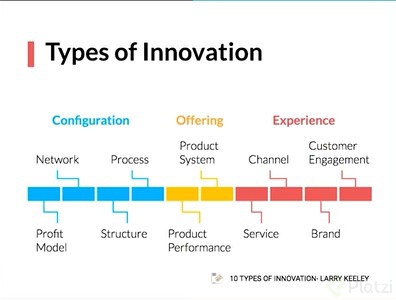
What are the types of innovation beyond product?
When we hear the word innovation, we usually think about a new product or a new service. But there are many other types of innovation, and knowing them expands where you can play.
Configuration: profit model, network and structure
This first group is about how your company is organized and how it makes money.
- Profit model: Netflix using a subscription model instead of selling individual titles.
- Network: H&M partnering with a big designer for a specific collection, combining brands and audiences.
- Structure: Zappos organizing itself internally in a very specific way to deliver excellent customer service.
These are less visible to the end user, but they can be extremely powerful because they change the rules of how you operate.
Process and offering innovation
The next group is closer to what most people already picture when they think about innovation.
- Process: Zara mastering fast fashion so new pieces reach stores quickly.
- Product performance: Mac making sure their products consistently perform at a high level.
- Product system: Nike turning sports into a lifestyle through a connected system of products.
Process innovation is often invisible from the outside, but it defines speed, cost and quality, which is exactly what your user feels in the end.
Experience: service, channel, brand and customer engagement
The last group is all about how the user lives your brand.
- Service: the Ritz Hotel going above and beyond with every guest.
- Channel: Amazon exploring drone delivery to rethink how products reach you.
- Brand: Virgin entering many different industries while staying emblematic of what the brand represents.
- Customer engagement: Starbucks and its loyalty program, designed to feel different from any other coffee shop.
What are the main types of innovation? They fall into three big groups: configuration (profit model, network, structure), offering (process, product performance, product system) and experience (service, channel, brand, customer engagement).
Start seeing innovation as a wide playground, not a narrow product launch. Which of these types feels closest to where you can create value right now? Share your example in the comments.