Contenido del curso
The coach skillset
- 6

Habilidades de Coaching: Mapas Conceptuales y Conocimiento Experto
05:56 min - 7

The 4 emotional intelligence skills every coach needs
09:20 min - 8

Experiência profissional: a base para virar coach
08:14 min - 9

Tres fuentes para construir tu reputación como coach
05:38 min - 10

Rate Yourself: Ready to Coach or Be Coached?
05:28 min
How to design a coaching program
- 11

Construcción de un Marco Teórico en Programas de Coaching
04:46 min - 12

How to design a diagnostic coaching assessment
05:41 min - 13

How to Build a Transparent Coaching Report
06:01 min - 14

Session Zero: Building Coaching Rapport Before Day One
06:24 min - 15

The ABC method for a real coaching session
08:27 min - 16

How to Close a Coaching Program Well
05:01 min
Building my first coaching session
- 17

Your First Coaching Session: Five Steps to Prepare
06:59 min - 18

Sorting Facts, Meanings, and Emotions in Coaching
07:20 min - 19

Reframing victim statements into coachable challenges
Viendo ahora - 20

99 Bad Ideas to Find One Genius Solution
02:09 min - 21

El efecto Pigmalión al asignar tareas de coaching
07:28 min - 22

Prepare, film, and get feedback: your first session
03:23 min
Coaching as a business
Reframing victim statements into coachable challenges

Resumen
Victim syndrome in coaching is the mindset where your coachee feels attacked, accused or trapped by circumstances they can't control. Learning to spot it and reframe it is what turns a stuck conversation into real action. This is for coaches who want to move their coachee from blame to responsibility.
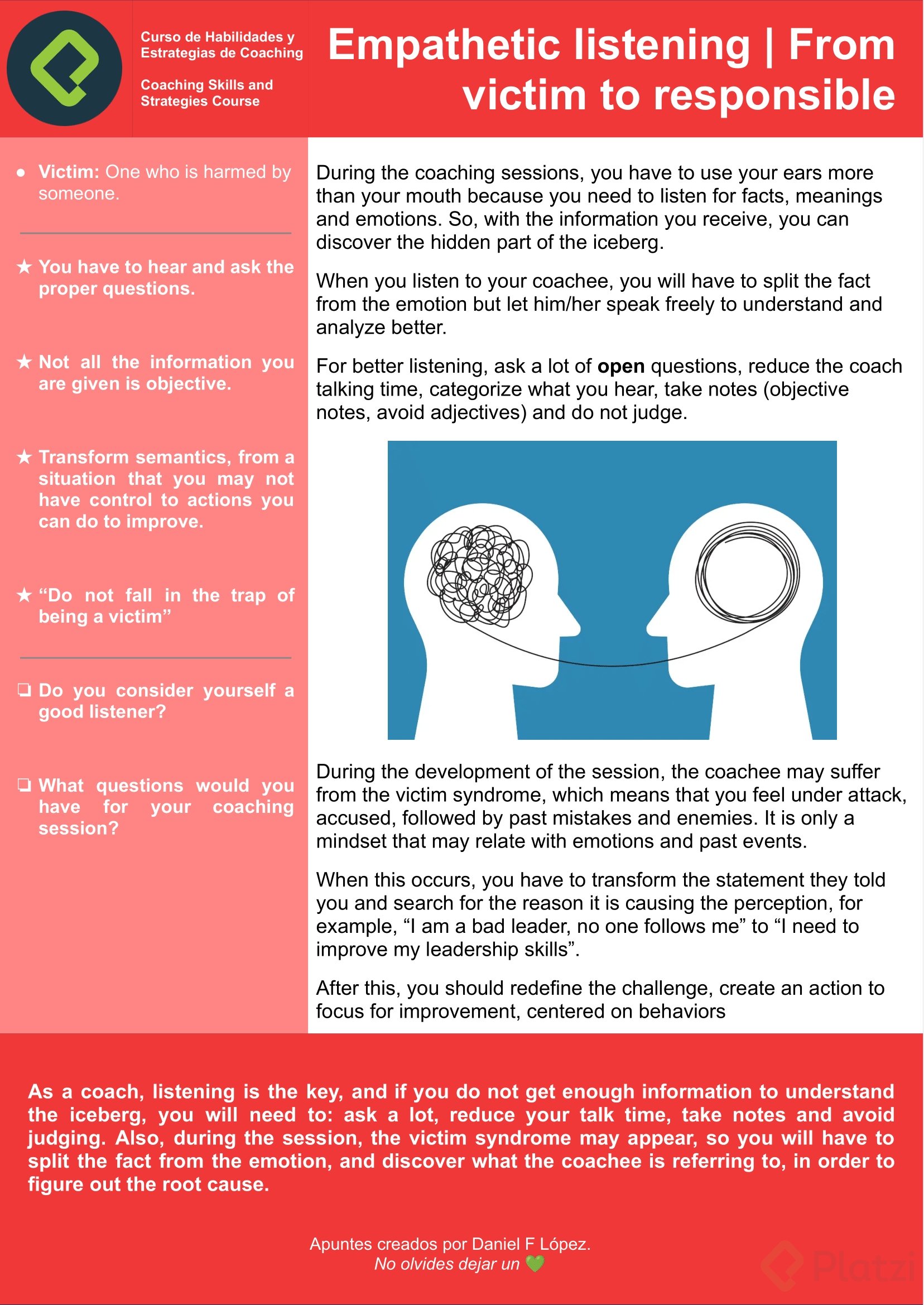
After listening empathetically, you already have good information. Now comes the transformation from victim to responsible, and here is where the real coaching work begins.
What is victim syndrome and why does it show up in coaching?
It is very common, and honestly, it is not a bad thing. It is part of the mindset your coachee might carry when they ask for help. People rarely reach out when everything is going great; they reach out at a vulnerable moment, and that vulnerability often sounds like blame.
You will hear phrases like:
- "My colleagues don't like me."
- "I'm a very bad leader."
- "I don't know what I'm doing in this job."
Each of these is a manifestation of what we call the victim syndrome [00:31]. It is a mindset where the person feels attacked or accused, focuses heavily on past mistakes, and sees the world as full of enemies.
What is victim syndrome in coaching? It's a mindset where the coachee feels like a victim of circumstances, blaming external people or events. It shows up as statements like "nobody listens to me," focused on the past and things they can't control.
And yes, it happens to all of us every once in a while. Feeling like a victim is human, so there is no judgment here.
Why can't you coach someone stuck in victim syndrome?
Here is the challenge: victim syndrome is not something you can work with as a coach [01:35]. If the person says "I'm a failure," there is not much you can do with that.
Why? Because you are not there as a psychologist. You are there to help them take action and change behaviors. A statement like "I'm a failure" gives you nothing actionable to build on.
That is the core distinction. You cannot control how the boss behaves, how a colleague behaves, or how other people spend their time and set their priorities. Neither can your coachee. What you can help change is the coachee's own behavior.
How do you rephrase victim statements into something you can work with?
The magic is in the semantics [02:02]. You help the coachee rewrite the challenge so it points to something they can actually control. Take a look at how each victim statement transforms:
- "I am a failure as a leader. Nobody likes me. Nobody listens to me" becomes "I think I need to give better instructions."
- "My manager wants impossible things from me" becomes "I need to ask for more help when accepting new projects."
- "My colleague is a pain in the neck" becomes "I need to improve my conflict management skills."
Notice the pattern in that second column. Every rephrased sentence focuses on something the coachee can change, using proper action verbs. That is how you empower the coachee to stop being a victim.
How do you reframe a victim statement in coaching? Shift the focus from an external source to the coachee's own behavior. Turn "nobody listens to me" into "I need to give better instructions," so the person controls the action.
By eliminating the victim syndrome, you are translating responsibility away from a mean universe or an external source and back to the person, so they can control their actions and change their behavior.
What does redefining the challenge look like?
The next part of the conversation is redefining the challenge [02:53]. Once the coachee has talked about their problem at work, your job is to detect whether they are falling into the victim syndrome.
When you spot it, you change the semantics, use the proper action verbs, and help the coachee stop replaying past mistakes. Instead, you point them toward the future and the things they can control, guided by some homework and questions you will give them.
What's the difference between victim syndrome and a coachable challenge? A victim statement blames others and dwells on the past. A coachable challenge names a specific behavior the coachee can change through future action.
What's your challenge as a coach right now?
Here is your homework: do not fall in the trap. You have already created some pieces of your script, so add a reminder to it.
Somewhere in there, maybe in red, write the words "syndrome" and "victim" [03:36]. Let it remind you not to fall into the trap yourself and to help your coachee rewrite what the challenge really is.
That way, later on, you can focus on actions instead of your coachee staying stuck as the victim. Ready? Go and amaze the world.
If you have caught yourself or a coachee slipping into victim language, share the reframe that worked for you in the comments.