Contenido del curso



Módulo 2: Gestión del alcance y aliados de un proyectos




Módulo 3: Gestión del Cronograma de un proyecto
- 11

How Project Schedule Management Works
03:02 min - 12

Dependencias entre actividades para cronogramas de proyecto
06:46 min - 13

Effort vs Duration: The PERT Method
05:49 min - 14

Ruta crítica y cronograma con diagrama de Gantt
05:58 min - 15
PERT and ClickUp for Project Scheduling
07:56 min - 16

Técnicas de compresión de cronogramas: fast tracking y crashing
09:03 min
Módulo 4: Planificación y Presupuesto de Costos
- 17

Gestión de costos en proyectos: procesos del PMBOK y control
04:23 min - 18

Tres métodos para estimar costos de proyectos con precisión
07:34 min - 19

Presupuestos de proyecto con reservas y curva S para control financiero
09:55 min - 20
Building a Project Budget Baseline With S-Curve
07:15 min - 21

Why Low Spending Can Hide Project Failure
11:58 min - 22

WSJF and ROI to Prioritize Projects
06:58 min
Módulo 5: Siguientes Pasos

How WBS Turns Project Chaos Into a Clear Plan
Resumen
Have you ever faced a project so massive it felt impossible to tackle? That overwhelming feeling of not knowing where to start or how to make sure nothing slips through the cracks. A Work Breakdown Structure (WBS) turns that chaos into a clear, conquerable map by breaking the whole project into smaller, manageable pieces you can actually deliver.
What is a Work Breakdown Structure in project management?
A WBS is a foundational tool whose main goal is to decompose the total scope of your project into small, manageable, and verifiable work packages. Think of it as a family tree of your project: each branch represents a portion of the work, and each leaf is a specific deliverable.
The WBS follows the 100% rule, meaning it includes 100% of the work defined in the project scope, no more and no less. Each descending level represents a more detailed definition of the work to be done [01:18].
What is the 100% rule in a WBS? It means your WBS must contain all the work defined in the scope, nothing extra and nothing missing. If something isn't on the WBS, it isn't part of the project.
How is a WBS structured by levels?
To build an effective WBS, you follow a logical hierarchy that moves from the general to the specific.
- Level 1: the product or final result. This is the main deliverable, the overall objective you defined in your scope.
- Level 2 and beyond: subsystems, components and major deliverables. You break the final product into its principal components, and each subsequent level adds more detail.
- Lowest level: work packages. These are the smallest deliverables on each branch, small enough to be assigned to a person or team and managed independently.
A work package usually has a duration of one to two weeks, depending on the type of project [02:25]. Visually, the WBS looks like a tree: the project title at the top, major deliverables in the middle, and work packages at the bottom.
What is the WBS dictionary and why do you need it?
The WBS dictionary is a companion document that provides detailed descriptions for each work package. It includes a clear definition of what will be done, and acts as the guide that ensures everyone understands exactly what needs to happen [03:01].
How do you apply a WBS to a real project?
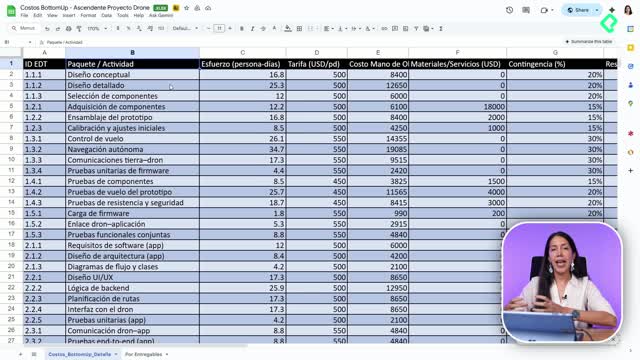
Let's take a drone delivery project as an example [03:17]. At Level 1, your main deliverable is the autonomous delivery drone. Moving to Level 2, you break it down into its major deliverables:
- Drone design.
- Drone manufacturing.
- Software development.
- Integrated testing.
- Certifications and approvals.
Now zoom into a specific work package inside drone manufacturing, such as prototype assembly. That package would describe the mounting of all components following the design blueprints. See how you go from a general concept to a specific, measurable deliverable?
Why is a Work Breakdown Structure important?
Without a well defined WBS, it's easy for invisible or unplanned work to slip through, leading to delays, cost overruns and uncontrolled scope growth. This is the famous scope creep [04:20].
With a clear WBS you can:
- Assign responsibilities, because every work package has a clear owner.
- Estimate better, since small packages are easier to size in time and cost than a giant project.
- Synchronize dependencies between parts of the work.
- Monitor progress with precision, knowing exactly what is done and what is pending.
- Manage risk in a more granular way at different levels.
What is scope creep? It's the uncontrolled expansion of a project's scope when work that wasn't planned starts sneaking in. A clear WBS is one of your best defenses against it.
The WBS becomes the backbone of your planning and execution.
How do you create your own WBS step by step?
Start from the scope and key deliverables you already defined in scope management, and use them for Levels 1 and 2. Then keep descending: decompose major deliverables until you reach work packages small enough to be manageable, ideally lasting one to two weeks.
Next, build the WBS dictionary. Write clear definitions, the boundaries of each deliverable, and the acceptance criteria. Finally, validate your WBS with stakeholders to confirm it meets the 100% rule and truly reflects what you'll build [05:35].
What common mistakes should you avoid in a WBS?
Watch out for two traps that weaken your structure:
- Mixing phases with components without a clear criterion. The WBS focuses on deliverables, not on the project life cycle phases. Items like design or testing should only appear if they result in a specific, unique deliverable.
- Creating giant, ambiguous work packages. If a package is too big, its description becomes vague. Break it down further until there's no ambiguity about what it takes to complete it.
The learning goal here is simple: transform your general scope into clear, measurable and assignable pieces. This skill lets you estimate time and cost more precisely, schedule realistically, and control progress with unprecedented visibility. It's the key to making execution as orderly as your vision.
Now take the project you're defining, draw your WBS down to the third level of decomposition, and write the dictionary for at least 10 key work packages. Share your branches in the comments and tell me which work package was the hardest to define.