Leadership is not about the title on your business card. The real difference between formal authority and influence is what separates managers who give orders from leaders who actually move teams toward a shared goal. If you want your team to follow you because they trust you, not because they have to, this is for you.
What is the difference between formal authority and influence?
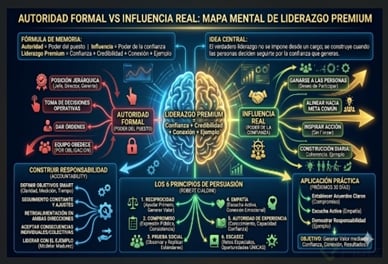
Formal authority comes from a hierarchical position: being the boss, the director, the manager. It gives you operational decision power, but it does not guarantee that your team will truly follow your lead.
Influence is something else. It is the capacity to move the needle, to align people around a common destination, and to inspire action without forcing it. And here is the interesting part: influence is built day by day, regardless of your title.
What is influence in leadership? It is the ability to align and motivate a team toward a shared goal without relying on hierarchy. Unlike formal authority, influence is earned through trust, consistency, and example.
Why does accountability matter for influence?
One of the foundations of influence is accountability. The Spanish translation, responsabilidad, only captures part of it. Accountability means being responsible, yes, but also being proactive instead of reactive, owning your results with transparency, and accepting consequences when you make mistakes.
As a leader, you have to be the first one to show that vulnerability: "I made a mistake, I take responsibility, and this is how I am going to fix it." That kind of honesty builds trust faster than any title.
How can you build accountability in your team?
There are concrete tools to make accountability real, both for you and for your team. They are not abstract values; they are habits you can practice every week.
- Define SMART objectives: specific, measurable, actionable, relevant, and time bound goals that give everyone clarity.
- Track progress consistently to detect when adjustments are needed before it is too late.
- Give feedback in both directions: when things work and when they do not.
- Accept consequences, both personal and collective, and lead by example.
A powerful reference here is Netflix. In companies like Netflix, people at every level have authority to make decisions, as long as they also own the consequences. In my own company we use a similar rule: you can make any decision you consider appropriate for the organization, as long as it is not illegal and does not put the future operation at risk.
What does accountability mean in leadership? It means owning your decisions and results without waiting for someone to tell you what to do. It includes being proactive, transparent, and willing to accept consequences.
What are the 6 principles of persuasion to influence your team?
To influence others, Robert Cialdini described six principles of persuasion in his book. They are practical levers you can apply in meetings, projects, and daily interactions to move the needle as a leader.
Reciprocity, commitment and social proof
The first principle is reciprocity. When someone does you a favor, you feel a natural pull to return it later. In my company we have a cultural rule: when someone needs help, be the first to raise your hand. The day you need help, many hands will be raised for you.
The second is commitment and consistency. When someone commits verbally in a meeting, saying "I will deliver this by Friday," that public statement creates accountability. I always invite teams to close meetings stating commitments out loud, not only by email.
The third is social proof. Humans are social beings, and we copy what we see around us. If meetings start late, your team will normalize that. If you set the example of starting meetings on time, you will notice your team connects to video calls before anyone else.
Empathy, authority and scarcity
The fourth principle is empathy. We all prefer working with people we like. Putting yourself in your team's shoes, listening, and implementing their ideas creates the positive energy that pushes the boat toward the common goal.
The fifth is authority, but not the one a title gives you. It is the authority of real expertise: your team trusts you because they know you have the skills and tools to make the best decisions for the group.
The sixth is scarcity. When something is rare, it becomes more desirable. If you launch a special project where not everyone can participate, those who are selected feel higher accountability. I always tell my team in those moments: this is your opportunity to shine.
How do you influence a team without authority? Apply the six principles of persuasion: reciprocity, commitment, social proof, empathy, expertise based authority, and scarcity. They build trust and align people without forcing them.
How will you apply these principles in the next 30 days?
Pick two or three principles of persuasion and commit to using them in your team during the next 30 days. Write your plan in your journal or share it in the comments: how exactly will you use each principle to influence your team and move the needle toward your common goal?