Setting clear goals is the backbone of effective leadership, and learning how to set SMART goals gives you the clarity every team needs to perform. If you lead people, you already know that without direction, even the most talented team drifts. Here you will learn two practical methodologies to define, measure, and iterate goals that actually move your organization forward.
What is the SMART methodology and how do you apply it?
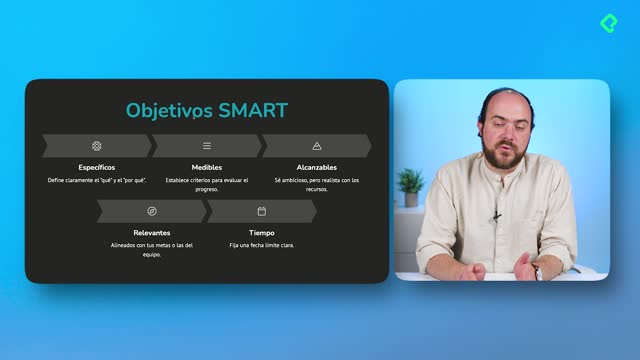
The SMART framework is a simple way to land objectives with your team using five criteria that turn a vague intention into a concrete commitment.
Each letter stands for a quality your goal must have:
- Specific: the objective is clearly defined, not abstract.
- Measurable: you can track progress with numbers or evidence.
- Attainable: it is realistic and achievable for the team.
- Relevant: it connects directly to the project or strategy.
- Time-bound: it has a deadline or window to be accomplished.
My recommendation is to build SMART goals as a team. Start from the macro organizational strategy, cascade it down to area objectives, and finally translate it into individual goals for each person on the team. That cascade is what creates real alignment.
What is a SMART goal? A goal that is Specific, Measurable, Attainable, Relevant, and Time-bound. It transforms a broad intention into a trackable commitment with a clear deadline.
How many goals should your team track per quarter?
Less is more. If you set twenty metrics, your team will lose focus and none of them will move. A healthy range is three to five goals per quarter, seven at most.
Once the goals are defined, you add the initiatives: the specific actions the team or individuals will take to hit those key results. Goals tell you where you are going; initiatives tell you how you will get there.
Why use OKRs and the build, measure, learn loop?
Whether you choose SMART or Objective Key Results, the real discipline is reviewing and adjusting goals on a regular cadence. At Médulo, for example, we run this review every quarter. We check whether each objective still aligns with the company strategy, and if it does not, we change it and communicate the update to the rest of the team.
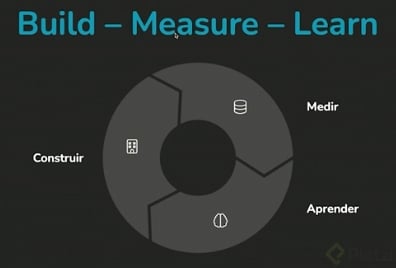
To iterate well, the build, measure, learn loop proposed by Eric Ries in The Lean Startup is a powerful tool. The logic is straightforward:
- Build: design the objective and define what success looks like.
- Measure: attach metrics so you can tell if it is working.
- Learn: analyze the data and decide what to keep or change.
Then you build again with a new or refined objective. Each iteration sharpens both your personal leadership and your organization.
What is the difference between SMART goals and OKRs? SMART defines the quality of a single goal, while OKRs structure an objective with measurable key results. You can combine both: write OKRs that meet the SMART criteria.
How do you keep goals aligned with strategy over time?
Goals are not set in stone. Markets shift, priorities change, and what was relevant in January may be noise by April. Build a quarterly ritual where you and your team ask three questions: is this goal still tied to the strategy, are the metrics still the right ones, and what did we learn from the last cycle?
That rhythm of construction, measurement, and learning is what separates teams that talk about goals from teams that actually achieve them.
Now it is your turn. Drop in the comments and in your journal what your personal goals are and what the goals of your team look like this quarter.