Strategic planning becomes simpler when you have the right tools to decide what deserves your time and what doesn't. Here you'll find practical frameworks I use daily to prioritize projects, align teams, and protect focus, useful for founders, managers, and anyone leading initiatives with limited resources.
How do you choose which projects to execute first?
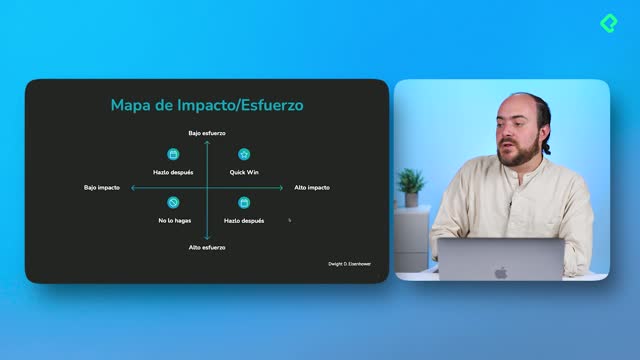
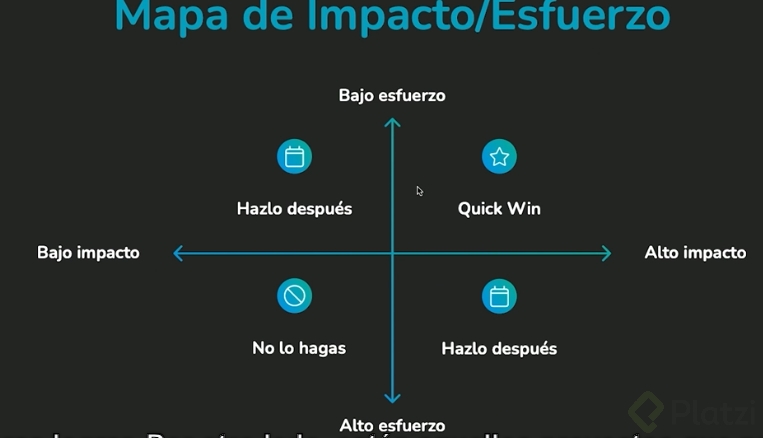
The impact-effort map is a quadrant that classifies projects using two criteria: how much impact they generate toward a specific objective, and how much effort they require to complete. Plotting your initiatives on this map turns vague to-do lists into clear decisions.
What are quick wins and why start there?
Projects with high impact and low effort are quick wins. You can implement them in a matter of weeks, and they motivate the team because the payoff arrives fast. Start with these today.
Then there are low-effort, low-impact projects. They don't cost much to do, but they don't move the needle either. Park them for later and decide if they're worth executing at all.
What about projects that take months to finish?
High-impact, high-effort projects, the ones that take six, nine, or even twelve months, shouldn't be tackled as one giant block. Break them into small steps and schedule each step progressively so the project advances without stalling.
Finally, the dangerous quadrant: high effort, low impact. These drain time, money, and energy for little return. Neither you nor your team should pursue them.
What is the impact-effort matrix? It's a quadrant that classifies projects by how much impact they create versus how much effort they demand, helping you decide what to start, defer, or drop.
How do I align my team on what to stop, continue, or start?
When you're constantly innovating, clarity gets messy. The stop, continue, start framework gives your team a simple way to audit every active project in three columns.
Sit down with your team and ask three questions:
- Start: what aren't we doing that we should be doing to hit our goals.
- Stop: which projects no longer make sense and need to be killed.
- Continue: which projects are working and clearly contribute to the objective.
Three columns, one honest conversation. That's it. You walk out knowing exactly where the team's energy belongs.
How does time boxing protect your focus?
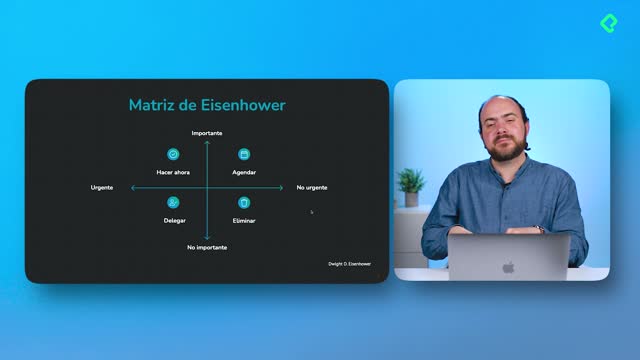
Once you know which projects to continue and which quick wins to chase, you still need a way to actually do the work. Time boxing is the habit of blocking specific slots in your calendar for specific tasks, and it pairs perfectly with the Eisenhower matrix from the previous class.
How do I apply time boxing in my calendar?
Take your prioritized to-do list, the tasks you won't delegate, and compare it against your calendar. Then schedule the work as if it were a meeting with yourself.
For example: "I'll draft the business plan for the new unit on Monday morning, three hours. Then Wednesday and Friday, two more hours each." Treat those blocks as non-negotiable commitments.
This forces you to estimate realistically. A task takes the time it takes, and the work won't happen on its own, you have to sit down and do it.
Can I take time boxing further?
Yes, by creating predetermined blocks. In my own calendar, every Monday is fully closed, no calls, no meetings, the entire day is reserved for execution work. Wednesday mornings I keep a three-hour block dedicated to objectives tied to the company.
When these blocks are visible and consistent, you train your team and collaborators to respect them. I also invite my team to build their own protected spaces so they aren't interrupted by calls or video meetings that could be scheduled elsewhere.
What is time boxing? It's the practice of assigning fixed time slots in your calendar to specific tasks, treating them as commitments to ensure important work actually gets done.
What's the difference between lagging and leading metrics?
Metrics tell you whether your strategy is working, but not all metrics speak the same language. Lagging metrics measure what already happened, they confirm whether an objective was achieved or missed.
Leading metrics, on the other hand, are prospective. They point to the future and let you anticipate whether you're on track to hit a goal before the result arrives. A solid strategic plan needs both: leading metrics to steer in real time, lagging metrics to validate outcomes.
What are leading metrics? They are forward-looking indicators that signal whether you're likely to reach an objective, allowing you to adjust course before the final result is in.
For your 30-day plan in the journal, sit with your team and map out which projects to start, which to stop, and which to continue. Drop your list in the comments and tell me which quadrant surprised you the most.