Leading a team through change feels less like flipping a switch and more like guiding people across an emotional bridge. If you want to manage resistance to change without burning out your team, you need to separate what you know from what you don't, anticipate the emotional curve, and respond to objections with clarity. This is for managers and team leads navigating transformations.
What is the difference between risk and uncertainty when leading change?
Before touching the team, you as a leader need to draw a clean line between two things that often get confused.
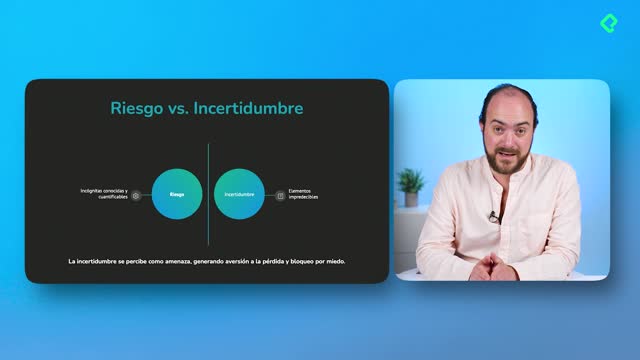
Risk is what you already know. It shows up as red flags you can spot in a pre mortem, things you can mitigate because you've seen them coming. Uncertainty is the opposite: it's what you don't know yet. And here comes the tricky part. When you dump uncertainty on your team without a frame, you create anxiety, and anxious teams freeze.
What causes resistance to change in a team? Mostly uncertainty. When people don't understand the why behind a decision, they read the change as a threat and shut down instead of moving forward.
Your job is to keep clarity high whenever possible, even when you don't have all the answers.
How does the change curve work in organizations?
Every change moves your team through a sequence of emotional stages. Knowing them lets you manage each one instead of reacting blindly.
- Surprise: the news lands like a cold bucket of water. Explain the why behind the decision so people can see the path.
- Denial: you'll hear the classic "if it's not broken, why change it?". Justify the move well and you can turn skeptics into allies.
- Frustration: the change is now real and discomfort kicks in. Keep the communication channel open and help them through the bumps.
- Depression: change means letting go of something that worked before, and that loss is real. Acknowledge it.
- Experimentation: people start interacting with the new way. Use early adopters as opinion leaders to pull others in.
- Decision: most of the team has accepted the change and is using it consistently.
- Integration: the new tool or process is simply how things are done now.
The sequence isn't always linear, but skipping a stage usually backfires later.
How do I respond to common objections to change?
Objections aren't enemies. They're signals telling you where the team needs more support or information. Here are the ones you'll hear most and how to handle each.
What do I say when my team pushes back on a new process?
- "We've always done it this way." Explain the concrete benefits and justify the why behind the decision.
- "This is never going to work." Bring hard data and success cases from other organizations or industries.
- "I don't have time for this, I'm already overloaded." Reassure them that there will be people supporting the transition so their day to day doesn't collapse.
- "What if I make a mistake?" Normalize errors culturally. Mistakes happen and you'll solve them as a team.
- "What's in it for me?" Make the personal benefits explicit, not just the organizational ones.
- "This is just another fad." Share early wins fast to keep motivation alive.
Notice the pattern: every answer is either clarity, data, support, or proof. Those four levers solve most resistance.
How do you reduce fear of failure during a change? Normalize mistakes openly. Tell your team that errors are part of the process and that you'll fix them together, not punish them individually.
How do I apply the unfreeze, change, refreeze technique?
This is a practical framework you can run with any team going through transformation. Three steps, in order.
Unfreeze means working with your team to sensitize them on why the change matters. You're breaking the old mental models about how things used to be done. Without this step, the rest doesn't stick.
Change is the actual implementation. Here you'll move through the change curve, so the priority is communication, support, resources, and training. Remember: uncertainty feels like a threat, so reduce it actively.
Refreeze is about cementing the new behavior so the team doesn't slide back into old habits. A simple way to do this is recognition: reward people publicly when they follow the new way of doing things.
What is the unfreeze change refreeze model? A three step approach to lead transformations: prepare the team mentally, implement the change with support, and lock in the new behavior through reinforcement.
Which objections have you heard in your own team when implementing a change, and how did you solve them? Drop your answer in the comments, or write it down in your journal as part of your 30 day plan.