Making decisions as a leader rarely happens with full clarity. You'll often have to commit to a path forward with only partial data, and that's exactly where strong leadership shows up. Here you'll learn how to make decisions with incomplete information using two simple tools: the pre mortem and the post mortem.
What does it really mean to make a decision?
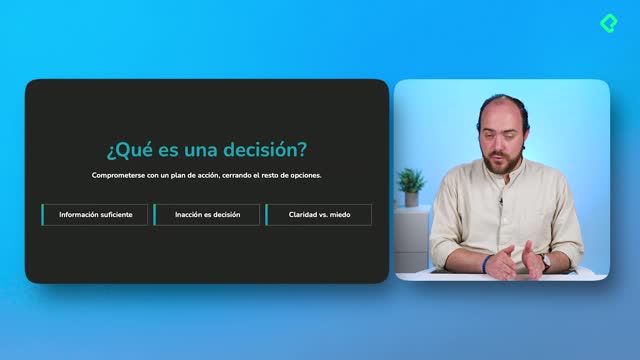
A decision is a commitment. And not deciding is also a decision, just an indirect one. Every choice you make (or avoid) carries consequences that ripple through your project and your team, for better or worse.
Fear and stress are the two biggest blockers when it's time to commit. The trick is in how you respond to them. If fear paralyzes you, you freeze. But if you use fear to spot red flags, it becomes useful intel for a better call. Same with stress: let it tip into distress and you'll burn out; channel it as fuel and it pushes you forward.
What percentage of information do I need before deciding? Around 40% is enough. If you wait until you have 100% of the information, your decision is already late.
How do I run a pre mortem before making a decision?
A pre mortem is the exercise you do before committing to a path. You sit down with your team, accept that you only have around 40% of the information, and openly ask: what could go wrong here?
This is where fear becomes a tool. Encourage your team to say things like "I'm worried this might happen" without judgment. Then, for each red flag, design a mitigation plan. By the time you actually decide, you've already mapped potential risks and how you'd handle them.
- List the decision you're about to make.
- Brainstorm everything that could go wrong.
- Define how you'd mitigate each risk if it shows up.
The goal isn't to predict the future perfectly. It's to walk into the decision with your eyes open and a basic safety net in place.
How do I run a post mortem after executing a decision?
The post mortem happens after the decision is made and executed. You gather your team and analyze what went wrong and how you solved it. This isn't about blame, it's about pattern recognition.
Every critical decision you review this way builds your team's intuition. Little by little, you start preventing repeated mistakes and spotting risks earlier in future decisions.
What's the difference between a pre mortem and a post mortem? A pre mortem analyzes what could go wrong before deciding. A post mortem analyzes what did go wrong after executing. Together, they make your decision-making sharper over time.
Which biases distort my decisions as a leader?
Even with the right tools, your brain plays tricks. Two biases show up constantly when leading projects.
Why does the planning fallacy keep breaking my timelines?
The planning fallacy is the tendency to assume things will take much less time than they actually will. It happens to every team, every day. When you're planning a big project or committing to a deadline, build in a buffer. That cushion is what absorbs the unexpected errors and risks that always appear along the way.
How does hindsight bias affect how I review decisions?
The hindsight bias kicks in after a post mortem, when you start blaming yourself for not seeing what now seems obvious. Resist that. Not everything was in your hands, and beating yourself up doesn't change the outcome.
Instead, extract the lesson. The whole point of the post mortem is to make sure that specific mistake doesn't repeat. That's the win, not perfection in hindsight.
Should I feel guilty when a decision goes wrong? No. Not everything is within your control. Focus on the lesson the post mortem gives you, so the same mistake doesn't repeat.
How do I apply this to my 30 day plan?
Open your journal and pick a project coming up soon. Run a personal pre mortem on a decision you're about to make.
- Write down the decision.
- List what could go wrong.
- Define how you'd mitigate each risk.
You'll walk into that decision lighter, knowing you already have some control over the parts that won't go perfectly. What decision are you postponing right now because you don't feel ready? Drop it in the comments and run a pre mortem on it today.