Learning how to give constructive feedback is one of the most powerful skills a leader can develop. It strengthens your team, reinforces what works and opens space for improvement without breaking trust. Here you will find a practical method, the right timing and the most common mistakes to avoid.
What is the SCI feedback model and how does it work?
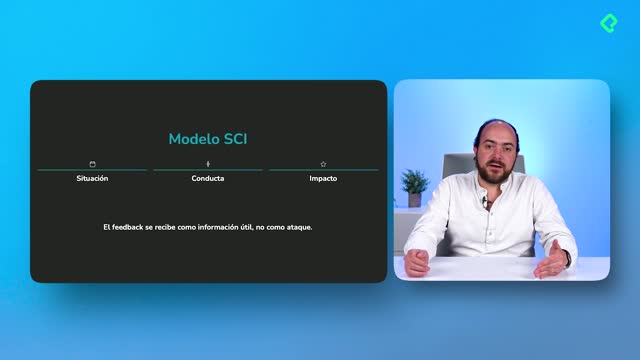
The SCI model stands for Situation, Conduct and Impact, and it gives you a simple structure to deliver feedback that lands well instead of feeling like an attack.
You start with the situation, which means describing the context: where you were, what was happening and who was involved. For example, we were in a meeting on Monday morning. Then comes the conduct, where you explain what actually happened, what worked or what did not. Following the same example: during that Monday meeting, you interrupted your coworker three times. Finally, the impact connects that behavior with its consequences for the team. In this case, those interruptions kept your coworker from expressing her point and blocked a real dialogue.
When you wrap your feedback inside this structure, the other person hears facts instead of judgments, and that changes everything.
What is the SCI feedback model? A three step framework (Situation, Conduct, Impact) that helps leaders give clear, fact based feedback without sounding aggressive or personal.
How should you prepare and time your feedback?
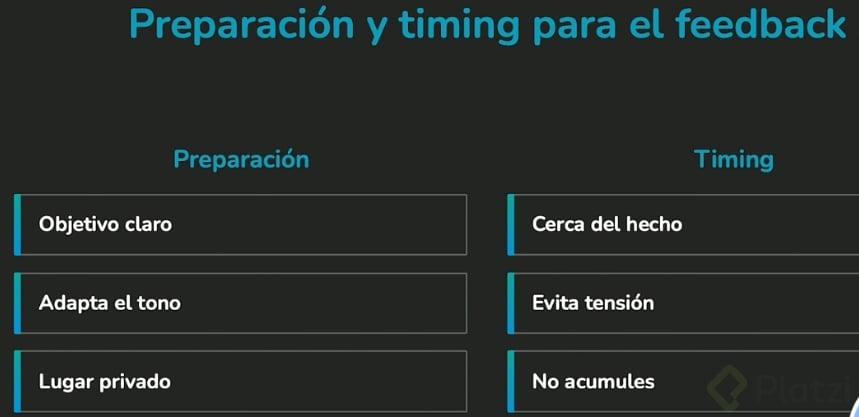
Good feedback does not happen by accident. Before the conversation, get clarity on what you want to achieve and what you really need to communicate. Then adapt your tone: a celebration sounds warm, grateful and fun, while a corrective message needs a firmer, more careful register.
The place also matters. A useful rule:
- Praise in public, so recognition multiplies.
- Correct in private, so the person never feels exposed in front of peers.
- Choose a quiet space when the topic is sensitive or emotional.
About timing, here is one of the biggest myths inside organizations: that feedback only belongs in monthly, quarterly or annual reviews. Do not wait for those formal moments. Give feedback close to the event, ideally right after the meeting where it happened. If you postpone it, you accumulate observations, you forget important details and you lose the chance to help the person grow or to celebrate something worth celebrating.
When is the best time to give feedback? As close to the event as possible. Not necessarily on the spot in front of everyone, but soon enough that the context is still fresh for both of you.
How do you create a safe space for the conversation?
Feedback only works inside an environment where people feel respected and heard. To build that environment, lean on a few principles:
- Base everything on facts and evidence, never on labels or personal traits.
- Share your point of view, and then invite the other person to share theirs.
- Speak with care and use the golden triad of respect; the moment respect disappears, the conversation collapses.
- Close with a clear action plan and a verbal commitment, ideally written down.
- Follow up on that agreement, because a leader who does not check back loses credibility.
This last step is the one most leaders skip, and it is exactly what turns feedback into real change.
What are the most common feedback mistakes to avoid?
Even with good intentions, there are traps that ruin the conversation. Watch out for these:
- Labeling the person with phrases like you are lazy. Labels close every door.
- Judging instead of describing, which pushes the other person into defensive mode.
- Generalizing with words like you always arrive late when it actually happened twice. Exaggeration ridicules.
- Giving corrective feedback in public, which humiliates the person in front of peers and erodes trust over time.
If a person feels attacked, no agreement is possible, and any accionable you try to define will fall apart.
How can you also receive feedback as a leader?
Feedback is a two way street. You give it, and you also need to receive it from your team with openness and respect. A great exercise to normalize this exchange is the 360 degree evaluation, where your boss, your peers, your team and you yourself evaluate your performance.
The self assessment piece is key, because that introspection is what helps you grow as a leader. When everyone, including managers, can be evaluated, the culture shifts toward honesty and shared improvement.
A simple homework for your 30 day journal: pick one peer or even your boss, and plan how you would give them feedback using Situation, Conduct and Impact. Write it down before the conversation, then notice how differently it lands.
Which part of the SCI model feels harder for you to apply, the situation, the conduct or the impact? Share your experience in the comments.