Strategic planning becomes easier when you stop guessing and start using frameworks that filter what truly deserves your time. If you lead a team or run projects, these strategic planning tools help you decide what to launch, what to kill and what to protect on your calendar, so your goals stop competing with noise.
How do you prioritize projects with the impact effort matrix?
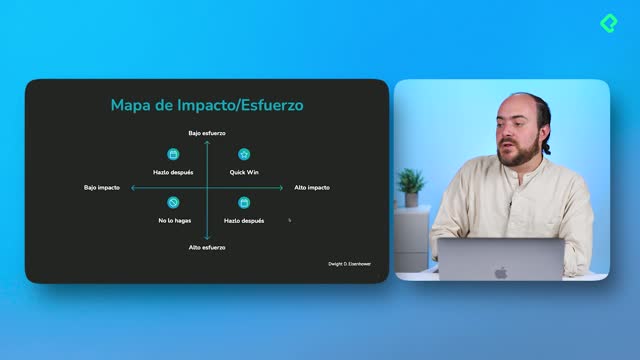
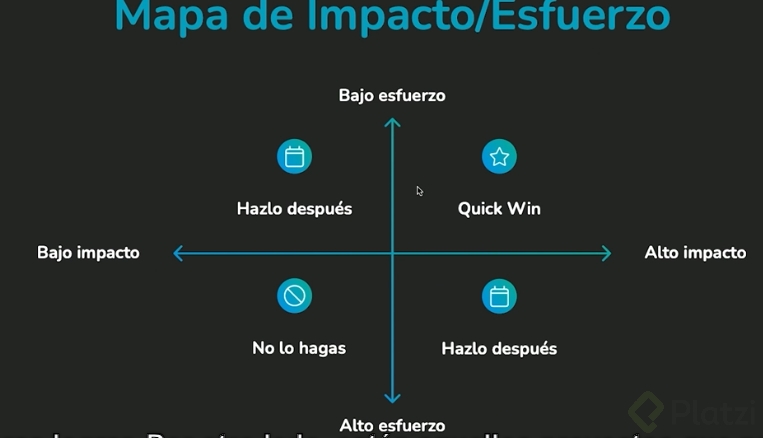
The impact effort matrix is a visual map that classifies projects using two criteria: the impact they generate toward a specific objective and the effort they require to be executed. You place each project in one of four quadrants and that position tells you what to do with it.
Here is how each quadrant works in practice:
- High impact and low effort: these are quick wins. Start them now, they motivate the team because results arrive in weeks [00:48].
- Low impact and low effort: leave them for later or reconsider if they are worth doing at all.
- High impact and high effort: projects of six, nine or twelve months. Break them into small steps and schedule them progressively [02:00].
- Low impact and high effort: nobody on your team should pursue these. Drop them.
What is a quick win in strategic planning? It is a project with high impact and low effort that you can execute in a few weeks. It delivers fast results and keeps the team motivated while you work on longer initiatives.
How does the stop, continue, start method work with your team?
When you love innovating and juggling many projects, clarity becomes scarce. The stop, continue, start framework forces honest conversations with your team about what is really moving the objective forward.
Sit down with your team and build three columns:
- Start: projects you are not doing yet but should, because they connect directly to the objective.
- Stop: projects that no longer make sense and need to be killed without guilt.
- Continue: projects that are working well and feeding the goal.
The magic of this method is its simplicity. Three columns, one conversation, and you walk out knowing exactly where your team should invest energy next week.
Why does time boxing protect your strategic priorities?
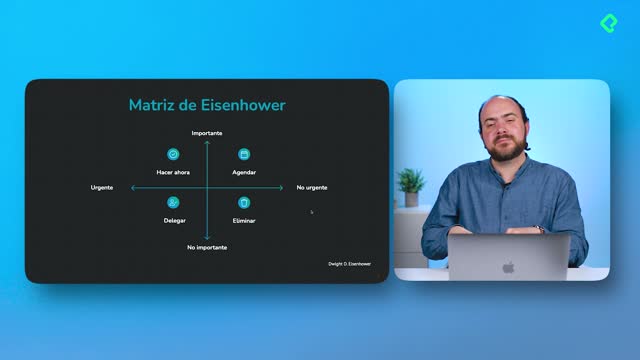
Knowing which projects matter is not enough. You also need to defend the hours where those projects actually get done, and that is what time boxing solves. This tool connects directly with the Eisenhower matrix from earlier classes and turns your priority list into calendar blocks [03:45].
The process is straightforward. Once you have your clean list of pending tasks, the ones you will not delegate, you compare it with your calendar and assign real time slots to each activity. For example, writing a business plan for a new unit may take three hours on Monday morning, plus extra blocks on Wednesday and Friday.
How do I apply time boxing to my weekly schedule? Treat your priority tasks like meetings with yourself. Block specific hours on your calendar to execute them, respect that time as a real commitment and measure if the task fits the slot you assigned.
Predetermined blocks to train your team
You can take time boxing one step further by creating recurring blocks. In my own calendar, Mondays are fully protected: no calls, no meetings, only execution time. Wednesdays I keep a three hour morning block dedicated to company objectives.
These predetermined spaces educate your team to respect deep work hours. I also encourage everyone around me to do the same, so nobody interrupts focused time with a sudden call or video meeting that could be scheduled elsewhere.
What is the difference between lagging and leading metrics?
Every strategic plan needs measurement, and not all metrics tell you the same story. Lagging metrics measure what already happened and confirm whether the objective was achieved. Leading metrics are prospective, they look forward and help you anticipate if the objective will be reached.
Using both together gives you a complete picture: leading metrics let you adjust course in real time, while lagging metrics validate the final outcome.
Your 30 day action plan
Open your journal and gather your team to map the three columns: which projects need to start, which ones need to stop and which ones deserve to continue because they are already working. That single exercise will clean your roadmap before you move into decision making in the next class.
Share in the comments which column was hardest to fill for your team.