Setting clear goals is the backbone of strong leadership. If you want your team to move with purpose, you need clarity, and clarity comes from well defined objectives. Here you will learn two simple methodologies, SMART goals and OKRs, plus a feedback loop to keep them sharp over time.
What is the SMART methodology for setting objectives?
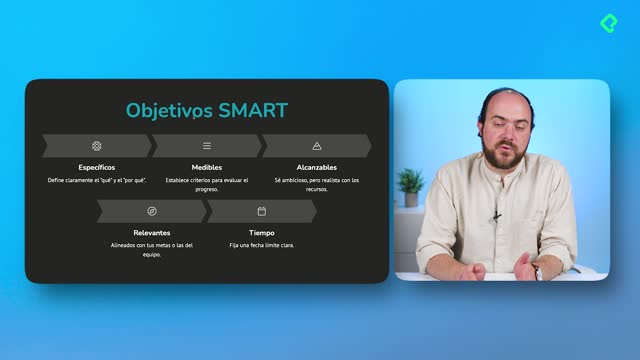
The SMART methodology breaks down each goal into five qualities that make it easier to define, communicate and track. Think of it as a checklist you run every objective through before committing your team to it.
- S stands for specific. The goal must describe exactly what you want to achieve.
- M stands for measurable. You need a number, percentage or signal that tells you if you are advancing.
- A stands for attainable or achievable. The goal should stretch the team but still be realistic.
- R stands for relevant. It must connect to the broader project or organizational strategy.
- T stands for time bound. Every goal needs a deadline or evaluation window.
What is a SMART goal? It is an objective that is specific, measurable, attainable, relevant and time bound. Instead of saying "improve sales," a SMART version would be "increase Q3 sales by 15% in the LATAM region."
How do you cascade SMART goals across a team?
The recommendation is to work them collaboratively. You start with the macro strategic objective at the organizational level, then translate it into SMART goals per area, and finally break those down into individual goals for each person on the team.
This cascade builds shared clarity. Everyone understands what the quarter looks like, what they are accountable for, and how their work ladders up to something bigger.
A common mistake is overloading people with metrics. You should not be tracking 20 indicators per person. Keep it to three, five, or at most seven goals per quarter so the team stays focused.
How do OKRs and key initiatives connect to your goals?
Objective Key Results, or OKRs, are another widely used framework. The logic is similar: you set an ambitious objective and define the key results that prove you reached it. Alongside those results live the initiatives, which are the concrete actions the team or individuals will take to move the needle.
Whether you choose SMART or OKRs, what really matters is that you evaluate and adjust your objectives with a clear cadence. At Médulo, for example, the review happens quarterly to check if the goals are still aligned with the organizational strategy. If they are not, you change them and communicate the update to the rest of the team.
What is the difference between an objective and an initiative? The objective is the outcome you want to reach. The initiative is the specific action you will take to get there. One describes the destination, the other describes the path.
Why use the build measure learn loop to iterate goals?
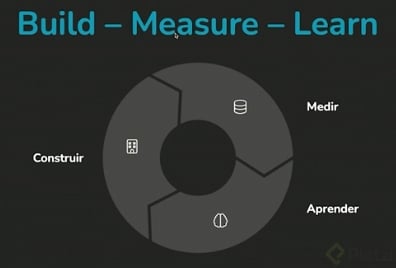
Goals are not carved in stone. To keep them useful you need a feedback loop, and a very practical one is build, measure, learn, proposed by Eric Ries in his book The Lean Startup.
The loop has three movements you repeat over and over:
- Build: construct your objective and define what success looks like.
- Measure: attach metrics to that objective and track them honestly.
- Learn: review whether it worked, what failed, and what the data is telling you.
From there you build again. Each iteration sharpens your judgment, and over time you improve both personally and as an organization. The leaders who grow fastest are the ones who run this loop without ego, willing to kill a goal that no longer serves the strategy.
How often should you review your team goals? A quarterly review works well for most teams. It gives enough time to see real progress without letting misaligned goals run for too long.
Now that you know how SMART goals and OKRs work, drop in the comments and write in your journal what your personal objectives are and what objectives your team is chasing this quarter.