Building a strong team is not about hiring talent and hoping for the best. It is about setting clear limits, developing each person on purpose, and creating the psychological safety that turns a group of professionals into a real team. Here is how to do it without leaving the outcome to chance.
¿How do you set clear limits with your team?
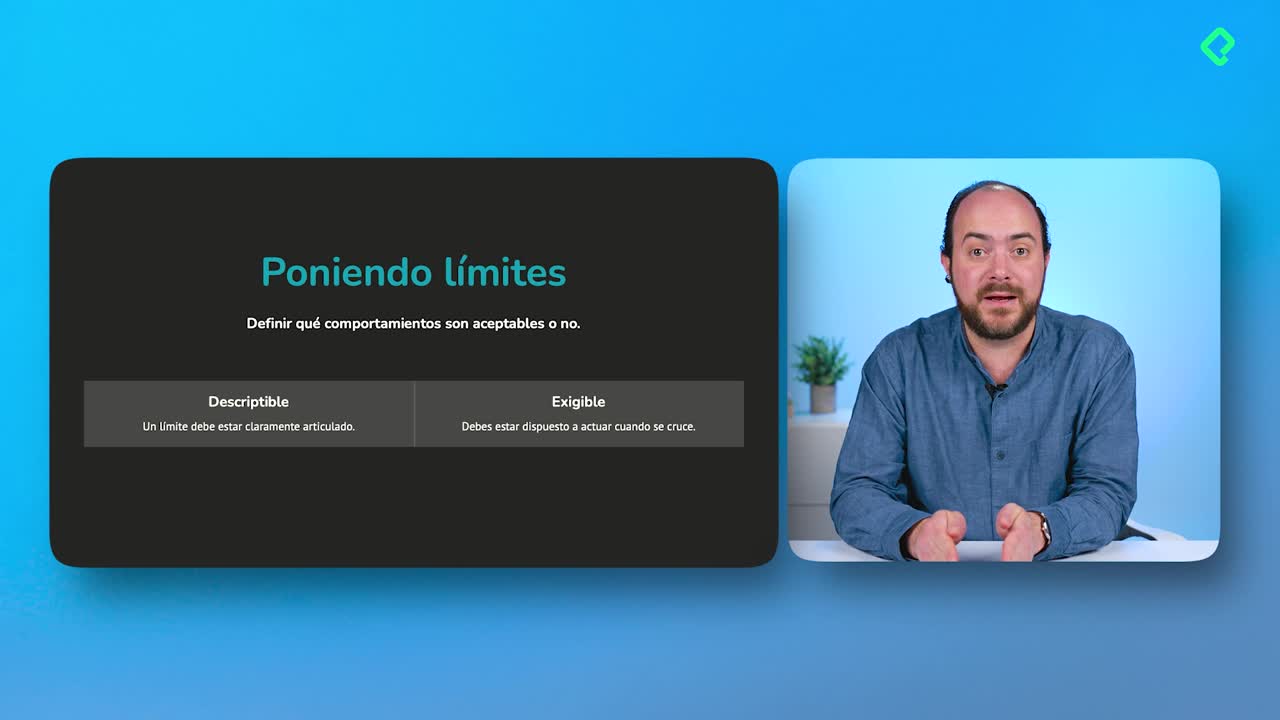
Limits define what is acceptable and what is not inside your organization. As a leader, you have to name them out loud and then enforce them with the same standard for everyone.
The trap is selective enforcement. If you let a behavior slide with one person and call it out with another, the rule stops being a rule and becomes a preference. Be explicit about what is correct, what is incorrect, and apply it equally across the team.
¿What does it mean to set limits as a leader? It means clearly telling your team what behaviors are acceptable and which are not, and then enforcing those rules consistently with every person, without exceptions.
¿How can you develop your team beyond promotions?
Professional development is often confused with promotions, but the real engine is continuous training. Your job as a leader is to spot the gaps and the strengths, then design ways to work on both [02:00].
That can take three shapes:
- Formal courses to close a specific skill gap.
- Real experiences that force people to apply what they learned.
- On-the-spot challenges where they have to solve a problem live.
A personal example from Medu illustrates this well [02:48]. The team realized, about four years after launching, that nobody knew how to say no. Every external request got a yes, which is a dangerous pattern that flows from the leader down to every level of the company. The fix was formal negotiation training plus real client situations where the team had to practice saying no and setting limits. Taking notes is not enough; you have to apply what you learn.
¿Why does understanding your team's dreams matter?
Your people can be fully committed to your massive transformative purpose and still have a different ultimate dream. At Medu, for example, some filmmakers dream of making a movie in Hollywood, and a doctor on the team dreams of working on hospital quality and patient safety [05:35].
Instead of ignoring those dreams, build experiences inside your organization that help people grow toward them. The doctor on the team works on medical education day to day, but gets involved in projects connected to hospital quality, which builds the resume she will eventually need. You are not losing talent by acknowledging their dreams; you are earning their full engagement while they are with you.
¿What are the benefits of developing your team?
The benefits split into two sides, and both compound over time.
For the person:
- A stronger resume and sharper skills.
- Real experiences that connect to their long term goals.
- A clearer path toward the career they actually want.
For the organization:
- Better products because experts get better at their craft.
- New capabilities entering the company, like a partner studying a master's in artificial intelligence that unlocks better AI tools for the team [07:50].
- Updated medical content from a team that stays current, which means health professionals serve patients better.
When your people grow, your purpose, vision, and mission move forward at the same time. The goal is to have people who are better than you in their areas of expertise. You cannot do everything, and you should not try.
¿What are the most common mistakes when developing your team?
Two errors show up again and again, and both are avoidable.
The first is leaving development to chance [08:46]. If you do not actively look for areas of opportunity in your direct team, nobody else will. A useful tool here is running a personal SWOT (also called FODA or DOFA) with each team member to surface weaknesses, threats, strengths, and opportunities you can train against.
The second is not measuring progress. When you launch a formal training project, attach metrics to it. Otherwise you will never know if the investment closed the gap you were trying to close.
¿How do you measure professional development inside a team? Define the specific skill or behavior you want to improve, set a metric tied to it, and track progress over time so training stops being a checkbox and becomes a measurable outcome.
¿How do you build psychological safety in your team?
Psychological safety is the foundation of a solid team. Without it, motivation and direction are not enough. Four practices help you build it day by day.
- Listen without punishment. Practice active listening, do not interrupt, and never retaliate against someone who tells you what needs to improve.
- Normalize mistakes and show vulnerability. When you mess up, say it openly: "I was wrong, I take responsibility, and this is how I will fix it." That permission flows down and stops people from hiding information.
- Admit when you do not know. You are not supposed to know everything. Saying "I do not know, let me find out" teaches the team that the leader is not a supreme being and also has to keep learning.
- Respect turns. Let people finish. Write down your comment and wait for a pause. Interrupting is a quiet form of disrespect.
For your 30 day planning journal, write down five concrete practices you will use to improve psychological safety inside your team. That is the base of every solid team, and it is built one conversation at a time.
¿Which of these practices is hardest for you right now? Drop it in the comments.