List Comprehensions That Replace Messy For Loops
Contenido del curso


Calidad y Profesionalismo del Código
Manejo de Datos y Recursos



Optimización y Pruebas

Creación de Aplicaciones de Consola
- 19

UV: Faster Python Dependency Management
07:17 min - 20

How Python Modules Keep Your Code Organized
07:14 min - 21
Organizing Python Code Into Packages
09:06 min - 22
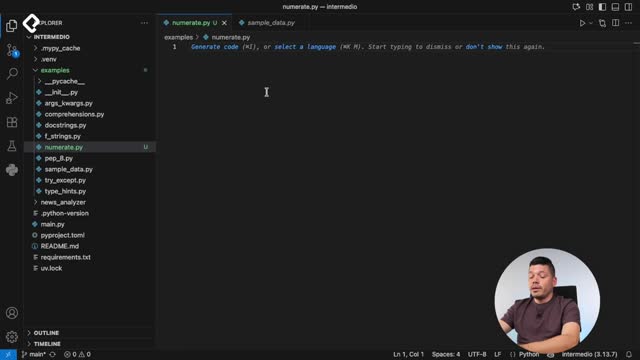
Función enumerate en Python para indexar listas automáticamente
09:31 min - 23
Filtrado de listas con filter en Python
11:44 min - 24
Función map para calcular tiempo de lectura en Python
08:59 min - 25
Conexión de OpenAI API con variables de entorno en Python
11:17 min
List Comprehensions That Replace Messy For Loops
Resumen
Comprehensions in Python let you replace multi-line for loops with a single, readable line. You will learn how to refactor traditional loops into list comprehensions, dict comprehensions, and set comprehensions, and when each approach makes your code cleaner or harder to read.
This matters for any developer who wants to write more pythonic code: shorter, faster to scan, and friendly to code reviewers.
What is a list comprehension in Python and why use it?
A list comprehension is a compact syntax to build a list from an iterable in one expression. Instead of declaring an empty list, looping with for, and appending values, you wrap everything inside square brackets.
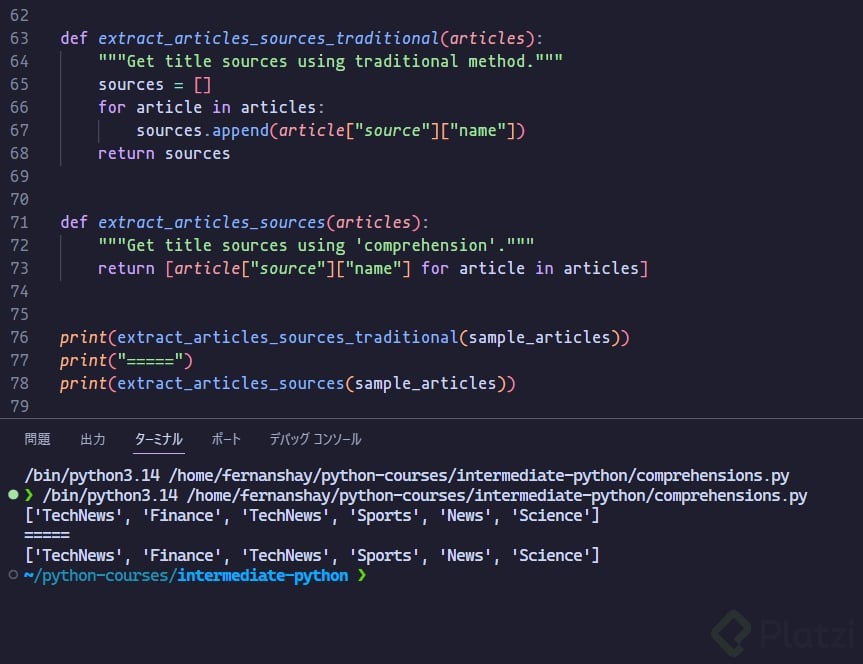
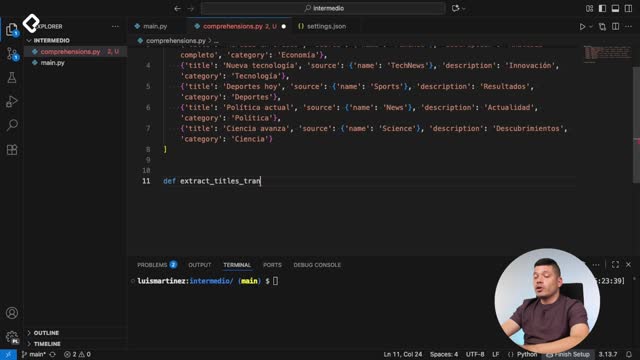
Imagine you have a list of articles, where each article is a dictionary with title and description. The traditional way to extract titles looks like this:
python def extract_titles_traditional(articles): """Extracts only the titles using a for loop.""" titles = [] for article in articles: titles.append(article["title"]) return titles
Now the pythonic refactor with a list comprehension:
python def extract_titles(articles): """Extracts only the titles using a comprehension.""" return [article["title"] for article in articles]
Both functions return the exact same output, but the second one removes the temporary variable and reads almost like a sentence in English.
What is a list comprehension? It is a one-line expression
[expression for item in iterable]that builds a new list without needing an extra variable or an explicitappend.
How do I add conditions inside a list comprehension?
Filtering is where comprehensions really shine. Suppose your business rule says: only extract titles with at least 10 characters. In a regular loop you add an if inside the body. In a comprehension, the condition goes at the end of the expression.
python
Traditional
for article in articles: if len(article["title"]) > 10: titles.append(article["title"])
Comprehension
[article["title"] for article in articles if len(article["title"]) > 10]
A quick warning from the lesson: when you access dictionary keys inside a comprehension, forgetting the colons or brackets is a common human error. The traditional version is more forgiving because the syntax is spread across multiple lines.
If you push the threshold to 200 characters and no title qualifies, both versions return an empty list. The behavior is identical; only the readability changes.
When should I use a dict comprehension instead of a list?
Use a dict comprehension when the output is a key-value mapping, not a flat sequence. The syntax swaps square brackets for curly braces and uses a key: value pair before the for.
Let's say you want a summary that maps each article title to its description:
python def extract_article_summaries(articles): return { article["title"]: article["description"] for article in articles if len(article["description"]) > 5 }
This returns an object where every title is a key and every description is its value. You can filter the same way as with lists, adding the if at the end. If you raise the filter to 20 characters and no description is long enough, the result is an empty dictionary.
When should I avoid a comprehension? When the logic gets so dense that a teammate has to pause to read it. If readability drops, go back to the traditional
forloop.
What are the real benefits of using comprehensions?
Beyond saving lines, comprehensions bring concrete advantages:
- You skip declaring an intermediate variable that lives in memory just to be returned.
- The intent of the code (build a list, build a dict) is visible at a glance.
- Tools like Ruff automatically format multi-line comprehensions so the iteration, the condition, and the value stay aligned and easy to scan.
The rule of thumb from the class: always prefer a comprehension when it is easier to read. If it is not, stick with the traditional approach.
How does a set comprehension work in Python?
A set comprehension uses curly braces like a dict, but without the key: value pair. It is perfect when you need unique values out of an iterable, because sets automatically remove duplicates.
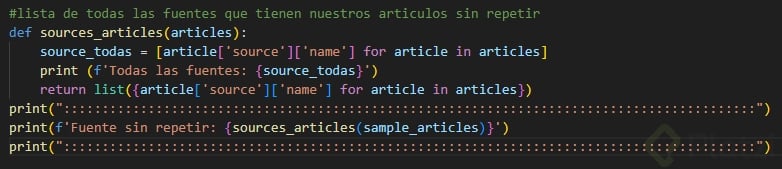
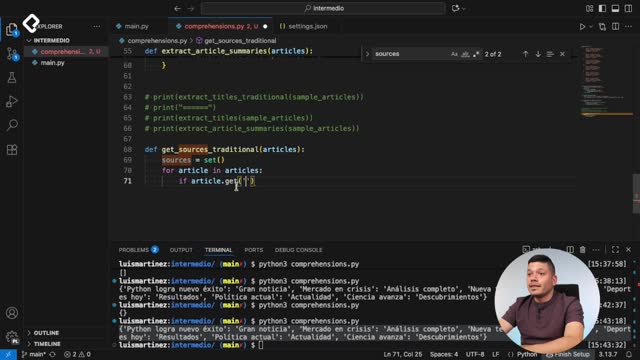
This is exactly the challenge to practice what you learned: build a collection of all the unique sources from your articles list.
- Step 1: solve it with a traditional
forloop. Create an emptyset(), iterate over the articles, and add eachsourcewith.add(). - Step 2: refactor it into a single line using a set comprehension:
{article["source"] for article in articles}. - Step 3: compare both versions and notice how the comprehension removes the boilerplate.
Share your solution in the comments so other students can review your approach and discuss alternatives. What part of the refactor felt most natural to you?