Set and Dict Comprehensions in Python
Contenido del curso


Calidad y Profesionalismo del Código
Manejo de Datos y Recursos



Optimización y Pruebas

Creación de Aplicaciones de Consola
- 19

UV: Faster Python Dependency Management
07:17 min - 20

How Python Modules Keep Your Code Organized
07:14 min - 21
Organizing Python Code Into Packages
09:06 min - 22
Función enumerate en Python para indexar listas automáticamente
09:31 min - 23
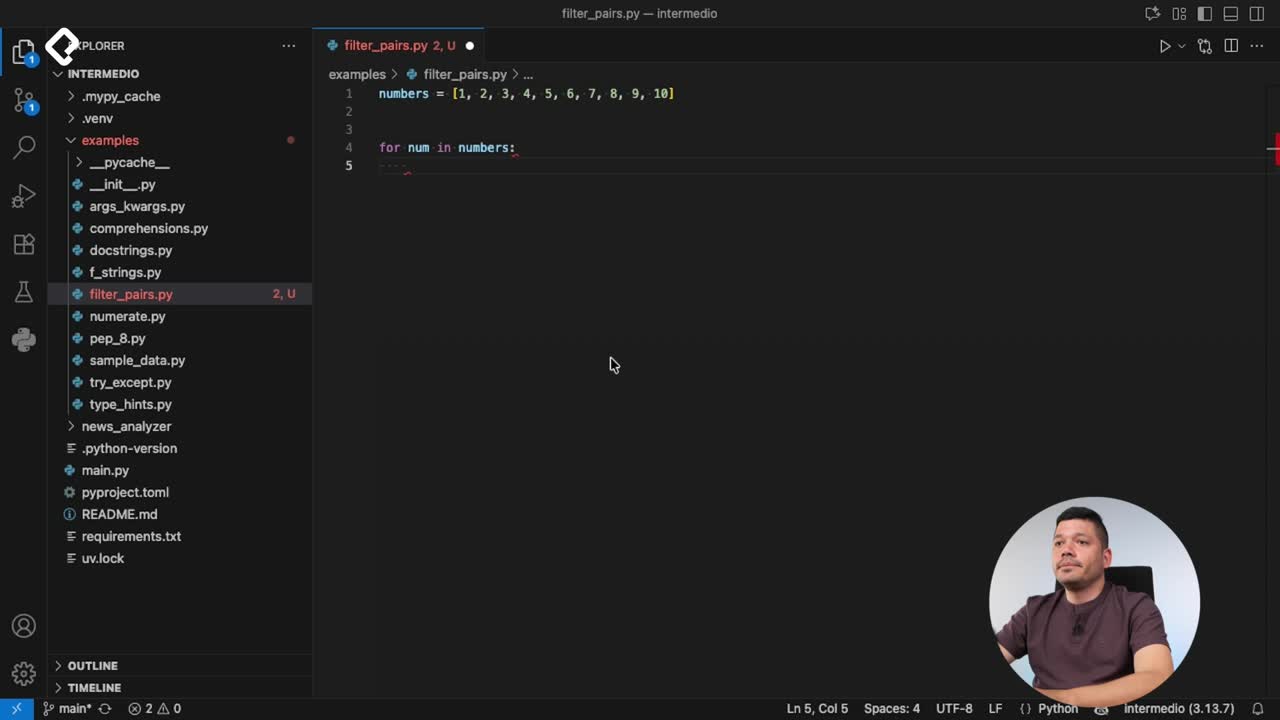
Filtrado de listas con filter en Python
11:44 min - 24
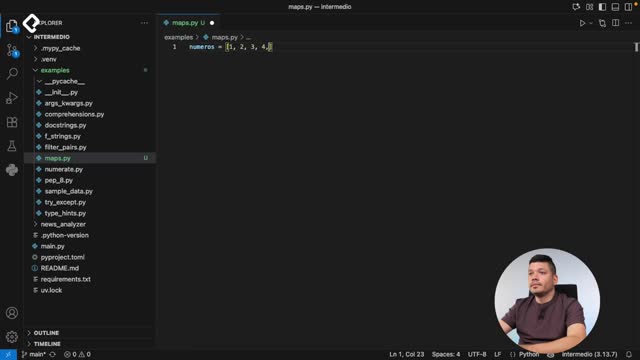
Función map para calcular tiempo de lectura en Python
08:59 min - 25
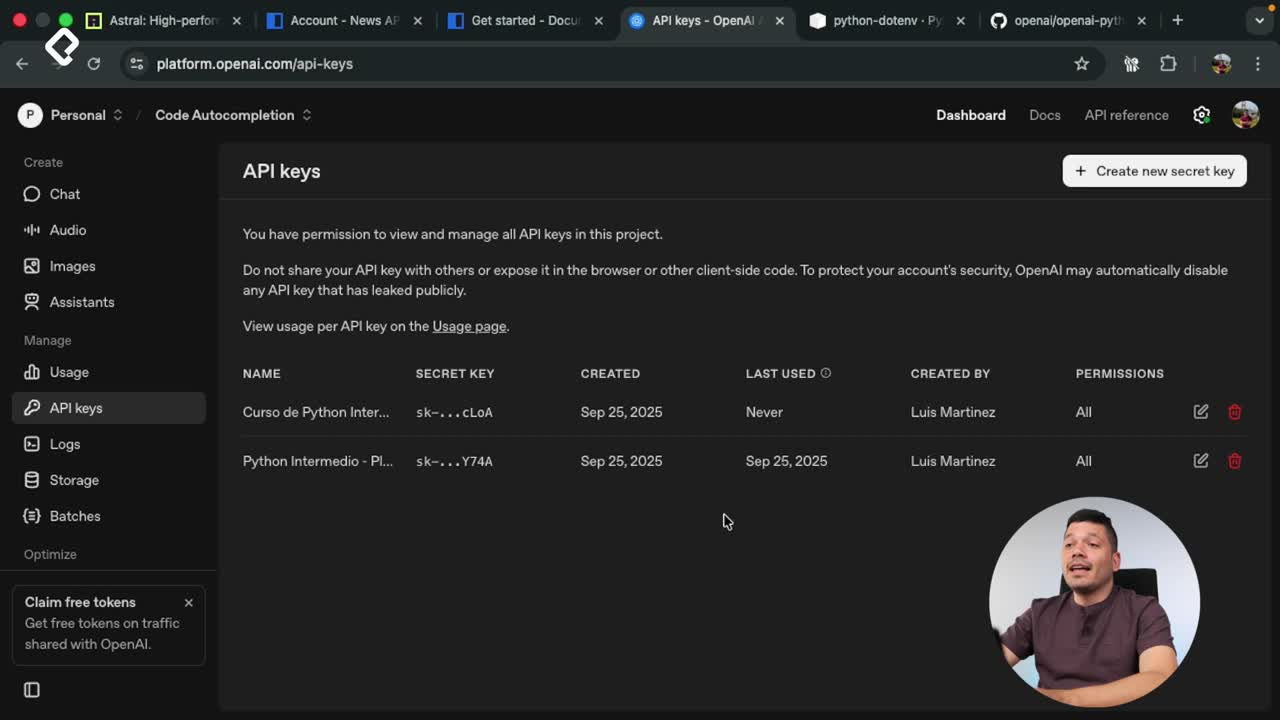
Conexión de OpenAI API con variables de entorno en Python
11:17 min
Set and Dict Comprehensions in Python
Resumen
Refactoring nested for loops into set comprehensions and dictionary comprehensions is one of the fastest ways to write cleaner Python. You'll learn how to deduplicate news sources with a set, categorize articles with a nested dict comprehension, and decide when each approach actually improves readability.
What is a set comprehension in Python and when should you use it?
A set comprehension builds a set in a single line using the syntax {expression for item in iterable if condition}. The set data type guarantees there are no duplicates, so it's ideal when you want unique values from a collection.
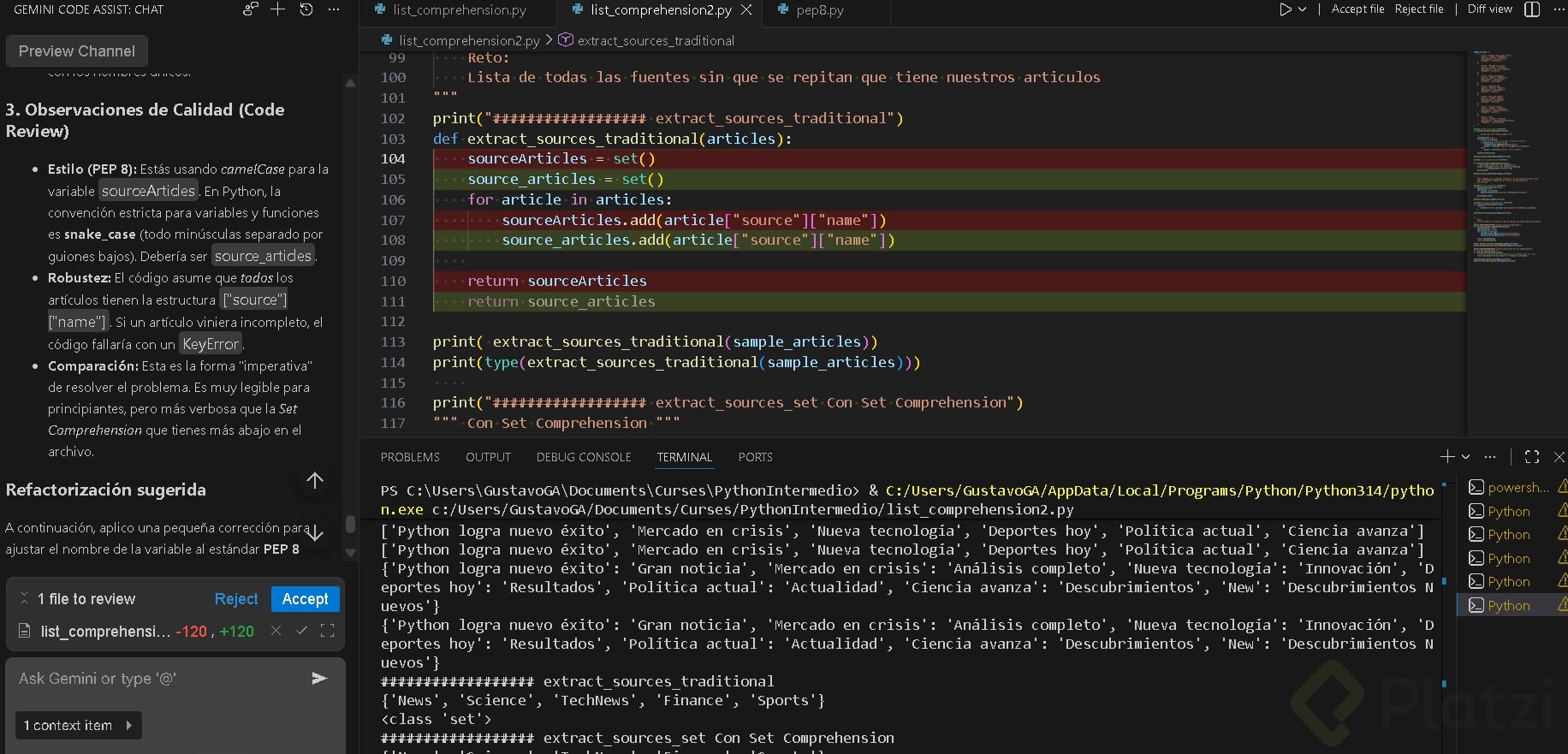
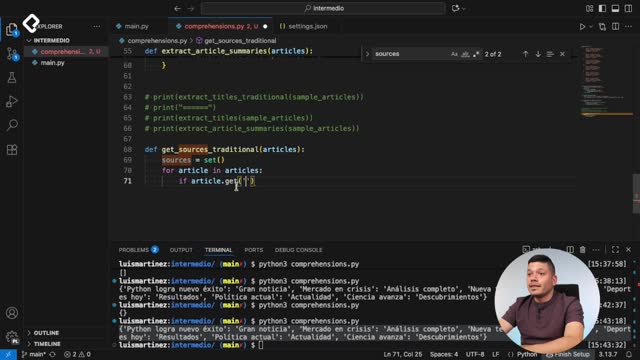
Imagine a list of articles where each article has a title and a source dictionary with a name. The goal is to extract every unique source name. The traditional approach iterates manually [00:18]:
python def get_sources_traditional(articles): sources = set() for article in articles: if article.get("source") and article["source"].get("name"): sources.add(article["source"]["name"]) return sources
This works, but it takes five lines for what is essentially one idea: give me the unique source names. Refactoring it as a comprehension makes the intent obvious [02:00]:
python def get_sources(articles): return {article["source"]["name"] for article in articles if article.get("source")}
Both versions return the same result. If your sample data has tech news repeated several times, the set keeps only one copy.
What is a set comprehension? It's a one-line expression that builds a set using
{expr for item in iterable if condition}. It deduplicates automatically and replaces aforloop plus aset.add()call.
How do you write a nested dictionary comprehension to categorize data?
Real business logic often needs nested iterations: looping over one collection while filtering another. A common case is grouping articles by their source into a dictionary where the key is the source name and the value is the list of matching articles.
The traditional version uses two nested for loops, an existence check with not in, and an append call [03:30]:
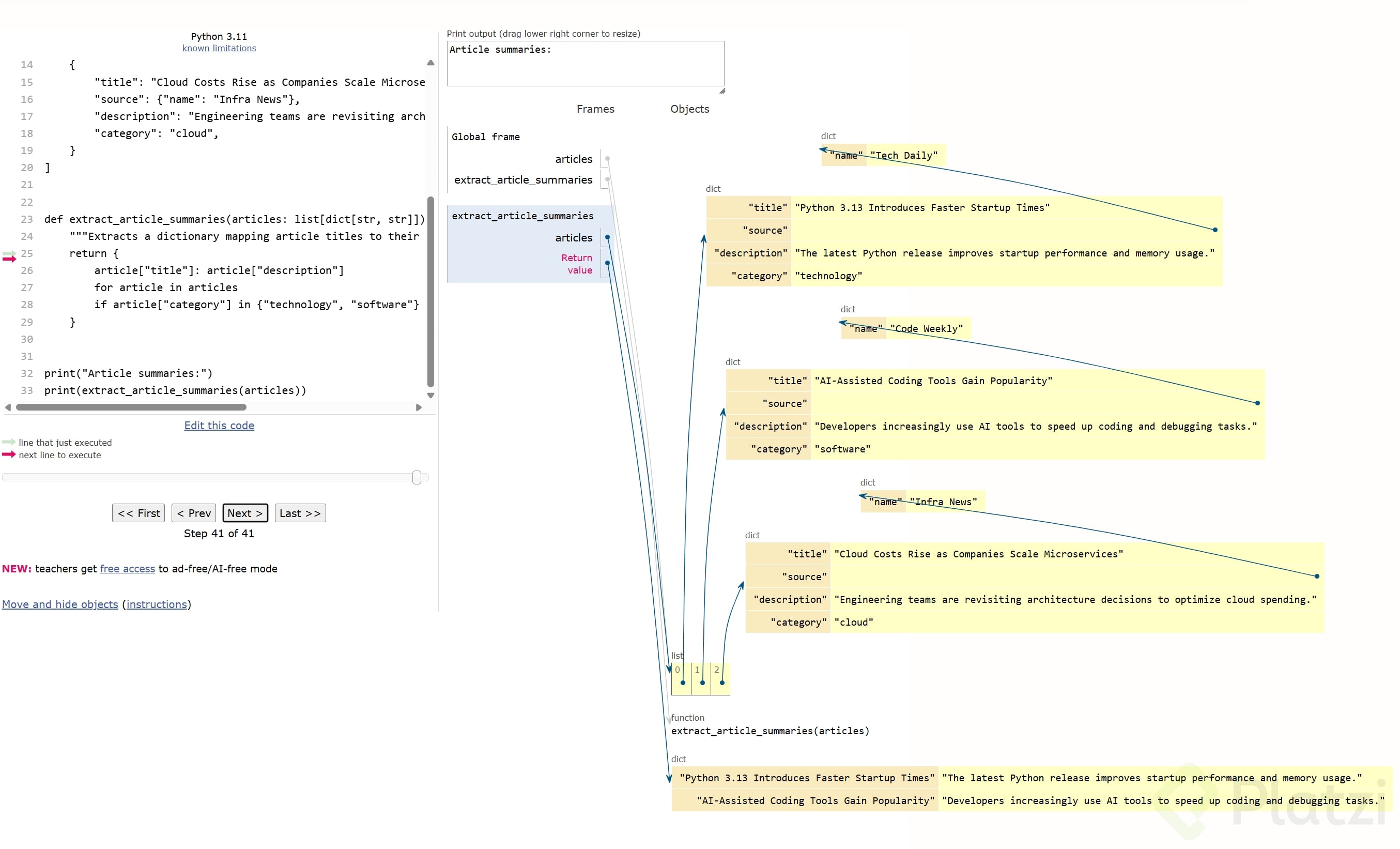
python def categorize_traditional(articles): sources = get_sources(articles) results = {} for source in sources: if source not in results: results[source] = [] for article in articles: if source == article["source"]["name"]: results[source].append(article) return results
Notice the manual work: initializing results[source] = [] only when the key doesn't exist, and appending one article at a time. A nested dict comprehension handles all of that in a single expression [05:40]:
python def categorize(articles): sources = get_sources(articles) return { source: [article for article in articles if article["source"]["name"] == source] for source in sources }
Reading it out loud helps: for every source, use it as a key, and the value is the list of articles whose source name matches. The empty list initialization disappears because the inner list comprehension always produces a list, even if it's empty.
When should you use a dict comprehension instead of a for loop? Use it when you're building a dictionary whose keys and values come from iterating a collection, especially if each key maps to a filtered or transformed subset.
Why does the nested comprehension produce identical results?
When you print both categorize_traditional(sample_articles) and categorize(sample_articles) side by side, the output is exactly the same. The comprehension simply expresses the same logic more densely, and Python evaluates the inner list once per outer iteration.
When should you refactor a for loop into a comprehension?
Not every loop deserves to become a comprehension. Use them when they improve readability and the logic fits cleanly into one expression. Avoid them when the loop has multiple side effects, complex branching, or steps that need intermediate variables.
A few practical checks before refactoring:
- Confirm the loop produces a single output collection: a list, set, or dict.
- Make sure the filtering condition fits in one
ifclause. - Measure performance if the loop runs over large datasets, since comprehensions are usually faster than equivalent
forloops withappendoradd. - After refactoring, verify the function still imports and exports the same data the rest of your application expects.
Are comprehensions faster than for loops in Python? Generally yes, because they're optimized at the bytecode level and avoid repeated attribute lookups for methods like
append. The gain is most noticeable on large iterables.
The rule of thumb: if a teammate can read the comprehension out loud and immediately understand what it returns, keep it. If they have to mentally unwrap three levels of brackets, write the explicit loop instead.
Try refactoring one of your own functions today and tell me in the comments which version you found easier to maintain.