The Daily Scrum often gets misunderstood as a status meeting, when in reality it exists to help developers self-manage their progress toward the sprint goal. If you lead or belong to an Agile team, knowing how to run a Daily Scrum properly will save you time, friction and a lot of unnecessary reporting.
What is the Daily Scrum and what is its real purpose?
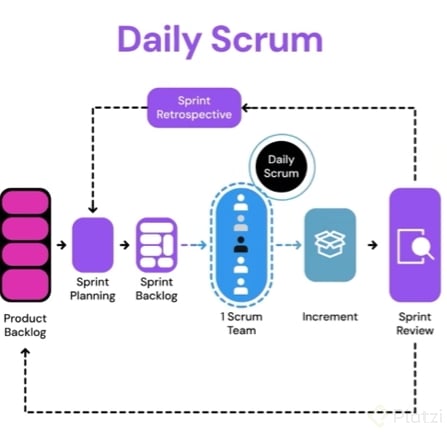
The Daily Scrum is a 15 minute event for developers designed to inspect progress toward the sprint goal and adapt the sprint backlog when needed. It is not a checkpoint for the Scrum Master or the Product Owner, and it is definitely not a status report.
Think of it as the moment when the team syncs, looks at the board together and decides how to keep moving. The focus stays on three things: the state of the tasks, the path toward the sprint goal and any impediment that could block delivery.
What is the Daily Scrum in Scrum? It is a 15 minute daily meeting where developers inspect their progress toward the sprint goal and adjust the sprint backlog. Only developers run it.
Why did the 2020 Scrum Guide remove the three classic questions?
For years, teams answered the same script: what I did yesterday, what I will do today and what is blocking me. The 2020 Scrum Guide removed those prescriptive questions to push teams toward real conversation instead of mechanical reporting.
The shift matters because the meeting stops being a roll call and becomes a working session. The team talks about the sprint goal, not about individual to-do lists.
What are the most common mistakes in a Daily Scrum?
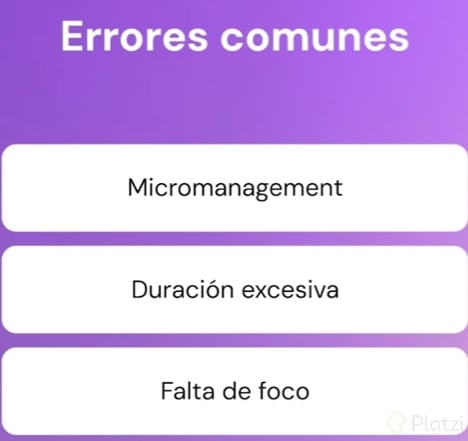
When the event loses its purpose, the symptoms are easy to spot. These are the patterns that signal something is off:
- Micromanagement: the meeting turns into a status report for the Product Owner or Scrum Master.
- Excessive duration: it stretches beyond 15 minutes, killing focus and cadence.
- Lack of focus: the team dives into technical details or topics unrelated to the sprint goal.
Technical deep dives are valuable, but they belong to other spaces such as refinement sessions or technical syncs. Mixing them into the Daily Scrum dilutes the event and frustrates the team.
Is the Daily Scrum a status meeting? No. It is a sync between developers to inspect progress and adapt the plan. Reporting to managers is not part of its purpose.
How does micromanagement sneak into the Daily Scrum?
It usually starts when someone outside the development team uses the meeting to ask for individual updates. Even with good intentions, that habit shifts the energy from collaboration to surveillance, and developers begin to perform instead of communicate.
How does a successful Daily Scrum look in practice?
Picture a team building a language learning app, gathered around a board with their task list. One developer says, for the goal of implementing the audio feature, yesterday I finished recording the 10 vocabulary words. Today I will focus on integrating those audios into the app.
A second developer adds, I am working on the user interface. Yesterday I had a problem aligning a button and could not finish it. It is not a serious impediment, but I would need about 30 extra minutes from someone with design knowledge. A third one replies, I can help you with that after my first task, so we both finish our parts on time.
That short exchange shows the heart of the event: the team is not reporting, it is synchronizing and collaborating to remove an impediment in real time. Notice how the conversation orbits the sprint goal, surfaces a concrete blocker and ends with a clear commitment between peers.
What signals a healthy Daily Scrum?
A few clear signs tell you the meeting is working:
- The conversation revolves around the sprint goal, not personal tasks.
- Impediments are named and someone steps in to help.
- The team finishes within 15 minutes with a clearer plan than when they started.
When these three signals are present, the Daily Scrum stops feeling like an obligation and starts acting as the engine of team self-management. It strengthens communication, builds trust and keeps the sprint backlog alive instead of frozen.
Now think about your own context. In which initiative, environment or team would running the Daily Scrum this way bring real value? Share your answer in the comments.