Planning Poker is a relative estimation technique used in Scrum to size product backlog items by comparing them against each other instead of measuring fixed hours or days. You'll learn how it works, why it reduces uncertainty, and how Agile teams use it to align on complexity before building a feature.
Why does relative estimation work better than hours?
When your team faces a product backlog, you need a shared view of the effort each item demands. Fixed time units fail because they ignore three variables that really matter: complexity, uncertainty, and size.
Relative estimation flips the script. Instead of asking how many hours will this take, you ask how big is this compared to something we already know. That comparison anchors the conversation in reality.
Think of estimating animals by their dimension. If you pick a fox as your pivot and assign it a weight of 3, a gorilla feels bigger, maybe an 8. An elephant? Way larger, perhaps a 20. You're not measuring kilos, you're comparing.
What is a pivot in relative estimation? It's the reference item the whole team agrees to assign a specific weight. Every other backlog item gets sized by comparing it to that pivot.
How does Planning Poker actually work?
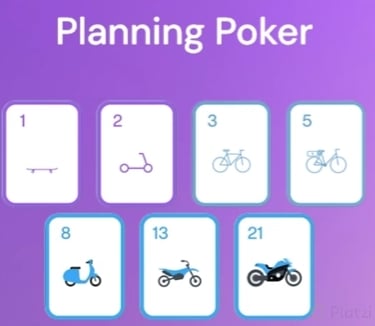
Planning Poker turns estimation into a game using the Fibonacci sequence, where each number (1, 2, 3, 5, 8, 13, 20...) represents a size or complexity level. The non linear jumps between numbers reflect a truth every developer knows: the bigger the task, the harder it is to estimate precisely.
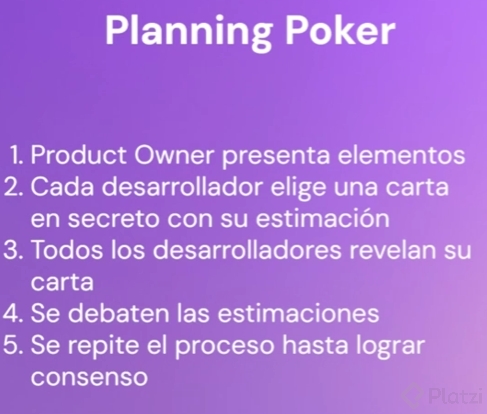
The flow runs like this:
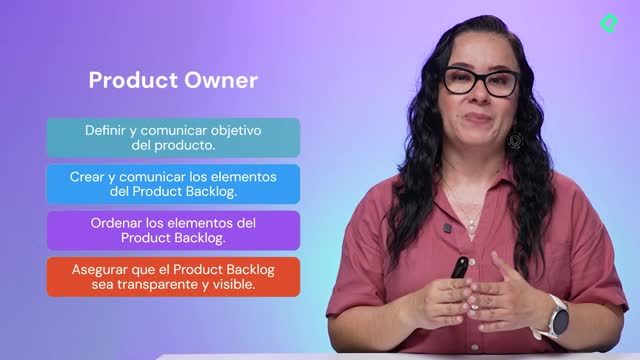
- The product owner presents a backlog item and the developers ask questions to understand scope.
- Each developer picks a Fibonacci card with their estimate and places it face down.
- Everyone reveals their card at the same time.
- The team debates the high and low values to surface hidden complexity.
- The round repeats until the team reaches consensus.
The magic isn't in the cards. It's in the conversation that happens when a 3 sits next to a 13 on the table.
A real example with a language learning app
Imagine your team is building a language learning app and the product owner brings this user story: as a user, I want to record my pronunciation and compare it with a native speaker to improve my accent.
Developers ask questions, then reveal their cards:
- Developer one shows an 8: integrating recording and comparing audio is complex.
- Developer two shows a 3: there's an existing API for audio comparison, not that hard.
- Developer three shows a 13: handling microphone permissions across platforms is delicate.
The debate exposes what each one missed. The developer who voted 3 hadn't considered cross platform permissions. The one who voted 13 explained the integration risks. They vote again and converge near 8. That convergence is the point.
When should you use Planning Poker?
Use it whenever your team needs to align on the effort of work that carries uncertainty. It shines in software development, but the logic travels well to any context where multiple people must agree on how big a task feels before committing to it.
Why use the Fibonacci sequence for estimation? Because the gaps between numbers grow as the size grows, forcing the team to acknowledge that large items are inherently harder to estimate with precision.
Beyond sizing backlog items, Planning Poker builds something less visible but equally valuable: a shared understanding of complexity across the team. Every developer hears the same concerns, the same trade offs, the same blind spots. That homogeneous knowledge is what reduces risk later.
In what other situations or contexts could you apply this technique? Drop your answer in the comments.