Before spending hours solving a linear system, you can diagnose whether it has a solution and whether that solution is unique. Knowing how to diagnose linear system solutions saves time and reveals the geometry behind the equations: lines that cross at one point, lines that never meet, or lines that overlap completely.
The whole diagnosis lives inside the augmented matrix A|b. Your job is to bring it to row echelon form using Gaussian elimination and then compare two numbers against the number of variables. That comparison tells you everything.
What numbers do you need to diagnose a linear system?
You need three values working together. Each one comes from the augmented matrix after Gaussian elimination.
- Rank of A: the number of non zero pivots inside the coefficient matrix.
- Rank of the augmented matrix A|b: the number of non zero pivots in the full matrix, including the results column.
- Number of variables in the system.
What is the rank of a matrix? It is the number of non zero pivots that appear once you reduce the matrix to row echelon form. It tells you how many truly independent equations the system carries.
With those three numbers in hand, every linear system falls into one of three buckets.
When does a linear system have a unique solution?
A system has one and only one solution when rank of A equals rank of A|b equals the number of variables. Geometrically, the lines cross at exactly one point.
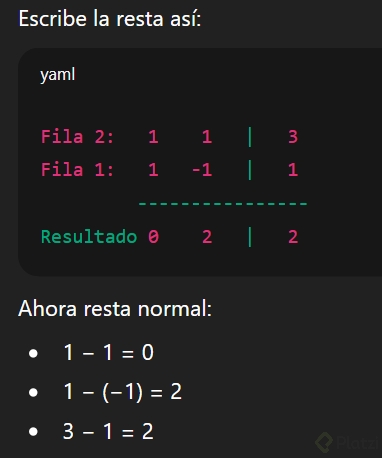
Take the system x minus y equals 1 and x plus y equals 3. Its augmented matrix is the coefficients 1, 1, -1, 1 next to the result vector 1, 3. After subtracting row two from row one you get a clean echelon form with two pivots in A and two pivots in the augmented matrix. Two variables, two pivots everywhere, so the system has a unique solution.
This is the friendliest case. The diagnosis is symmetric: every number lines up.
How do you spot an inconsistent system without solution?
A system is inconsistent when the rank of A is smaller than the rank of A|b. There is no point where the lines meet because they are parallel.
Look at x plus y equals 2 paired with x plus y equals 4. The augmented matrix has coefficients 1, 1, 1, 1 next to 2, 4. After Gaussian elimination, the coefficient part shows one pivot, but the augmented matrix shows two pivots because the last row reads 0 0 | 2.
Why does a row like 0 0 equals 2 mean no solution? Because it is a contradiction. Zero can never equal two, so no values of x and y satisfy the system. The lines are parallel and never touch.
That mismatch in ranks is your red flag. The moment rank of A is below rank of A|b, stop solving: there is nothing to find.
When does a system have infinite solutions?
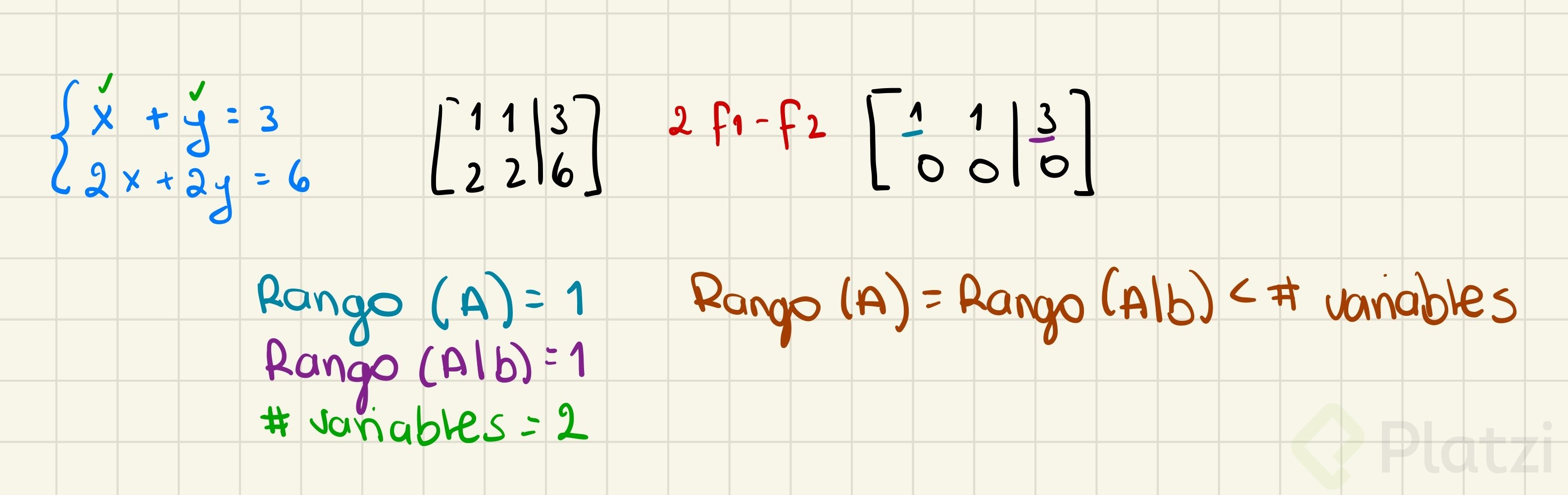
A system has infinite solutions when rank of A equals rank of A|b, but both are smaller than the number of variables. Geometrically, the lines lie on top of each other.
Consider x plus y equals 2 and 2x plus 2y equals 4. The augmented matrix is 1, 2, 1, 2 next to 2, 4. After elimination, the second row becomes all zeros, which translates to 0x plus 0y equals 0. That is always true, which means the second equation was redundant: it is just the first one multiplied by two.
You are left with one real equation and two unknowns, so one variable becomes free. Pick x equals 2 and y must be 0. Pick any other value for x and y adjusts accordingly. Every point on the shared line is a valid solution.
How can you recognize a free variable in a system?
A free variable shows up when you have fewer pivots than unknowns. After elimination, any column without a pivot belongs to a variable you can set to anything you want. The remaining variables adjust to keep the equation true.
In the example above, the row of zeros confirms redundancy. One equation, two variables, one free variable, infinite combinations.
How do the three cases look graphically?
The geometry mirrors the algebra exactly.
- Unique solution: two lines that cross at a single point. Rank of A equals rank of A|b equals number of variables.
- No solution: two parallel lines that never meet. Rank of A is less than rank of A|b.
- Infinite solutions: two lines superimposed on each other. Rank of A equals rank of A|b, but less than the number of variables.
This visual map is the fastest way to internalize the diagnosis. Once you see the ranks, you already know what the graph looks like before plotting a single point.
And here comes the interesting part: in the real world, inconsistent systems are everywhere. Measurement noise, conflicting data, models that almost fit but not quite. So what do you do when there is no exact solution? You will learn that in the next class. Drop in the comments which of the three cases tripped you up the most.