Knowing whether a vector adds something new to a set or just repeats information is the heart of linear independence. You will learn how to mathematically detect when a vector is redundant, why the standard basis vectors are the gold standard in R2, and how to test small vector sets without overcomplicating the math.
What does it mean for a set of vectors to be linearly independent?
A set of vectors is linearly independent when none of them can be written as a combination of the others. Think of it as the ideal construction kit: every piece matters, and removing any one of them shrinks the space they generate.
If you can rebuild one vector using scalars and sums of the others, that vector is dead weight. If you cannot, each vector is pulling in a direction nobody else can reach.
What is linear independence? It is the property of a vector set where no vector can be expressed as a linear combination of the others. Each vector contributes a unique direction to the span.
Why are i hat and j hat the perfect example?
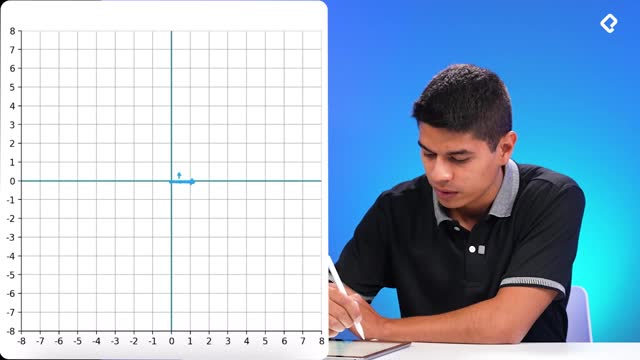
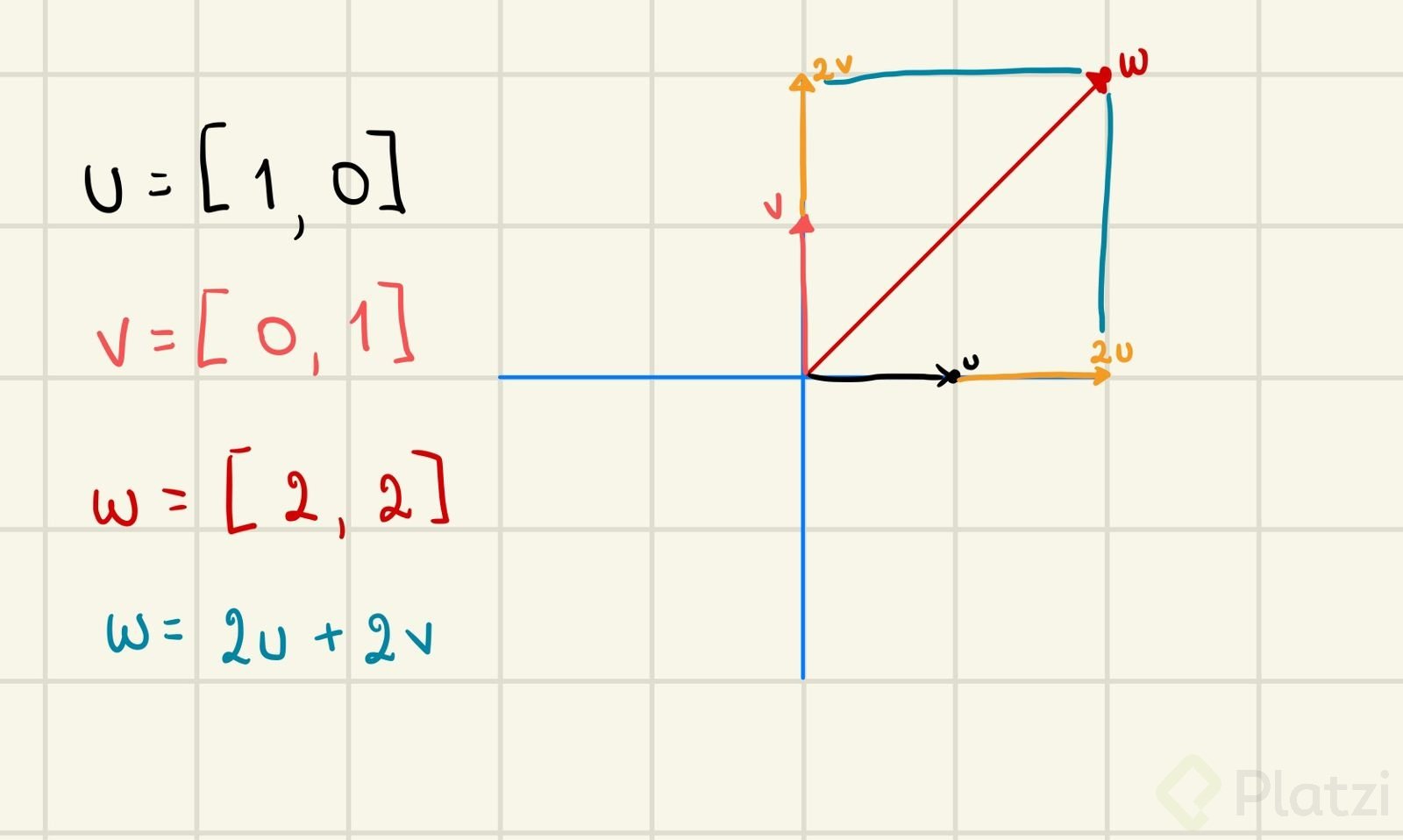
The standard basis in R2 (around [01:00]) shows this idea in its cleanest form. The vector i hat has coordinates 1 in X and 0 in Y. The vector j hat has coordinates 0 in X and 1 in Y.
No matter what scalar you multiply i hat by, you will never move up or down on the Y axis. The same goes for j hat: no scalar will push it left or right on the X axis. They control completely different dimensions, and that is exactly why they qualify as the most efficient building blocks for a two dimensional plane. Zero redundancy.
When is a set of vectors linearly dependent?
A set is linearly dependent when at least one vector can be built from the others. That vector adds nothing new to the span; it already lives inside the space the others generate.
A clean example appears around [01:55]. Take U = (1, 2) and V = (3, 1), then define W = 2U + V. Running the math:
- 2U gives (2, 4).
- Adding V gives (2+3, 4+1) = (5, 5).
- So W = (5, 5).
If you graph U, V and the doubled U, then place V at the tip of 2U, you close a parallelogram whose diagonal lands exactly on W. That is the visual proof that W lives in the plane generated by U and V, which makes the set linearly dependent.
How do I test two vectors for linear independence?
With only two vectors, the question collapses into a single check: can you find a scalar c such that one vector equals c times the other?
Take U = (2, 1) and V = (-1, 1) (around [04:30]). If you try c = 2, then 2V = (-2, 2), which is clearly not U. No scalar will fix both coordinates at once, so the set is linearly independent. Two vectors are dependent only if one is a scaled copy of the other.
How do you check if two vectors are linearly dependent? Try to find a scalar that turns one vector into the other. If no scalar works for both coordinates simultaneously, the vectors are independent.
How do I check linear independence with three vectors in R2?
With three vectors, intuition can fool you. Look at U = (2, 1), V = (-1, 1) and W = (1, 2) (around [05:30]). At first glance they look different enough to be independent.
But try a quick sum:
- U + V = (2 + (-1), 1 + 1) = (1, 2).
- That result is exactly W.
Since W = U + V, the third vector is redundant. The set is linearly dependent, even though no single pair looks like a scaled copy of another. This is why testing combinations matters more than visual guessing.
What is the role of the span in this analysis?
The span is the full set of points you can reach by combining your vectors with scalars. When a new vector falls inside that existing span, it adds zero new territory. That is the formal reason it counts as redundant: the dimension of the space does not grow when you include it.
In R2, two independent vectors already span the entire plane, so any third vector you add will automatically be a combination of them. That is a useful shortcut to remember.
Can three vectors in R2 ever be linearly independent? No. Two independent vectors already cover the entire plane, so any third vector in R2 must be a linear combination of them.
Practice exercise to test your understanding
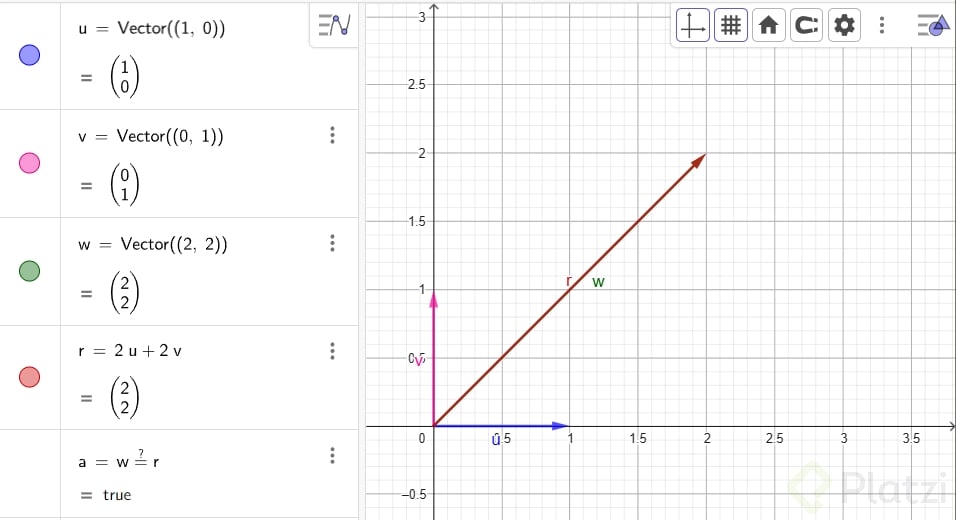
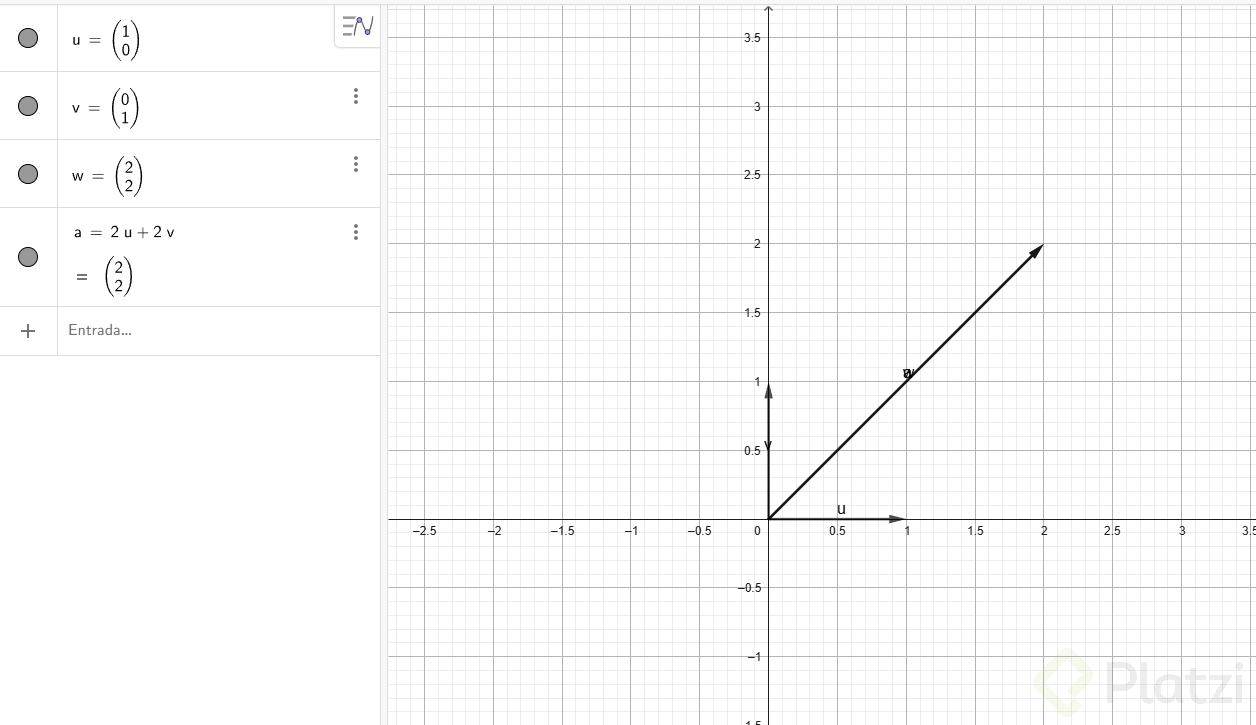
Try this set: U = (1, 0), V = (0, 1) and W = (2, 2). Is the set linearly independent?
Think about what U and V already span, and ask yourself whether W can be built from them. Drop your answer in the comments and explain your reasoning.
Once you can spot independence, the next question is how to measure the relationship between vectors: how aligned they are, or what angle separates them. That is where the dot product enters the picture, opening the door to orthogonality and projections in the next class.