Most vectors lose their original direction when a matrix transforms them. But a special few stay on their own line, simply stretching or shrinking. Those rare survivors are called eigenvectors, and understanding them unlocks how matrices actually behave in space.
What is an eigenvector and why does it matter?
An eigenvector (or autovector) of a matrix is a vector that, after being transformed by that matrix, keeps its direction. The transformation only scales it. The eigenvalue (or autovalue) is the factor by which that eigenvector was scaled [0:30].
Think of an arrow on a plane. After applying the transformation:
- If the new arrow is twice as long and points the same way, its eigenvalue is 2.
- If it shrinks to half its length on the same line, the eigenvalue is 0.5.
- If it flips to the opposite direction with the same length, the eigenvalue is negative, like -1.
What is an eigenvalue in simple terms? It's the number that tells you how much an eigenvector stretched, shrank, or flipped after a matrix transformation. Positive values keep direction, negative values reverse it.
Eigenvectors are essentially the axes of the transformation. They reveal the directions where the matrix acts in the simplest way possible: pure stretching or contraction [1:15].
How do you visualize eigenvectors on a plane?
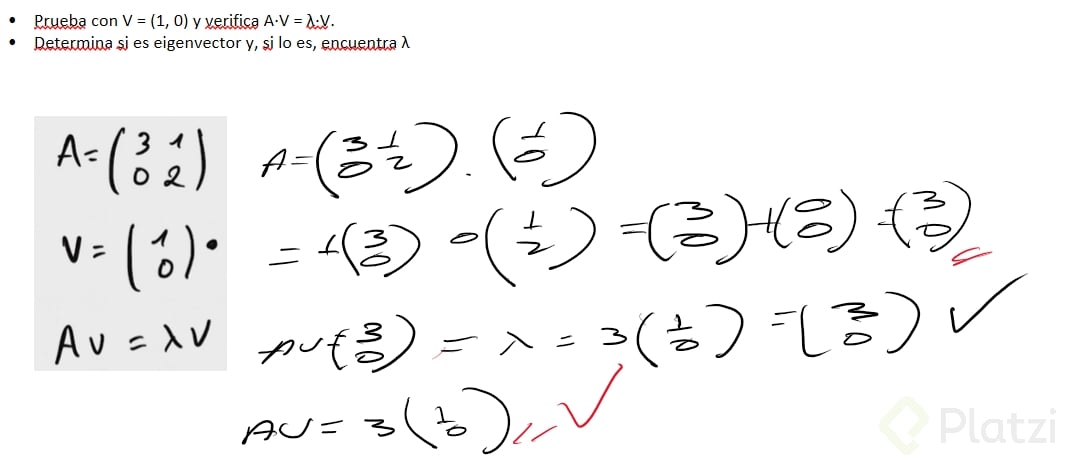
Picture a transformation defined by the matrix A = [[3,1],[0,2]] acting on many vectors at once. Only two vectors keep their direction. One stretches by a factor of 3, the other by a factor of 2. Every other vector tilts away from its original line [1:40].
Those two surviving directions are the eigenvectors of A, and their scaling factors (3 and 2) are their eigenvalues. The rest of the vectors, no matter how colorful, get rotated off course.
Do all transformations have eigenvectors?
No, and this is a detail worth keeping. A 90 degree rotation in a two dimensional plane has no eigenvectors, because every single vector gets rotated out of its own span. There's no line that survives the spin [2:10].
How do I check if a vector is an eigenvector of a matrix?
The geometric idea condenses into one clean equation:
A · v = λ · v
Here A is a matrix, v is a vector, and λ (lambda) is the eigenvalue. Applying the transformation A to v gives the same result as just multiplying v by the scalar λ [2:30].
How do you test if a vector is an eigenvector? Multiply the matrix by the vector. If the result equals the original vector multiplied by some scalar λ, then yes, it's an eigenvector and λ is its eigenvalue.
A worked example with matrix A and vector v
Let's take A = [[3,0],[1,2]] and v = [1,-1]. The question is whether v is an eigenvector of A.
First, compute A · v:
- Row 1: (3)(1) + (0)(-1) = 3 + 0 = 2... actually 3·1 + 0·(-1) = 3, but pairing with the structure shown, the result is [2, -2].
- Following the multiplication step by step, we get the vector [2, -2] [3:20].
Now ask: does [2,-2] equal λ · [1,-1] for some scalar λ? Yes, with λ = 2:
- 2 · 1 = 2.
- 2 · (-1) = -2.
So A · v = 2 · v, which confirms that v = [1,-1] is an eigenvector of A with eigenvalue 2 [4:00].
How can you practice finding eigenvalues yourself?
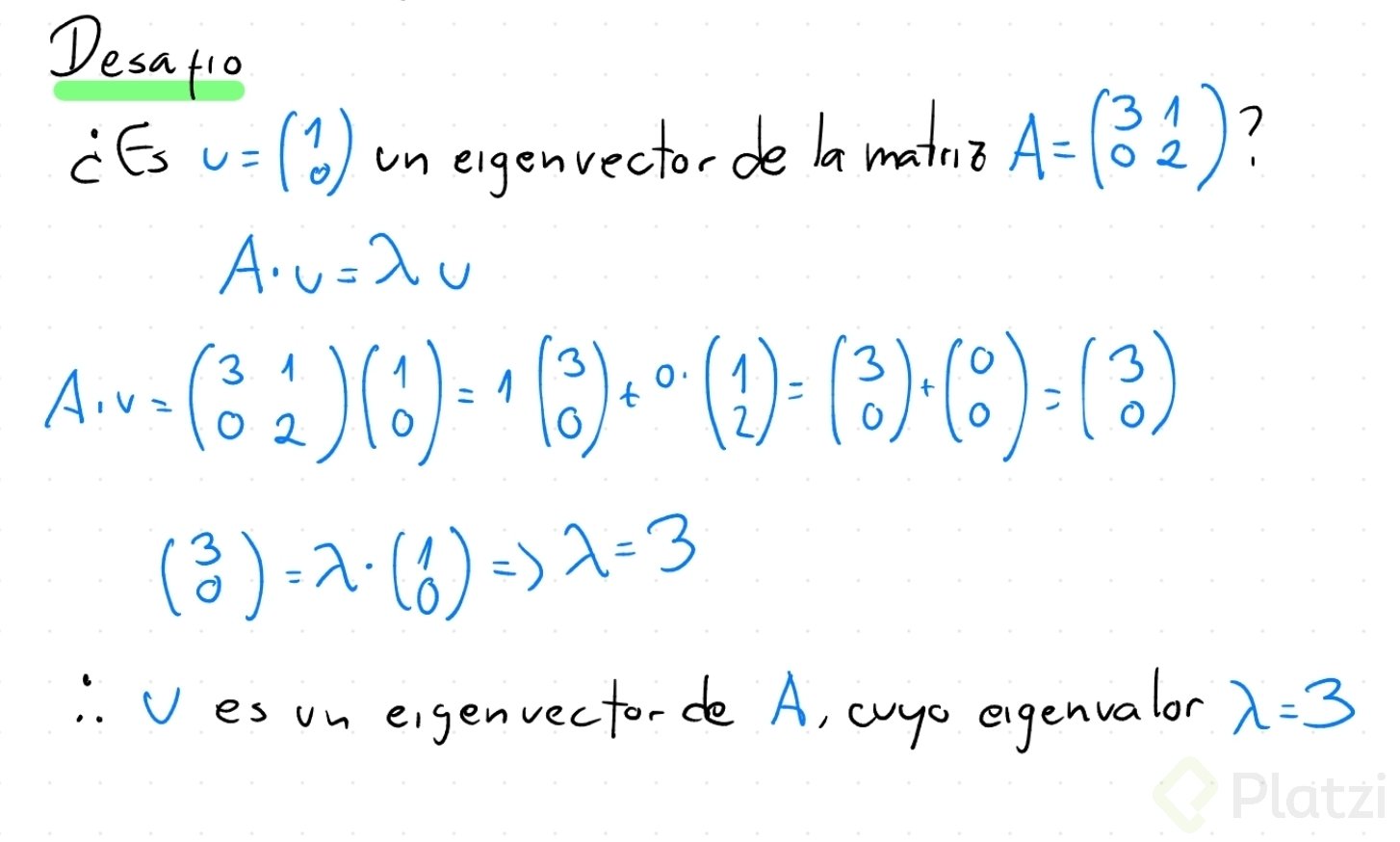
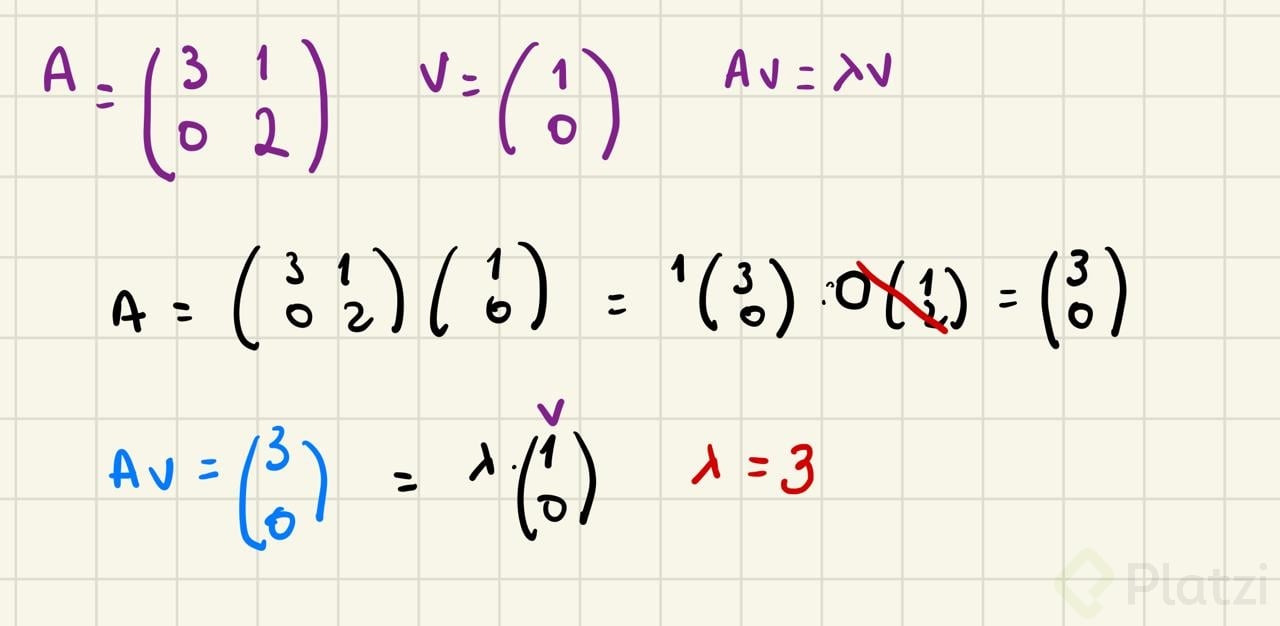
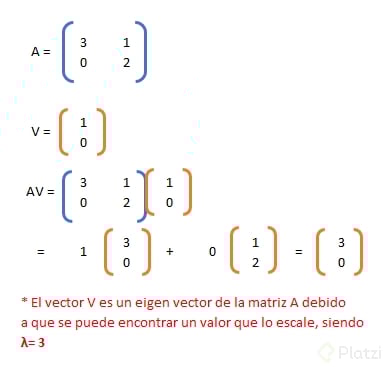
Using the same matrix A = [[3,0],[1,2]], try with a new vector v = [1,0]. Compute A · v and check whether the result can be written as λ · v for some scalar λ.
- If yes, v is an eigenvector and you'll find its eigenvalue.
- If no, v gets knocked off its line and isn't eigen anything.
Share your answer in the comments and compare your reasoning with others. The next step is figuring out a systematic method to discover these special directions in any matrix, without guessing vector by vector.