Linear algebra gives you a compact way to express any linear system: the equation AX = B. This notation packs an entire set of equations into three pieces (a coefficient matrix, a vector of unknowns, and a results vector) and becomes the universal language for modeling problems in economics, engineering, and network design.
What is a linear system of equations?
A linear system is a set of equalities with multiple unknowns that must be satisfied at the same time. The word lineales matters here: variables are not raised to any power, so you will not see an X² or a Y³.
Geometrically, that restriction has a clear meaning. Each equation represents a straight line in a 2D plane or a plane in 3D space [00:25].
What does linear mean in linear algebra? It means every variable appears with exponent one. No squares, no cubes, no roots. That is why each equation traces a line or a plane.
Take this simple example: 2X + 3Y = 8 together with X − Y = 1. Two equations, two unknowns, and a clean path to rewrite them in matrix form.
How do you break a system into A, X and B?
Linear algebra unpacks any system into three fundamental components [00:50]. Once you see them separately, the matrix form becomes obvious.
The unknowns vector X
The vector X is a column vector that groups the unknowns of the system. For the example above, you write it as a column with X on top and Y below.
Think of X as the answer you are hunting. You do not know its values yet, but you know its shape.
The coefficient matrix A
The matrix A stores the numbers that multiply your variables. For 2X + 3Y = 8 and X − Y = 1, the coefficients are 2 and 3 in the first row, and 1 and −1 in the second row [01:18].
Each column of A corresponds to one variable. The first column carries everything that multiplies X, the second column everything that multiplies Y.
The results vector B
The vector B is a column vector with the numbers on the right side of each equality. In our example, B holds 8 and 1 [01:35].
With these three pieces in hand, you have everything you need to rewrite the system.
Why does AX=B work as a single equation?
Multiplying A by X is a linear combination of the columns of A, weighted by the entries of X [01:55]. You take the first entry of X, multiply it by the first column of A, then add the second entry of X multiplied by the second column of A.
That operation reproduces the original system exactly. So instead of writing two equations, you write one compact expression: AX = B.
What does AX=B actually mean? It means: find the linear combination of the columns of A, using the entries of X as weights, that produces the vector B [02:30].
This form is the universal language for systems of equations and relationships in linear algebra. Economists use it to model markets, engineers use it to analyze circuits, and network designers use it to study information flow [02:50].
How do you apply AX=B to a 3x3 system?
Let's scale up to three equations with three unknowns [03:05]:
- X + 2Y − Z = 4.
- 2X + 2Y + 0Z = 0.
- 3X − Y + 5Z = 1.
The coefficient matrix A gathers the numbers in front of each variable, row by row: 1, 2, −1 in the first row; 2, 2, 0 in the second row; 3, −1, 5 in the third row [03:35].
The vector X is the column with X, Y and Z. The vector B is the column with 4, 0 and 1 [03:55]. Done. The whole system collapses into AX = B.
Practice exercise
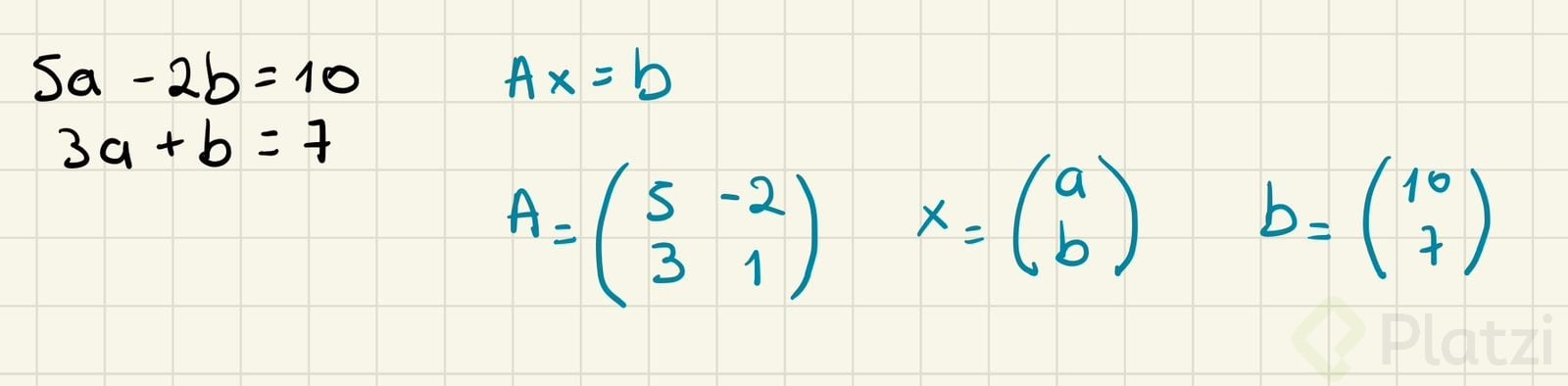
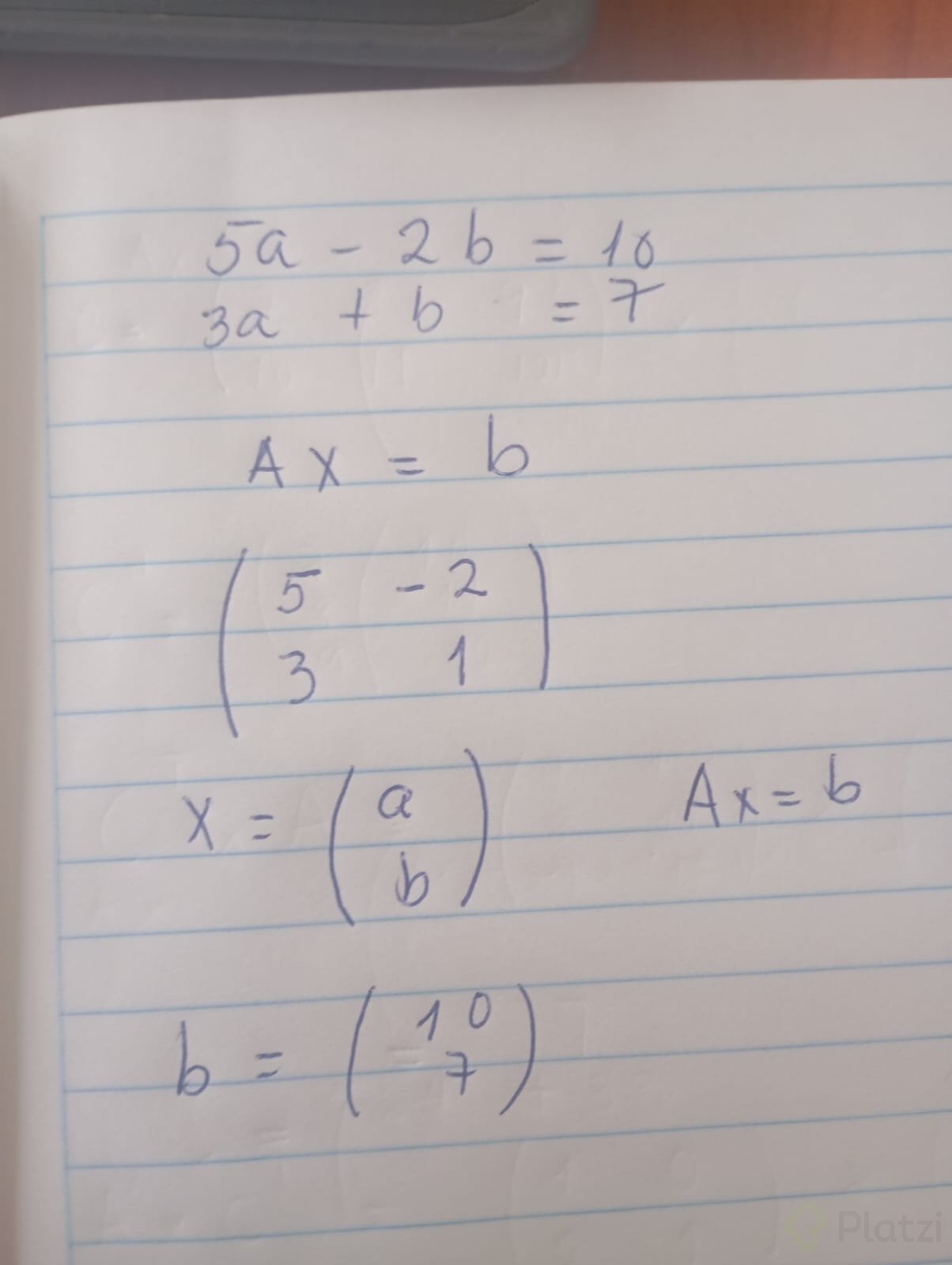
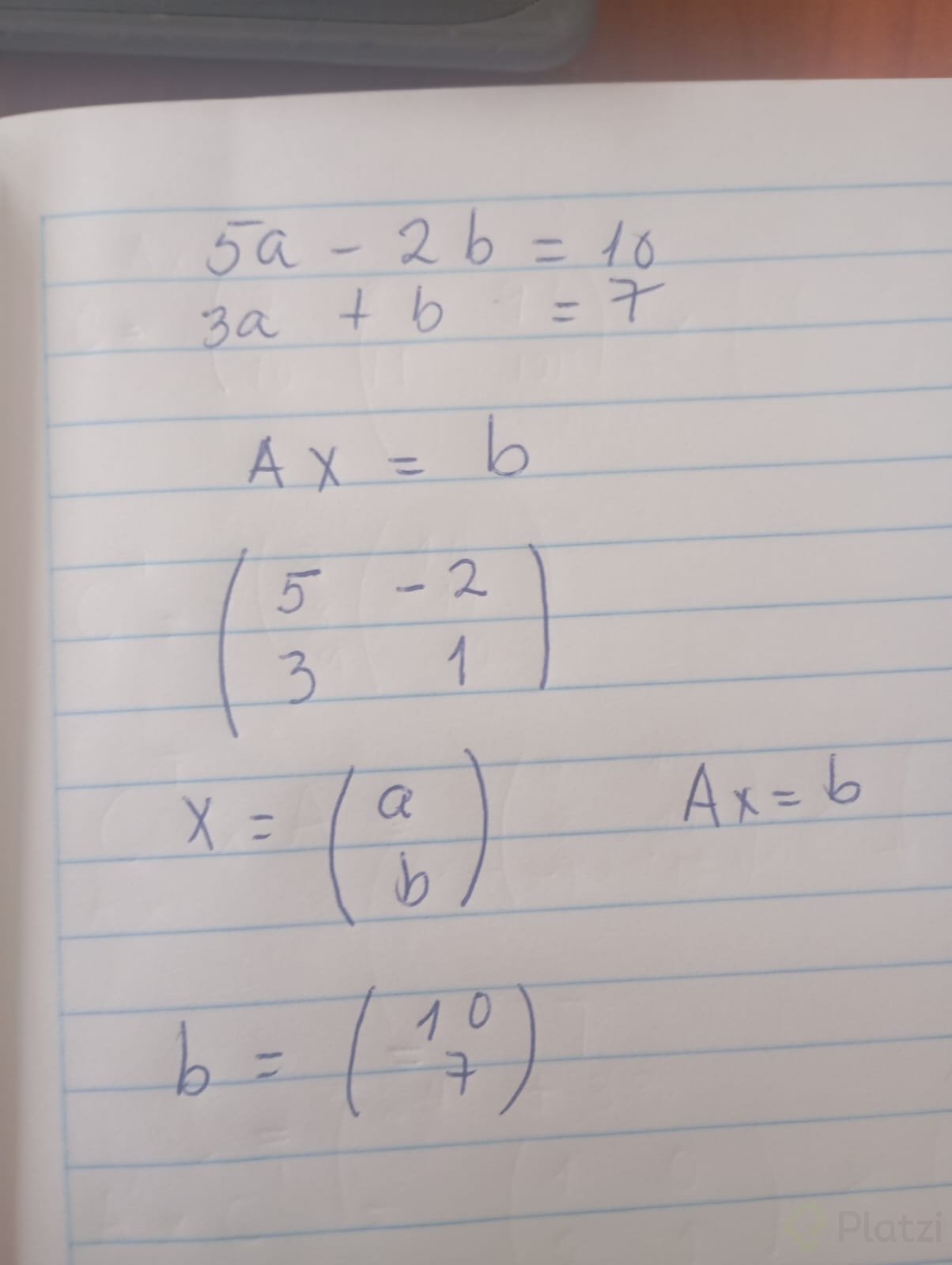
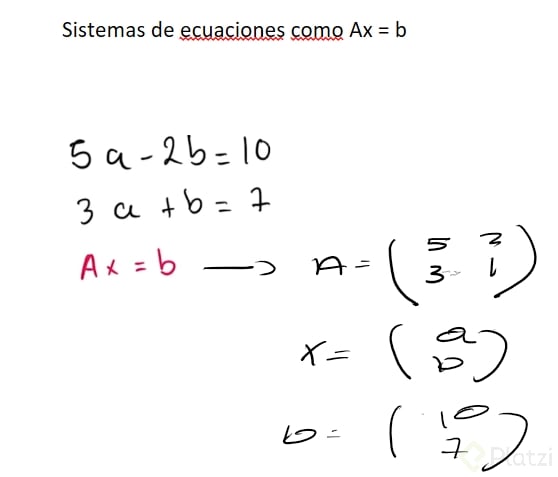
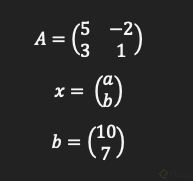
Try this on your own. Given the system 5A − 2B = 10 and 3A + B = 7, translate it into matrix form AX = B [04:15]. Pause, work it out, and drop your answer in the comments.
What comes next is where things get interesting. The matrix A hides information about which results are possible, which solutions exist, and how the transformation behaves. To unlock that, you will explore the four fundamental subspaces of a matrix in the next lesson.