Finding the exact angle between two vectors is one of those moments where linear algebra clicks: you stop seeing arrows and start seeing relationships. With one formula that mixes the dot product, the norm, and the cosine, you can measure how aligned two forces, velocities, or directions really are.
Why does the formula use cosine instead of another trig function?
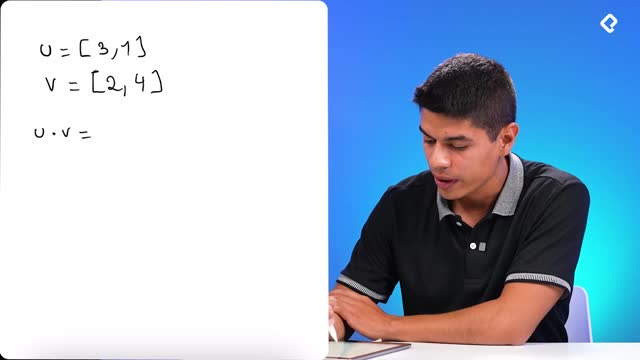
The core identity says that the dot product between two vectors U and V equals the norm of U times the norm of V times the cosine of the angle theta between them. That formula is powerful because it connects something purely algebraic (the dot product) with something purely geometric (the angle).
Cosine is the chosen function because its values match our intuition about alignment. Think of three clean cases:
- When the vectors point in the same direction, theta is 0° and cosine equals 1, the maximum alignment.
- When the vectors are perpendicular, theta is 90° and cosine equals 0, no alignment at all.
- When the vectors point in opposite directions, theta is 180° and cosine equals -1, maximum opposition.
No other trig function captures this idea of similarity so directly. That is why cosine sits at the heart of the formula [00:31].
What does the dot product really measure? It measures how aligned two vectors are. If the result is positive they point in similar directions, if it is zero they are perpendicular, and if it is negative they oppose each other.
How do you isolate the angle from the dot product formula?
You already know how to compute almost every piece of that equation: the dot product and the norm of each vector. The only unknown is theta, so you solve for it.
First, divide both sides by the product of the norms. That gives you the cosine of theta equal to the dot product of U and V divided by the norm of U times the norm of V. Then apply the inverse cosine, also called arc cosine, to both sides. The angle theta becomes the arc cosine of that whole expression [01:38].
A scientific calculator handles the arc cosine step in seconds, so the workflow is always the same: compute the dot product, compute both norms, divide, and apply the inverse function.
Worked example: two people pushing a box
Imagine two people pushing a box. Person one applies a force F1 equal to the vector (3, 1), and person two applies a force F2 equal to (1, 2). You want the exact angle between their efforts [02:10].
Start with the dot product of F1 and F2: 3 times 1 plus 1 times 2, which equals 5.
Now the norms:
- Norm of F1 equals the square root of 3 squared plus 1 squared, which is the square root of 10.
- Norm of F2 equals the square root of 1 squared plus 2 squared, which is the square root of 5.
Plug everything into the formula. Theta equals the arc cosine of 5 divided by the square root of 10 times the square root of 5, which simplifies to 5 over the square root of 50. That ratio is approximately 0.77, and the arc cosine of 0.77 is roughly 45 degrees [03:35].
What does a 45 degree angle between forces mean? It means the two people are collaborating in a similar general direction, but they are not perfectly aligned. Their combined push is efficient, just not optimal.
How can you verify the result graphically?
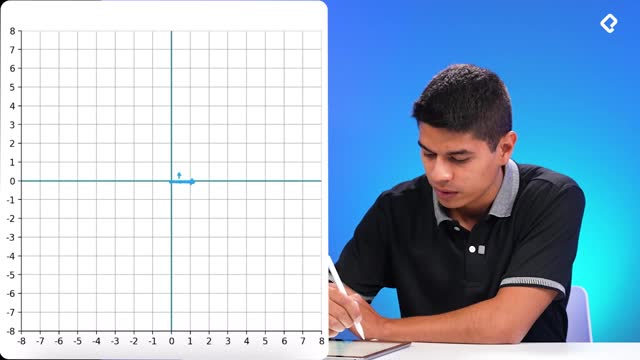
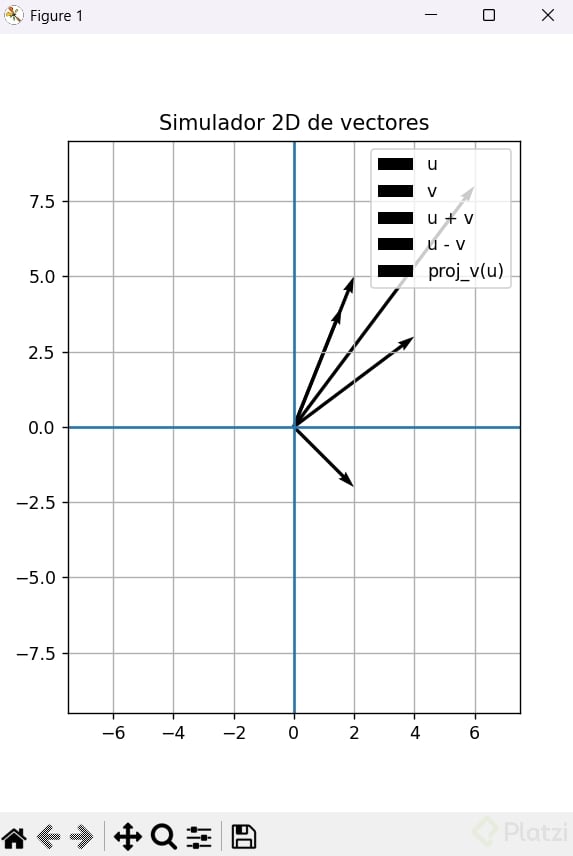
Plot F1 at the point (3, 1) and F2 at (1, 2) on the plane. Visually, the two arrows form an angle that looks like 45°. To double check, flatten F1 onto the x axis by setting its y component to 0, and flatten F2 onto the y axis by setting its x component to 0. Those two adjusted arrows form a clean 90° angle, and your original vectors sit exactly halfway between them, confirming the 45° result [04:25].
This kind of verification is useful because it ties the algebraic answer to a geometric picture you can trust.
What does the angle tell you about the relationship between vectors?
The angle is not just a number, it is a story about how two quantities interact. In the box example, 45° means cooperation with some loss of efficiency. If the angle were 0°, both people would push in exactly the same direction and the combined force would be maximum. If the angle were 180°, they would cancel each other out completely.
This logic scales to any pair of vectors: forces, velocities, embeddings in machine learning, or directions in physics. You are quantifying similarity with pure math.
Practice exercise: angle between two car velocities
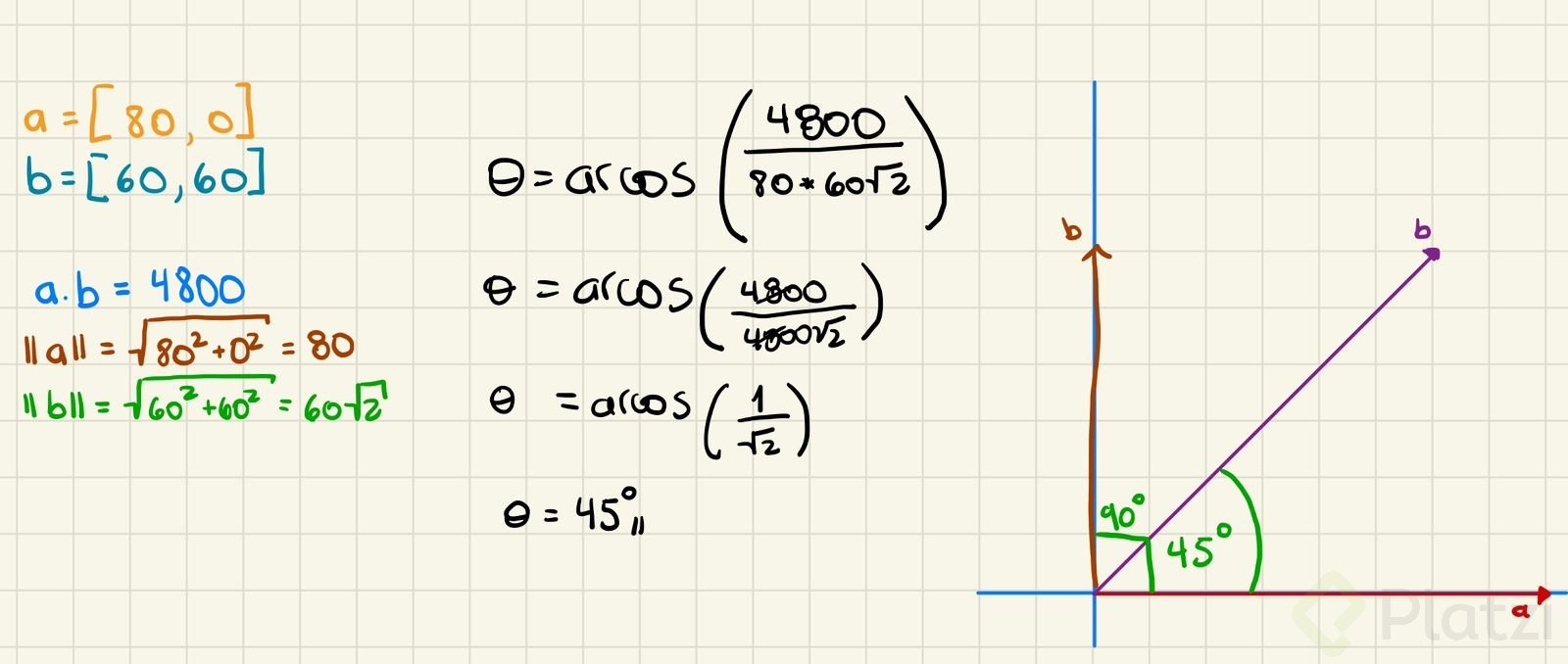
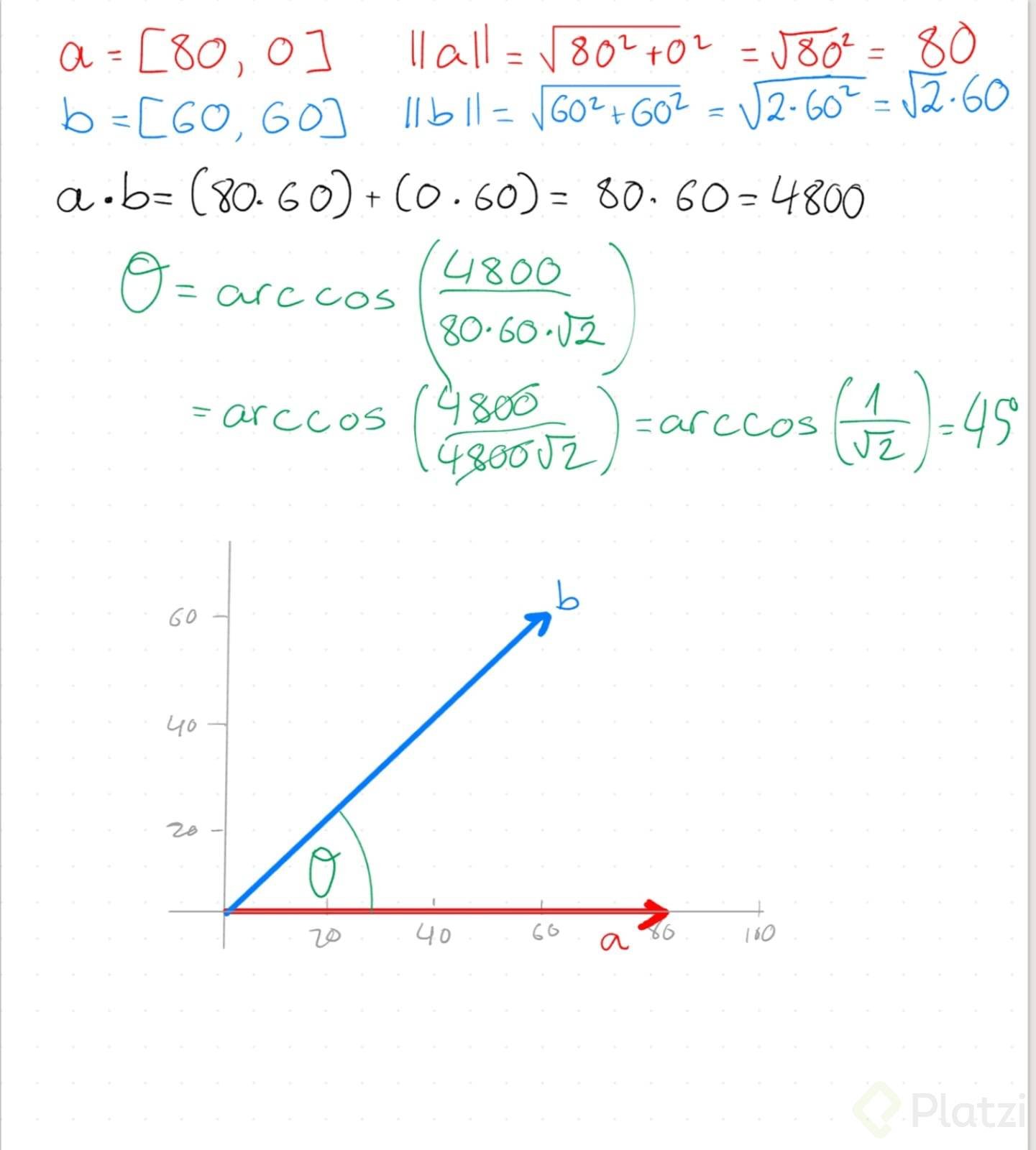
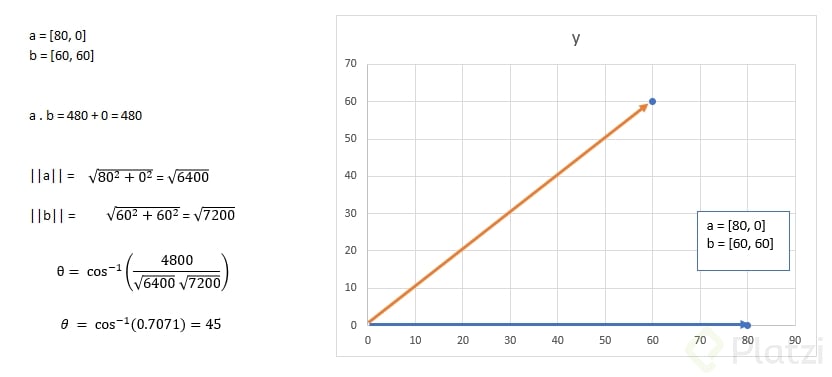
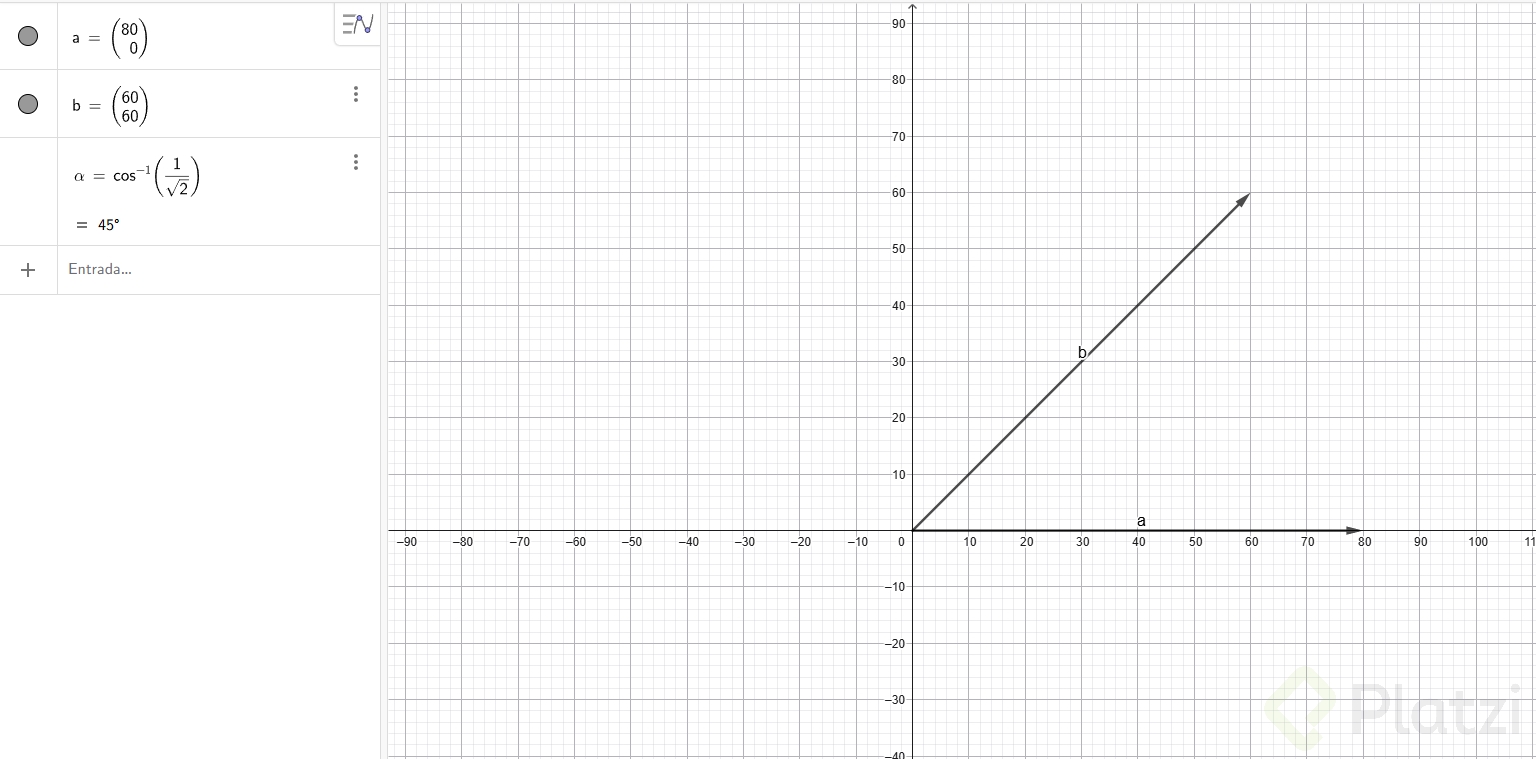
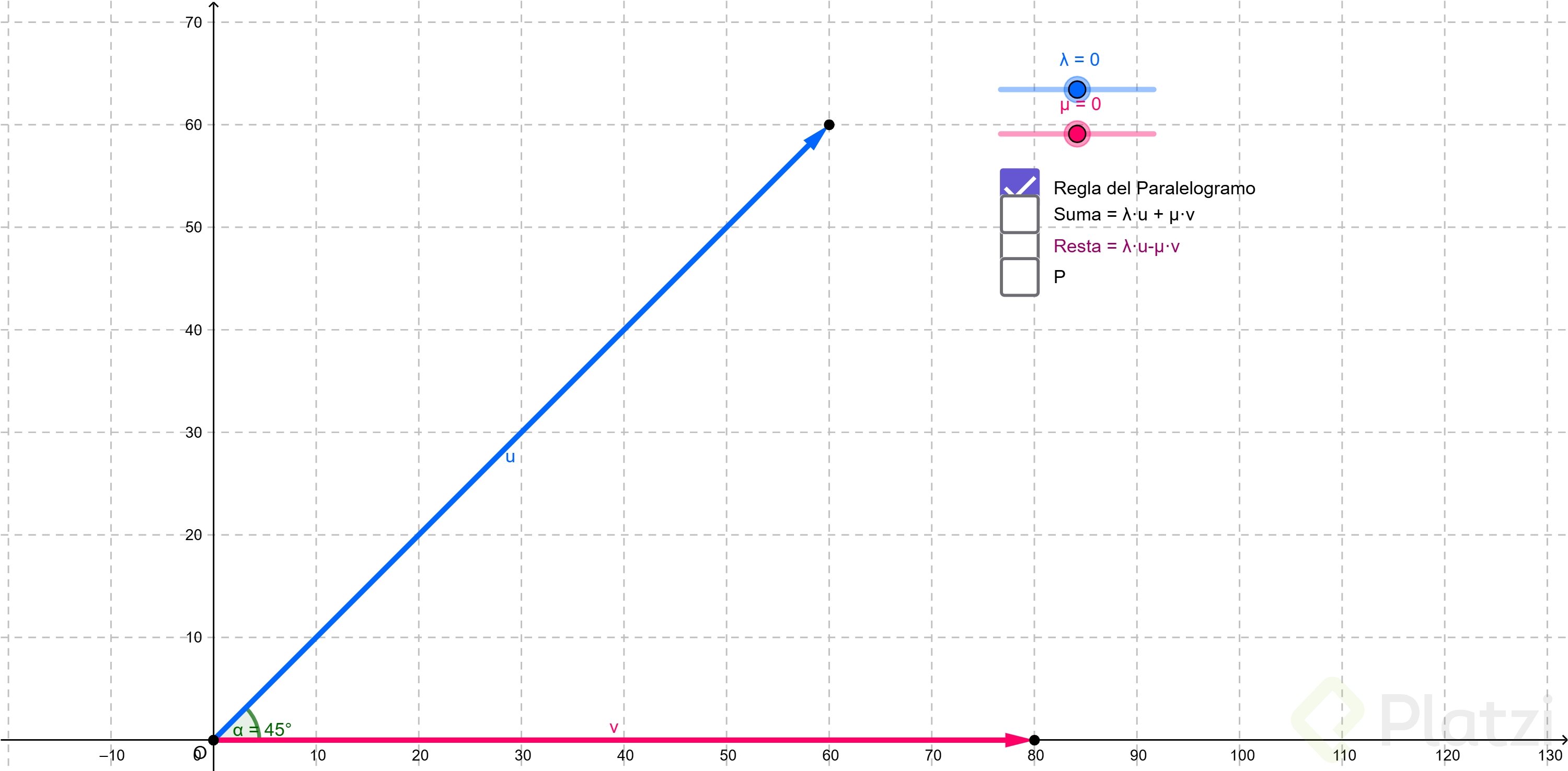
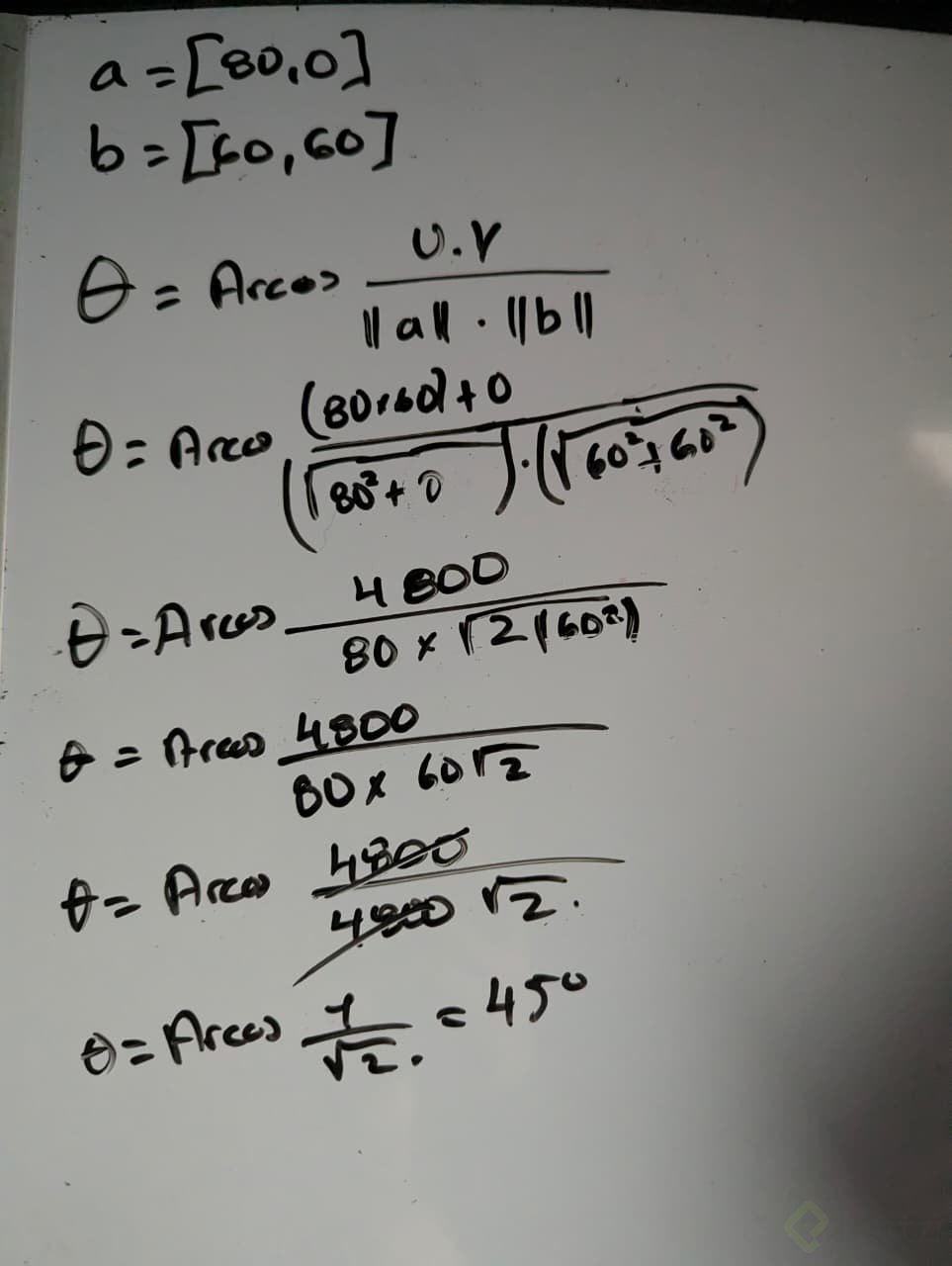
Try this one and share your process in the comments. Car A has a velocity vector of (80, 0), which you can read as 80 km/h heading east. Car B has a velocity vector of (60, 60), meaning 60 km/h east and 60 km/h north [05:42].
Calculate the exact angle between these two vectors using the same three steps:
- Compute the dot product of A and B.
- Compute the norm of each vector.
- Apply the arc cosine to the ratio.
Drop your answer and your reasoning below. With this tool in your kit you can now measure alignment with the dot product, magnitude with the norm, and the exact angle that separates any two vectors, giving you a complete picture of how they relate.