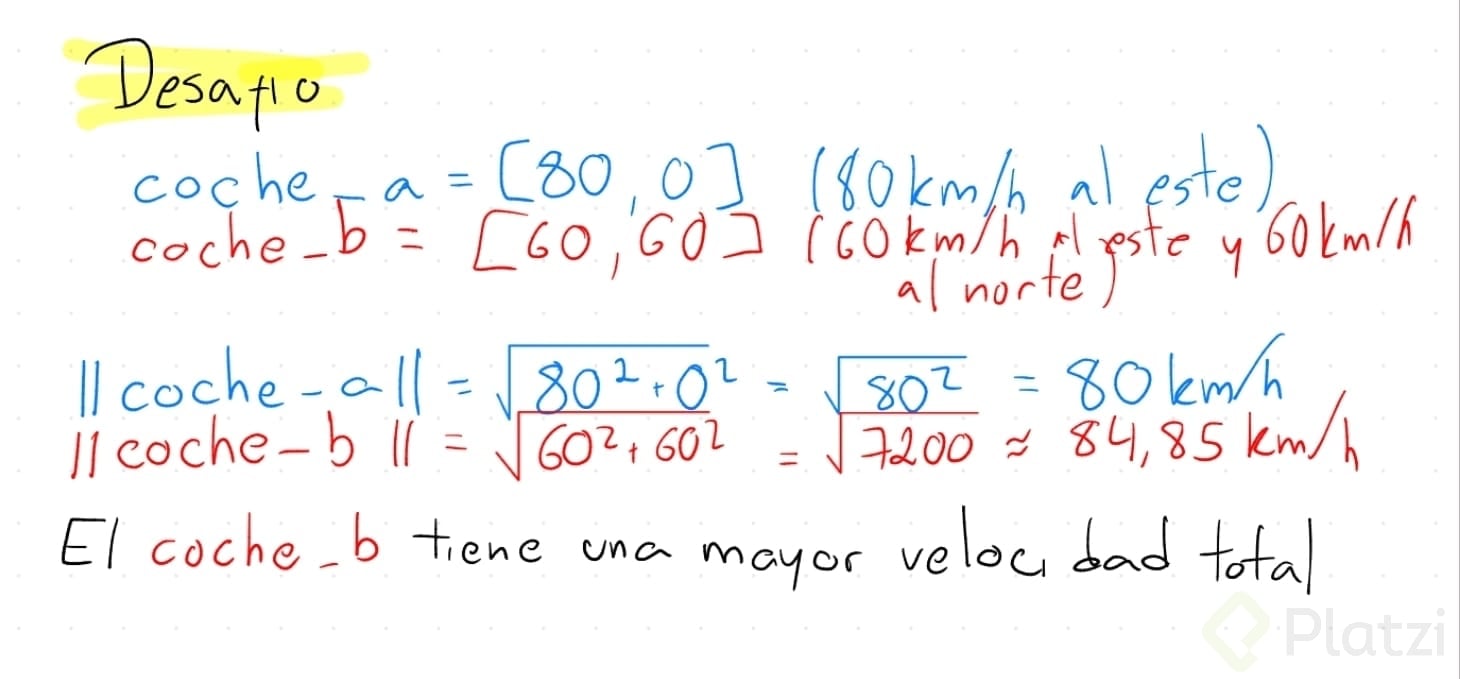
Knowing the direction of a vector is only half the story. To fully describe it, you also need its length, and that's exactly what the norm of a vector measures. This concept is essential in linear algebra, physics, GPS navigation, and graphic design, because it gives you a single number that tells you how long a vector really is.
What is the norm of a vector and why does it matter?
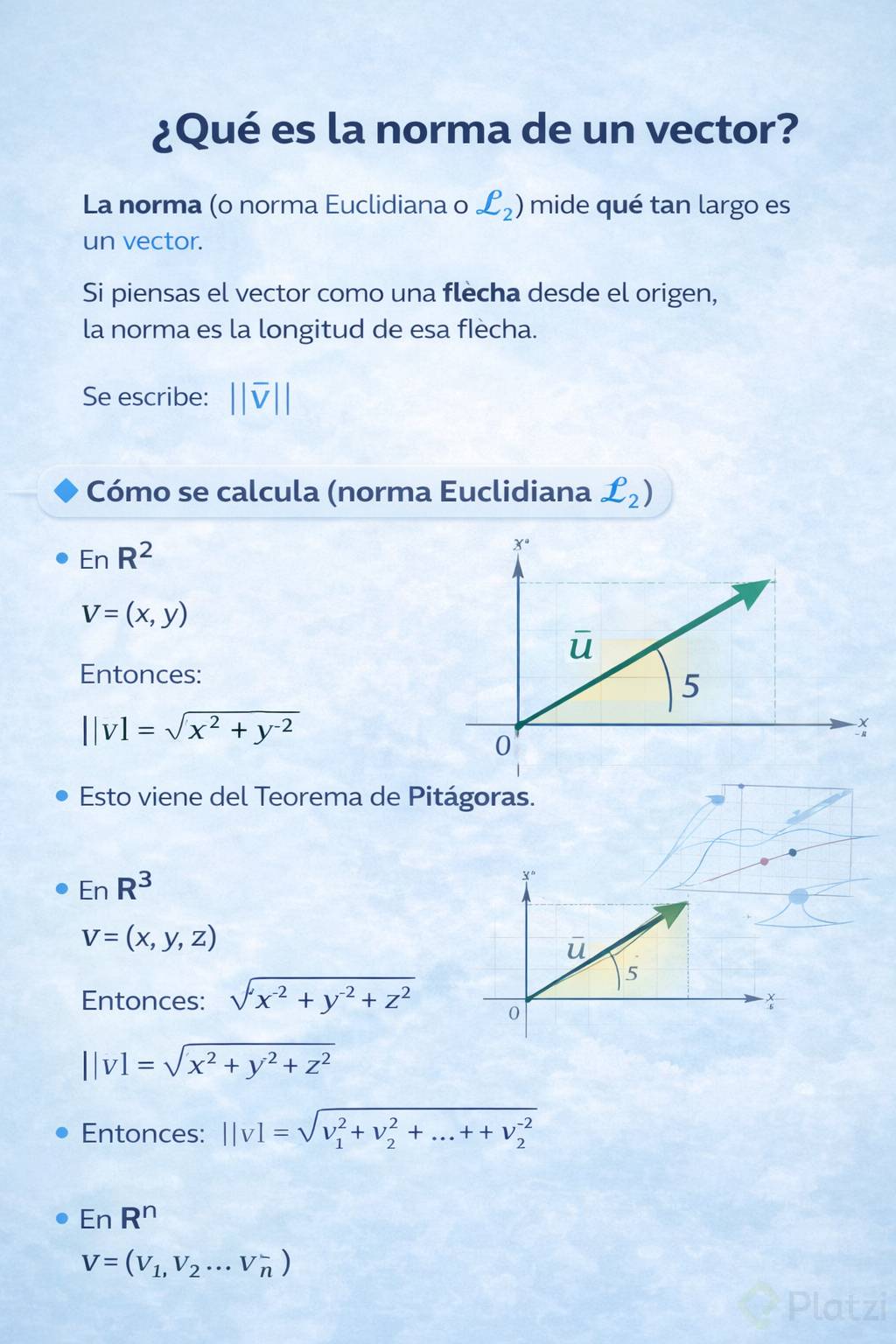
The norm is a scalar value that represents the magnitude or length of a vector. The most common version is the L2 norm, also called the Euclidean norm, which measures the straight line distance from the origin to the tip of the vector [01:00].
Think of it as the ruler you use to measure your space. In navigation, the L2 norm gives you the straight line distance between two cities. In physics, it tells you how intense a force is. In graphic design, it sets the scale of objects.
What is the L2 norm? It's the straight line distance from the origin to the point defined by a vector, calculated as the square root of the sum of its squared components.
How do you calculate the norm using the Pythagorean theorem?
The formula comes straight from a tool you probably already know: the Pythagorean theorem. The components of the vector form the legs of a right triangle, and the norm is the hypotenuse [01:30].
For a vector V in two dimensions, the norm is written with double bars around V and equals the square root of each component squared and added together.
Take the vector V = (3, 4):
- Square each component: 3² = 9 and 4² = 16.
- Add them: 9 + 16 = 25.
- Take the square root: √25 = 5.
Graphically, the vector forms a right triangle with legs of 3 and 4, and the arrow itself, with length 5, is the hypotenuse [02:30]. The same logic scales up: in three dimensions you sum three squared components, and in N dimensions you sum N squared components.
What properties does the norm always satisfy?
Before jumping to exercises, it helps to know the three rules every norm follows [03:30].
- Non negativity: the norm of a vector V is always greater than or equal to zero. Length can never be negative.
- Absolute homogeneity: if you multiply a vector by a scalar alpha, the new norm equals the original norm times the absolute value of alpha. Doubling the scalar doubles the length.
- Triangle inequality: the norm of the sum of two vectors is less than or equal to the sum of their individual norms. The direct route is always shorter than making stops.
How do you compute the norm of W = (6, -8)?
Follow the same recipe [05:00]. The norm of W equals the square root of 6² + (-8)². That gives √(36 + 64) = √100 = 10. The negative sign disappears because squaring any real number returns a positive value.
What is a unit vector and how do you normalize?
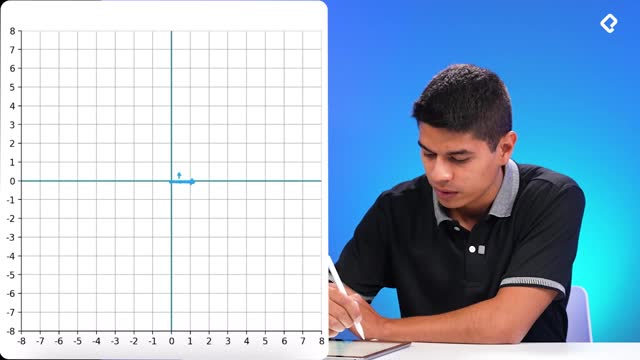
A unit vector is a vector whose norm is exactly one. Its power is huge: by fixing the length to one, it represents pure direction without the noise of magnitude [06:00]. The base vectors i hat and j hat that build coordinate systems are unit vectors.
To turn any vector into its unit version you apply normalization, which means dividing the vector by its own norm.
For W = (6, -8) with norm 10:
- Multiply W by 1/10.
- You get (6/10, -8/10).
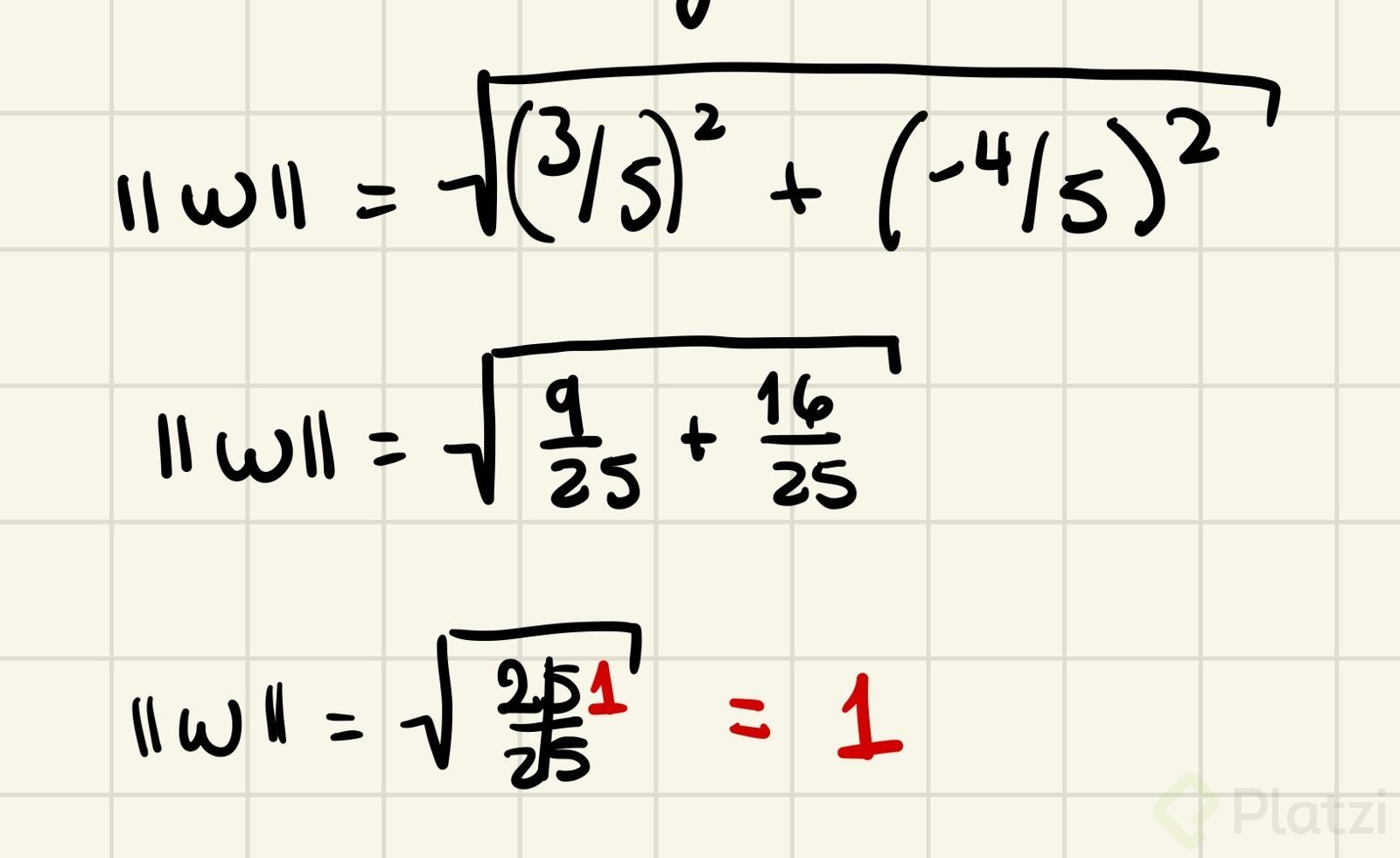
- Simplify to (3/5, -4/5).
If you compute the norm of (3/5, -4/5), you get exactly 1. Try it yourself to confirm.
How do you normalize a vector? Divide each component by the norm of the vector. The result keeps the same direction but has length one.
Which other norms exist beyond L2?
The L2 norm is your default, but other measurements appear in different contexts and you should recognize them [07:30].
- L1 norm or Manhattan norm: sums the absolute values of the components. It's named after the grid streets of New York, where a taxi can't cut diagonally through buildings.
- L0 norm: not a strict mathematical norm, but very practical. It counts how many components are different from zero, useful to measure how sparse a vector is.
- L infinity norm or maximum norm: returns the component with the largest absolute value. It's perfect when you care about the worst case scenario or the maximum impact of a single component.
With the norm in your toolbox and the dot product from the previous lesson, you're ready to connect both ideas and discover a new geometric definition of the dot product. Share in the comments which norm you think you'll use the most in your projects.