Vectors don't change when you switch coordinate systems, but the numbers you use to describe them do. Change of basis is the linear algebra technique that lets you translate a vector or an entire transformation from one coordinate language to another, and it's the key to making complex problems feel simple.
What does a vector like 3,2 actually mean?
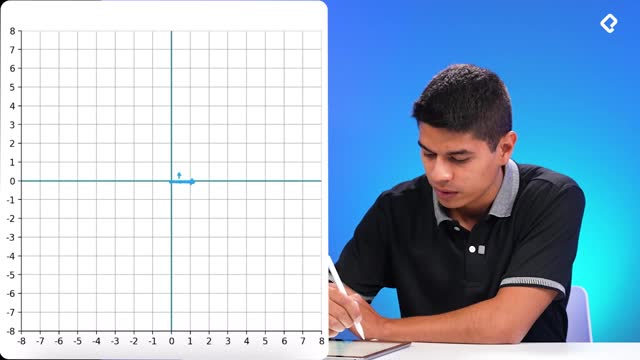
When you write the vector 3,2, you're implicitly speaking the language of the standard basis. That basis uses two building blocks: i-hat equal to 1,0 and j-hat equal to 0,1. So 3,2 is shorthand for the linear combination 3i-hat + 2j-hat.
The numbers 3 and 2 aren't the vector itself. They're instructions for assembling it using i-hat and j-hat as bricks. Change the bricks, and you change the instructions, even though the arrow in space stays exactly the same.
What is a basis in linear algebra? A basis is a set of linearly independent vectors that can generate the entire space. In R2, any two vectors that aren't parallel form a valid basis.
How do you find coordinates in a different basis?
Imagine someone named Jennifer uses a different coordinate system. Her basis vectors are v1 = 2,1 and v2 = -1,1. They're linearly independent and span all of R2, so they're a perfectly valid basis.
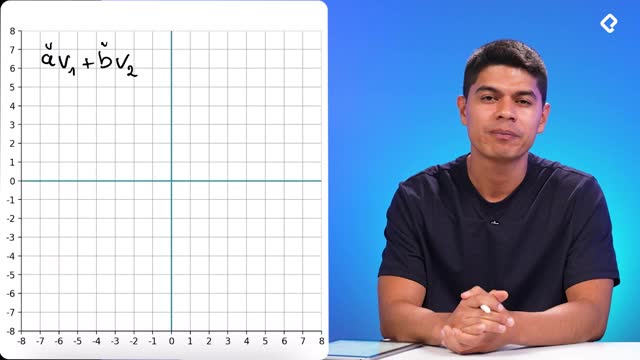
The question becomes: if a vector lands at position 3,2 in your system, what numbers describe that same arrow in Jennifer's language? You need scalars c1 and c2 such that c1·v1 + c2·v2 reproduces the vector. Finding those scalars means finding the new coordinates.
How do you translate a transformation matrix between bases?
This is where change of basis becomes powerful. You can take any transformation, say a 90 degree counterclockwise rotation, and rewrite it so it operates inside Jennifer's coordinate system. The formula uses three pieces in a specific order.
The three step translation formula
The expression looks like B⁻¹ · M · B, and each piece does one job:
- B is the change of basis matrix, built from Jennifer's vectors as columns: 2,1 and -1,1.
- M is your transformation in the standard basis. For a 90 degree rotation, M = 0,-1,1,0.
- B⁻¹ is the inverse, which translates results back into Jennifer's language.
The logic flows like this: B takes a vector written in Jennifer's coordinates and rewrites it in yours. Then M applies the rotation in your familiar system. Finally B⁻¹ translates the rotated vector back into Jennifer's coordinates.
Calculating the inverse and the product
To find B⁻¹, you compute the determinant of B first: (2)(1) - (-1)(1) = 3. Then you swap the main diagonal, flip the signs of the off diagonal, and divide by the determinant. The result is B⁻¹ = (1/3) times the matrix 1,1,-1,2.
Multiplying M·B gives -1,-1,2,-1 as columns. Then B⁻¹·M·B produces the final translated matrix: (1/3) times 1,5,-2,-1, which equals 1/3, 5/3, -2/3, -1/3 in entry form.
Why multiply in the order B⁻¹·M·B? Because matrix multiplication reads right to left. First B converts into your basis, then M transforms, then B⁻¹ converts back into Jennifer's basis.
Why does change of basis matter in practice?
Think of a videogame character moving diagonally. In standard X-Y coordinates, that movement might look like 3,3, awkward to work with. But if you rotate the coordinate system so one axis points along the character's direction of travel, the same movement becomes something clean like 4.2, 0.
The vector hasn't changed. Only your description of it has. And that shift in perspective often turns a tangled problem into a trivial one. Picking the right basis is one of the most powerful moves in science and engineering, because problems that look ugly in the standard basis can become almost obvious in a basis aligned with the structure of the problem.
If you apply the translated rotation matrix 1/3, 5/3, -2/3, -1/3 to Jennifer's vector 1,2, you get -1,1. Graphically, the orange vector in Jennifer's grid rotates 90 degrees inside her own coordinate system, mirroring exactly what the standard rotation does in yours.
Practice exercise: translate an inclination matrix
Your turn. Take the shear or inclination matrix A = 1,0,2,1 and translate it into Jennifer's language using the same basis vectors v1 = 2,1 and v2 = -1,1. Then apply the resulting matrix to any vector expressed in Jennifer's coordinates.
A natural follow up question: is there a basis that makes a given transformation as simple as humanly possible? An ideal coordinate system where the transformation barely does anything weird? Yes, and those special directions are called eigenvectors. Share your exercise results in the comments.