Recursos
Resumen
Take a prime p built by the paper, a prime q that might divide the index (p−1)/ord_p(a), and decide which part of the argument removes q and why it is enough. This class works through how the paper attacks Artin's primitive root conjecture, using that single question.
The obstacle and the two ingredients
- The base a fails at p exactly when some prime q divides the index. That happens precisely when p splits completely in the Kummer field K_q = ℚ(μ_q, a^{1/q}) [0:23].
- Hooley's method counts these splittings, but it needs GRH, because the field changes with q. A standard zero-free region gets thinner as the field grows.
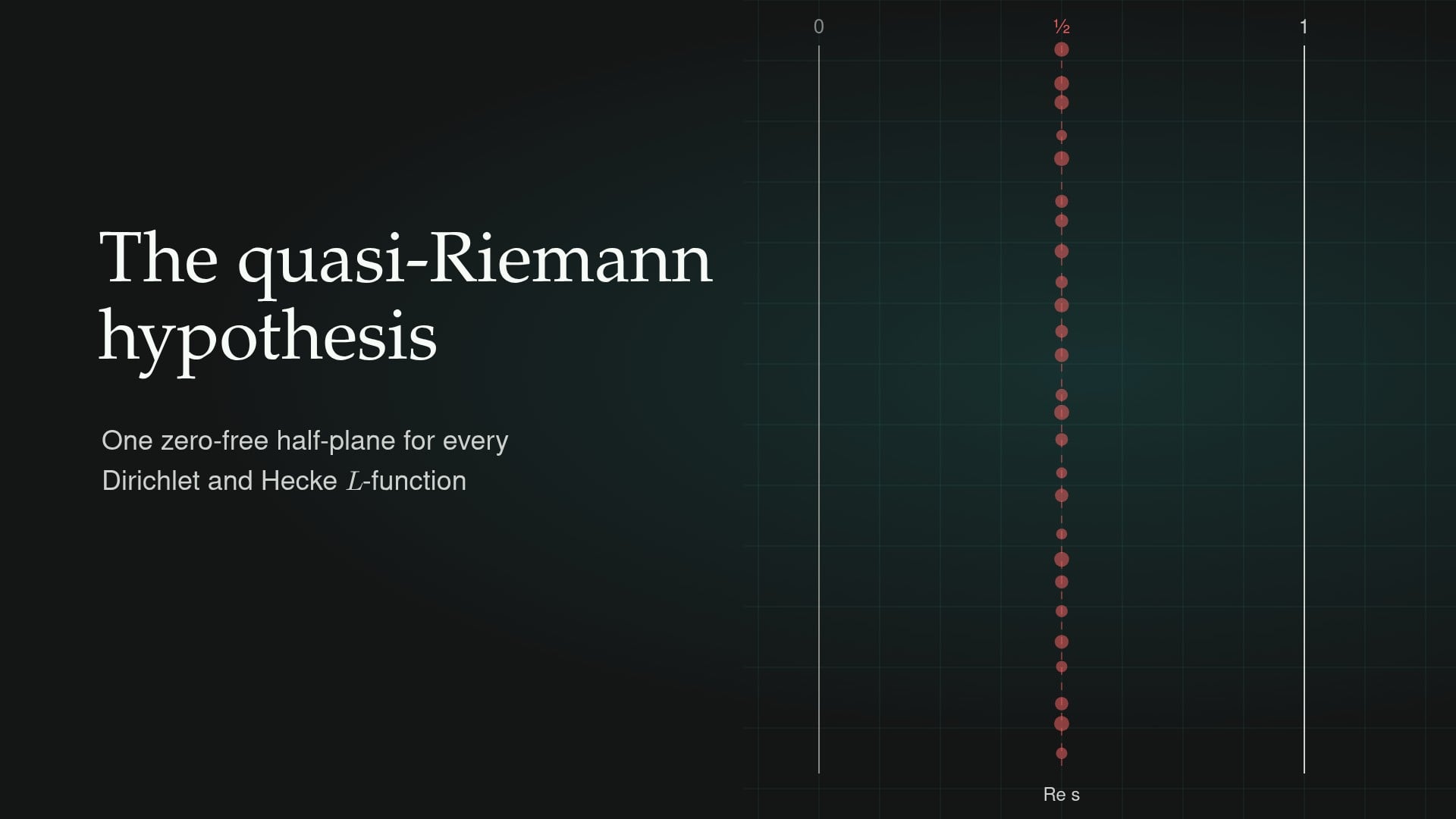
- The paper puts two ingredients together [1:06]. The first is a construction of many primes with p − 1 = c·r·Q, where c ∈ {2, 4}, Q > x^0.9 is prime, and every prime of r lies between e^{L^0.1} and e^{L^0.3} (L = log x). The second is a zero-free region Re s > 1 − 10⁻⁶ for the Hecke L-functions of every cyclotomic field containing μ₁₂. Its width is the same for every such field.
The three bins (worked case a = 2, p ≡ 3 mod 8)
Starting at [1:49]:
- q = 2: (2/p) = −1, so 2^{(p−1)/2} ≡ −1 and 2 never divides the index. A congruence class handles it.
- q = Q: the order of a divides cr < 2x^0.1, so p divides some a^j − 1 with j small. Only about x^0.2 / L primes are lost.
- q | r: the uniform splitting bound x/(q(q−1)L) + x^{1−δ₀}, summed over the window, gives o(x/L²). This only works because the power saving is fixed: a saving that shrank as the field grew would not survive the union over up to e^{L^0.3} fields.
The check at [3:34] asks about q = 3. No bin is needed, because 3 cannot divide p − 1 at all. That is what "controlled predecessors" means.
Where the 10⁻⁶ comes from
- Descent [4:03]: K_q·ℚ(μ_{12q}) is cyclic over a cyclotomic field containing μ₁₂. Its zeta function factors into Hecke L-functions that the theorem covers, so ζ_{K_q} has no zeros in the strip either.
- Engine [4:29]: the paper estimates one additive average of cubic theta coefficients (cubic Gauss sums) in two ways. On the reflection side, the sextic exponents 1 and −4 add to 3 mod 6, so the interaction is quadratic and the quadratic large sieve controls it. On the Poisson side, the principal frequency builds 1/L(s, η). Together they give a power saving that continues 1/L across Re s = 1, which rules out zeros.
Use it [5:32]: factor p − 1, put every possible index prime into a bin, and check that each bin loses o(x/(log x)²) primes. Keep in mind that x/(log x)² is below Artin's predicted x/log x.