Recursos
Resumen
Take any noncentral normal subgroup N of G(k), where k is a global function field and G is absolutely almost simple and simply connected, and follow it through the proof until it shows up as δ_A⁻¹(W) for an open normal subgroup W of the product H_A of the compact anisotropic local groups.
The statement
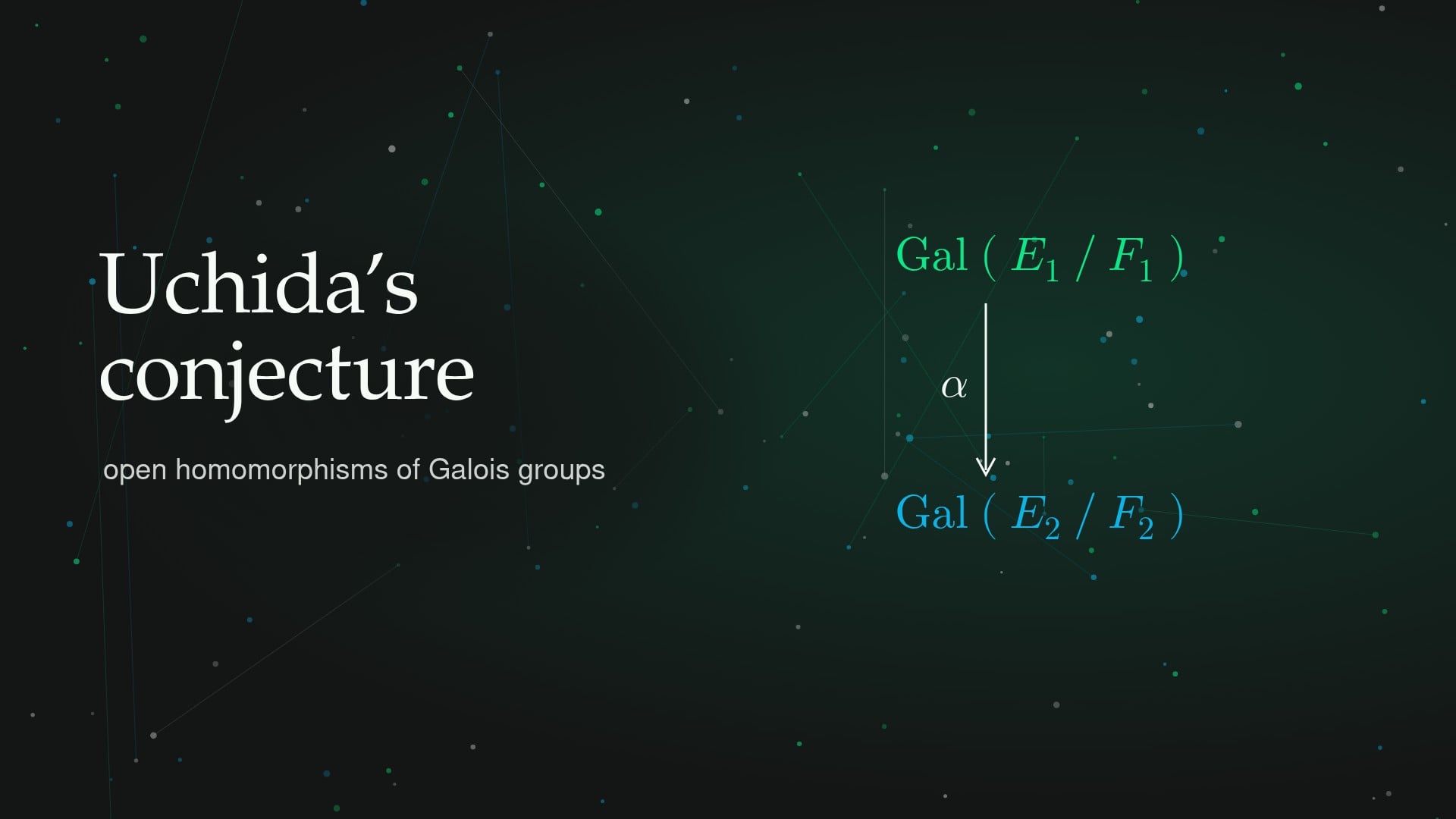
The rank-zero places A(G) form a finite set. Their local groups are compact, and their product is H_A. Theorem 1.1 [0:45] says that every noncentral N ◁ G(k) equals δ_A⁻¹(W) for an open normal W ◁ H_A. This holds in every positive characteristic, characteristic two included. Quick check [1:13]: if A(G) is empty, then H_A is trivial, so N = G(k). The hard part is not finite index, which Margulis already gives. The hard part is which local topology detects N.
The route through the proof
- Reduce [1:49]: the isotropic case follows from Kneser–Tits, and inner type A was already known. Harder's results leave only S = SU(D, ∗), with deg D = n ≥ 3 over a separable quadratic L/k.
- Power defect [2:17]: finite index gives N ⊇ R, the subgroup generated by e-th powers. Take P₀ = closure of δ_A(R) and V₀ = δ_A⁻¹(P₀). The finite group V = V₀/R is the gap between the abstract group and what the local groups can see.
- Induction on the degree [3:01], run over all function fields at once. In odd degree, a nontrivial V would produce either a finite abelian character or a finite simple quotient, and both are ruled out. In even degree, an element factors into a quaternion part and a centralizer part. Degree four needs its own two-norm correction.
- Why char p is different [3:39]: p·x = 0, so dilating by integers just cycles. The Furstenberg–Katznelson step is replaced by finite additive Fourier analysis: in odd characteristic, orthogonality of characters plus a quadratic parametrization; in characteristic two, additive polynomials and coordinates over power subfields.
Closing the loop
Once V = 1 [4:15], density gives S(k)/R ≅ H_A/P₀. N/R matches a normal subgroup on the right, and pulling that back gives W. Then N = δ_A⁻¹(W), and W is the closure of δ_A(N). The procedure to reuse [4:53]: get finite index, choose e to kill the quotient, show the power defect vanishes, then read W off H_A/P₀.