Recursos
Resumen
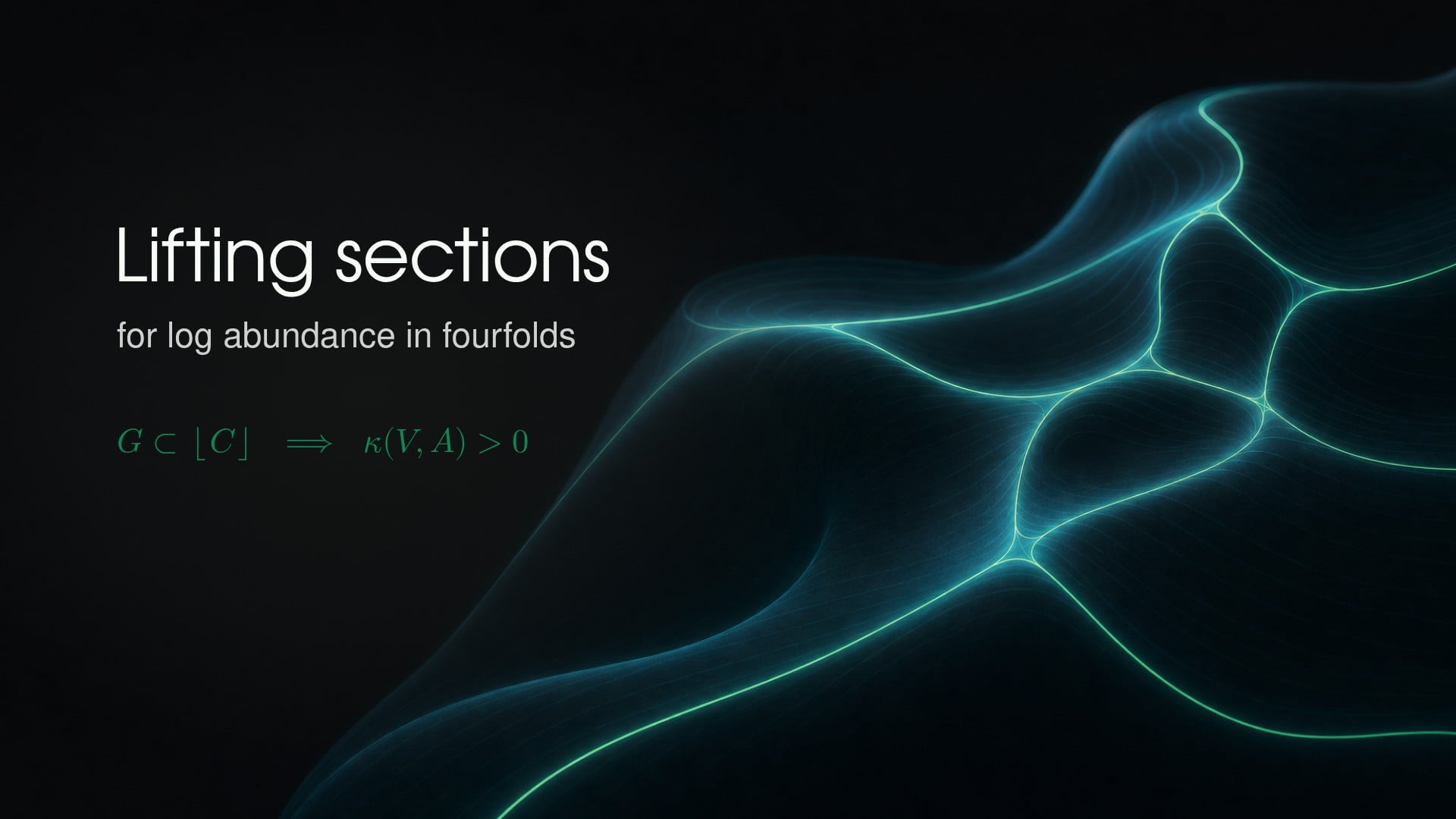
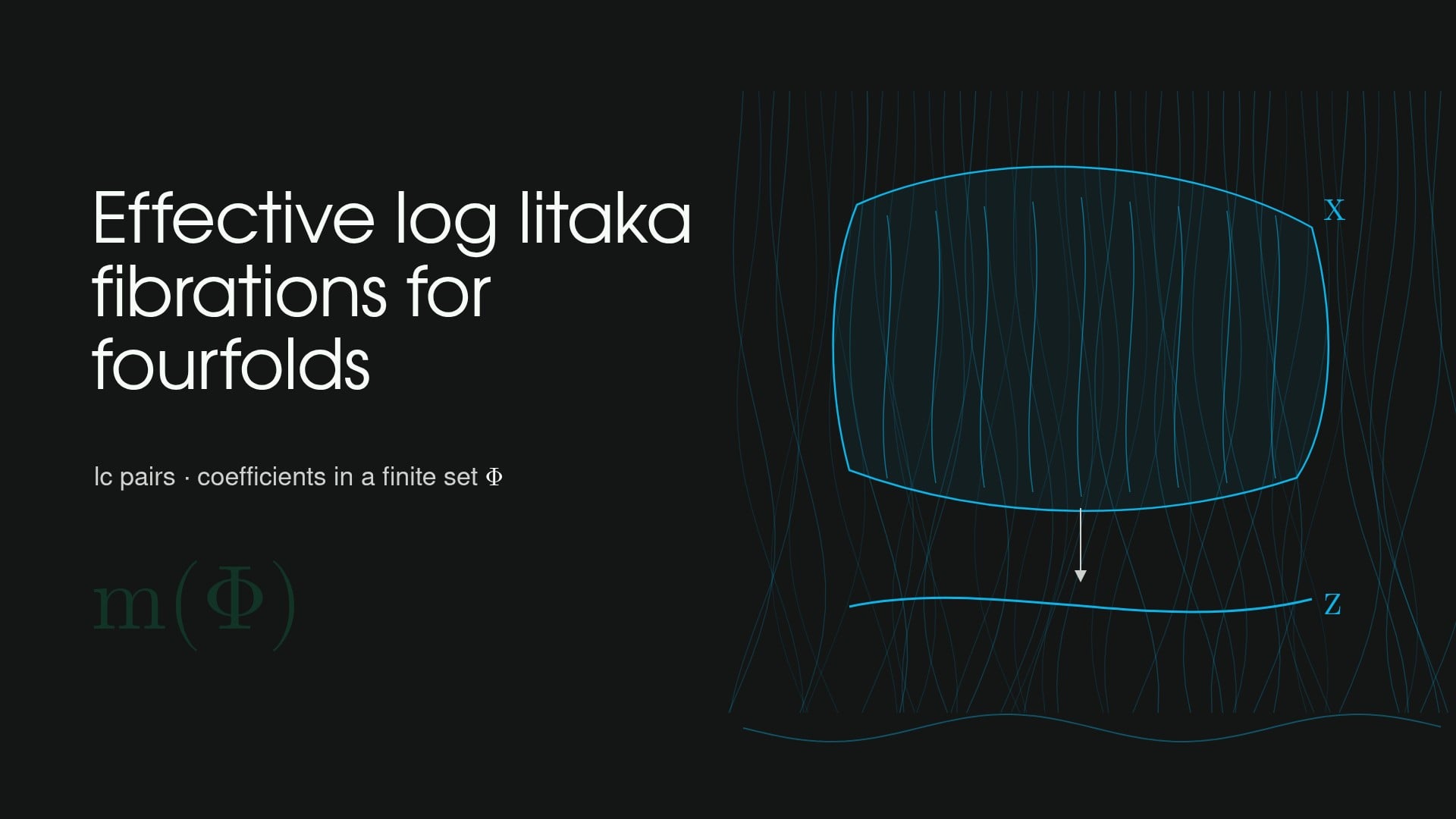
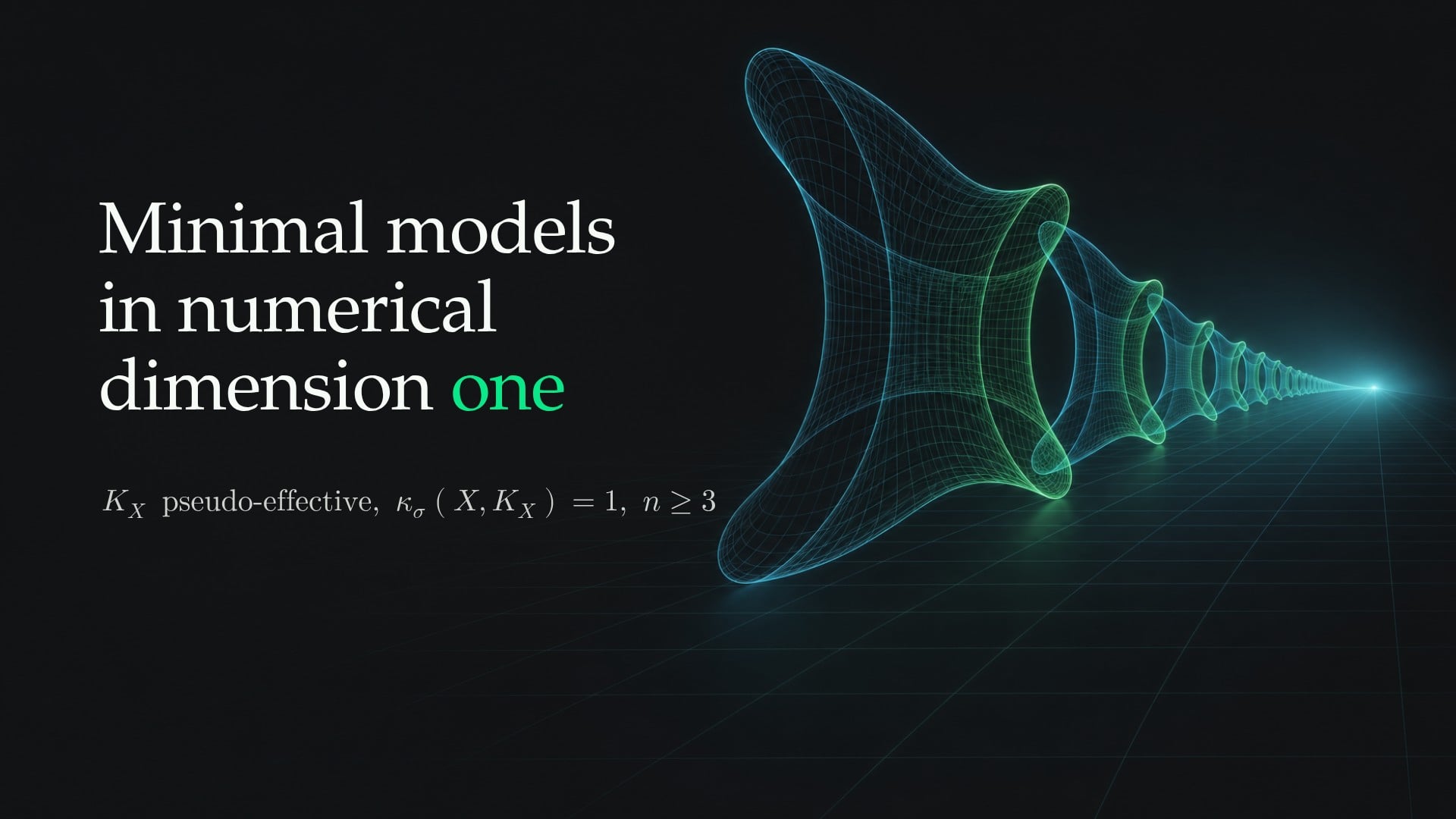
Take a compact Kähler klt fourfold pair with a pseudo-effective adjoint and work out where its first pluricanonical section comes from. That one section is the missing link between the minimal model program and a good minimal model.
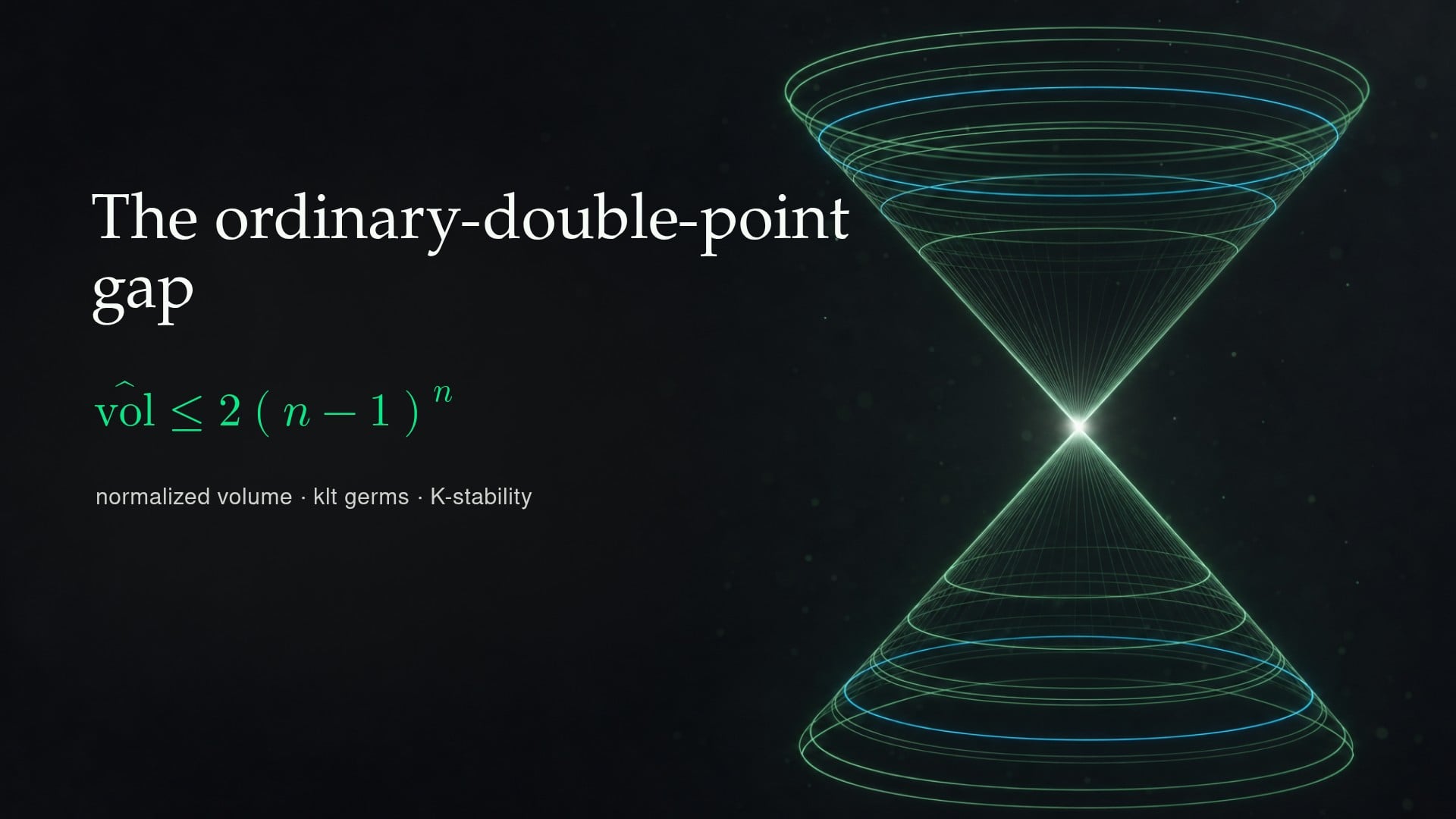
The chain and its gap [0:07]
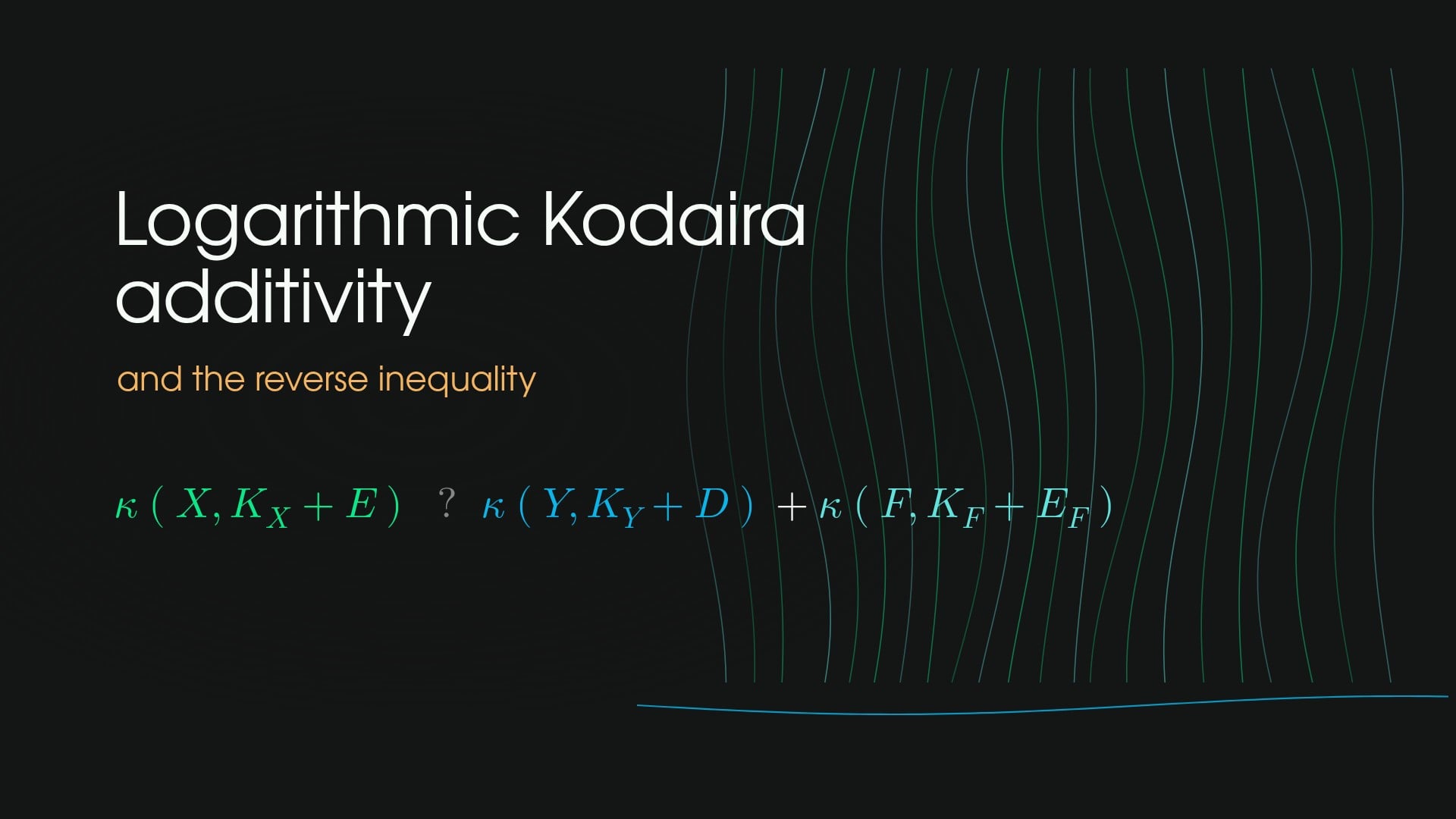
The paper keeps the projective script, with conditions attached. Assumption 2.3 (the fourfold MMP) gives a nef endpoint (Y, B_Y). Assumption 2.4 (abundance) then makes a Cartier multiple of the adjoint globally generated, but only if κ ≥ 0 already holds. Orbifold Iitaka subadditivity (Assumption 2.2) is the third input. So the real work is Theorem 1.2: nonvanishing on the nef endpoint. Once you have it, Theorem 1.1 follows: a bimeromorphic model that extracts no divisor and whose nef adjoint has a globally generated Cartier multiple.
Sort the pair into its branch [0:57]
Ask these questions in order:
- Moishezon? Use the projective branch: log abundance, proved in the appendices, with its logarithmic premise derived from subadditivity.
- Smooth resolution W uniruled? The rational quotient gives a fibration with rationally connected fibers, and subadditivity finishes the job.
- Not uniruled: Ou's theorem makes K_W pseudo-effective. q(W) > 0 sends you to the Albanese fibration.
- q = 0, a(W) > 0: build a canonical pullback over a projective base (Prop. 4.1).
- q = 0, a(W) = 0: use the analytic route (Thm 9.4).
Worked case [1:47]: in the irregular branch, the base has κ(K_T) ≥ 0 from wedges of one-forms, and the fiber has κ(K_F) ≥ 0 from nonvanishing in dimension at most 3. Subadditivity gives κ(W) ≥ 0 + 0. The fibration works like a ladder down to dimensions where the answer is already known.
Practice [2:48]: q = 0 and a = 2 lands in positive algebraic dimension. The base is a projective surface, K_M ∼ f*A + R, and fiber powers plus Riemann–Roch produce the section of A.
When there is no ladder [3:27]
If a(W) = 0, there is no fibration. The proof uses zero-Lelong-number metrics instead, which make the multiplier ideals trivial. With no divisors, a foliation argument gives a contradiction. Otherwise, a reduced boundary D carries a section, and hard Lefschetz with multiplier ideals removes the H¹ obstruction to extending it [4:03].
Try it on a pair from your own reading: place it in its branch first, then name the tool that supplies the section [4:38].