Recursos
Resumen
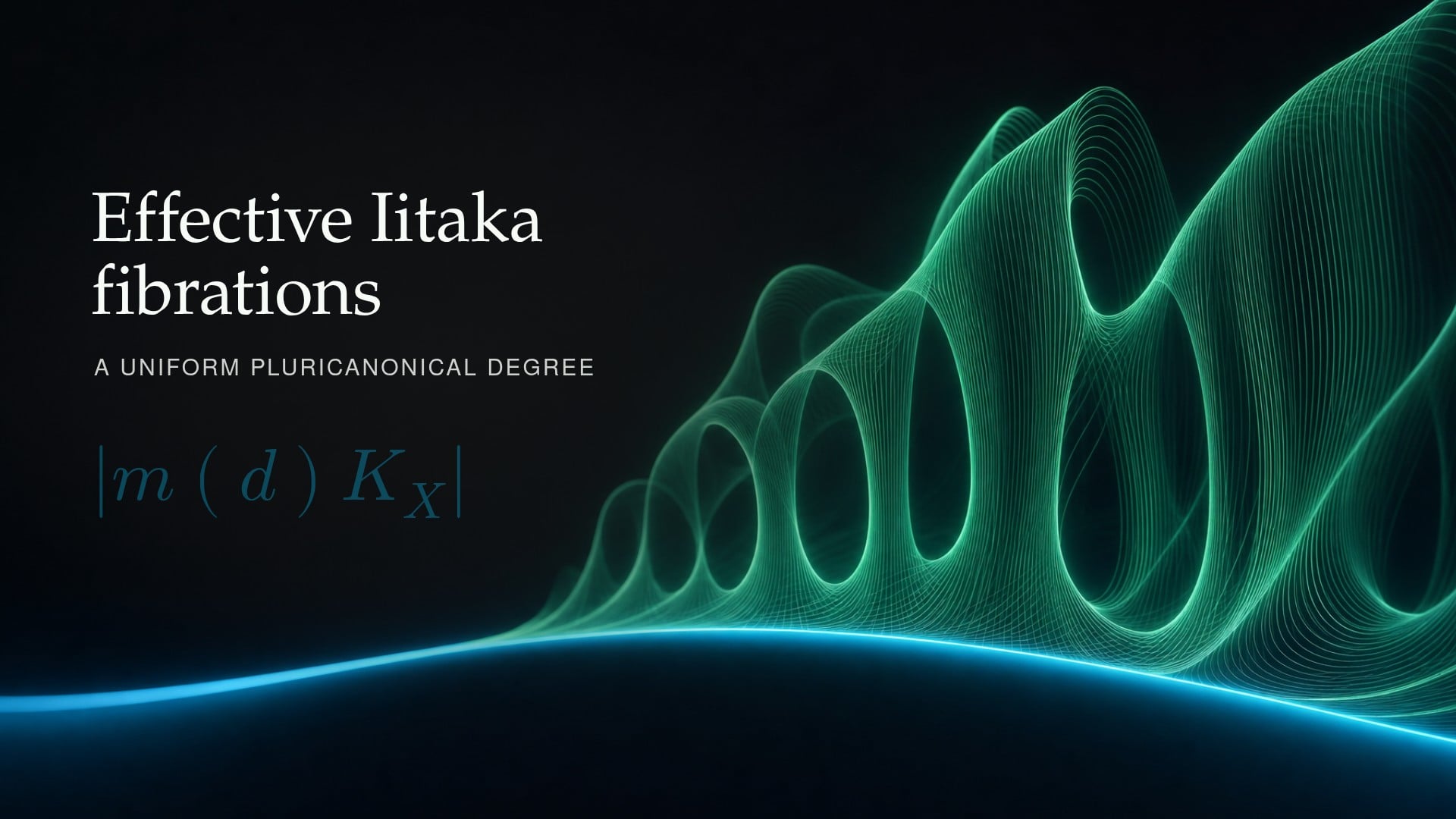
Take a proposed degree m for a smooth projective d-fold and decide whether |mK_X| really defines its Iitaka fibration. Then explain why the paper can choose that degree from the dimension d alone.
What "defines the Iitaka fibration" demands
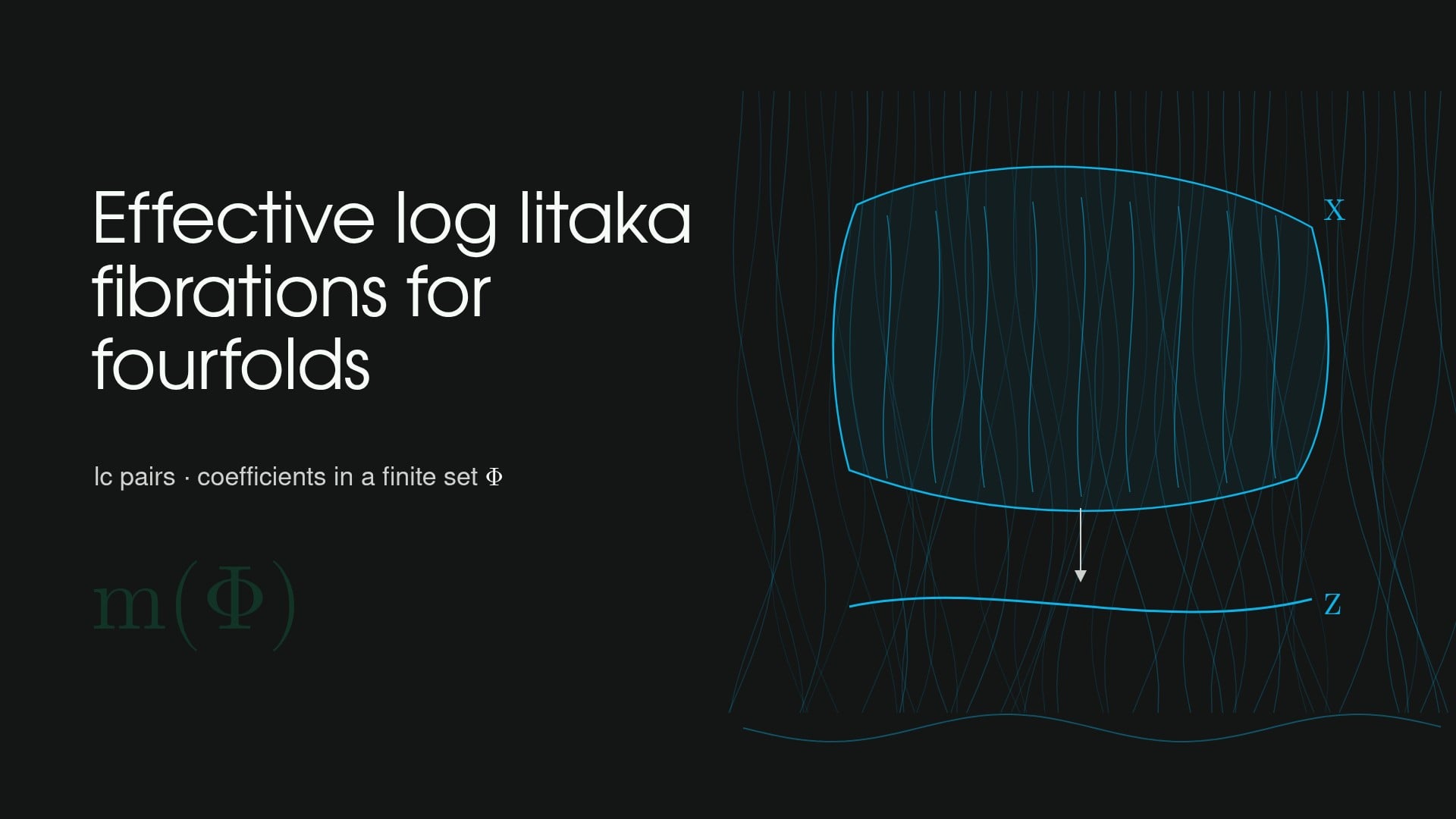
Take ratios s/s₀ of nonzero sections in the same degree. Across all degrees, these ratios generate the Iitaka field 𝒦(K_X), which is the function field of the Iitaka base Z [0:41]. A complete system defines the fibration when it is nonempty and its own section ratios generate the whole field. An image of dimension κ is not enough. If the degree-m map lands on a curve Z′ and Z → Z′ is 2 : 1, the image has dimension κ. But ℂ(Z′) ⊊ ℂ(Z) is a proper subfield, so that degree fails [1:06].
The claim
For each d there is an m(d) such that, over any algebraically closed field of characteristic zero, |m(d)K_X| defines the Iitaka fibration of every smooth projective d-fold with κ ≥ 0 [1:39]. Every multiple works too, because s/s₀ = s·s₀^(q−1)/s₀^q. In general type the map is birational. In Kodaira dimension zero the system is nonempty and the image is a point. The theorem is existential: it gives no practical value of m(d).
Where uniformity comes from
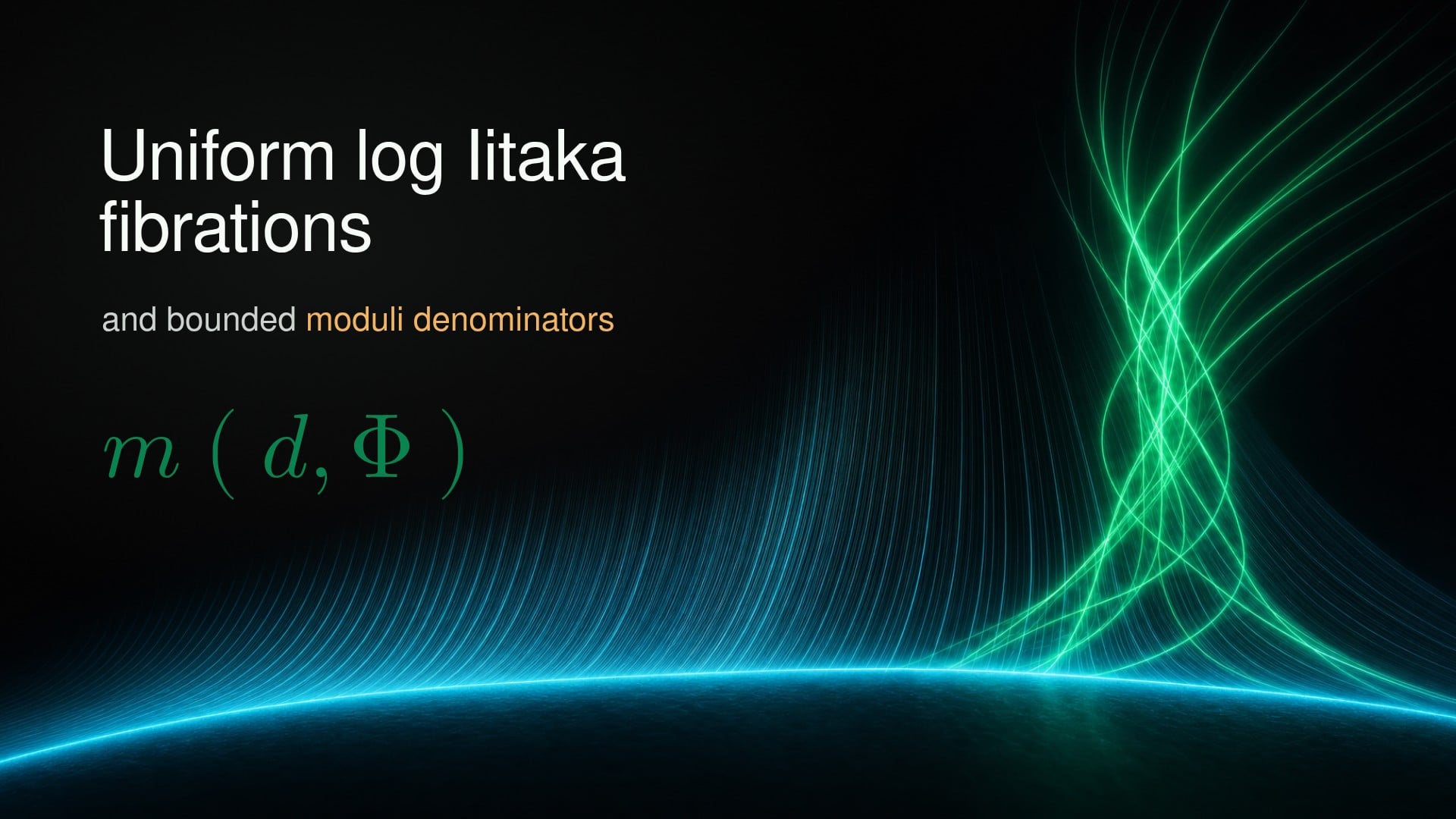
On a good minimal model, the canonical bundle formula gives K_X ∼_ℚ f*(K_Z + B_Z + M_Z) [2:20]. The coefficients of B_Z lie in a fixed DCC set. The hard part is the denominator of the moduli part M_Z. Birkar–Zhang's constant depended on the general fibre, including a middle Betti number. This paper bounds that denominator using lower-dimensional lc Calabi–Yau indices (Theorem 1.2), by degenerating the Beauville–Bogomolov factors of the general fibre. Both theorems are proved together, by induction on dimension [3:04]. The klt index step is a squeeze on the diagonal product Y^t/G_diag: the Seshadri lower bound grows like c·r^(1/n), while a jet argument caps it at C·t². That clash forces a contradiction, so the index is bounded [3:55].
Your check for any effective Iitaka statement: is the system nonempty, do its section ratios generate the whole Iitaka field, and what controls the moduli denominator? [4:37]