Recursos
Resumen
Take the compact log-smooth Kähler b-semiampleness theorem and say which part of its proof gives each of its two conclusions. Then use the threshold to work out the Hodge order of a root volume along a prime and the matching discriminant coefficient.
The problem
For a log-smooth fibration with K_Y + Δ ∼ f*L and coefficients in [0,1], the canonical bundle formula splits L − K_X into the discriminant B and the moduli part M. B-semiampleness asks for a model S of the base where (a) M pulls back to every higher model, and (b) some multiple of M is globally generated. The algebraic proof of Bakker–Filipazzi–Mauri–Tsimerman keeps the morphism projective. Here source and base may be nonprojective, and numerical positivity is not enough [0:45].
Conclusion (a): an exact order identity
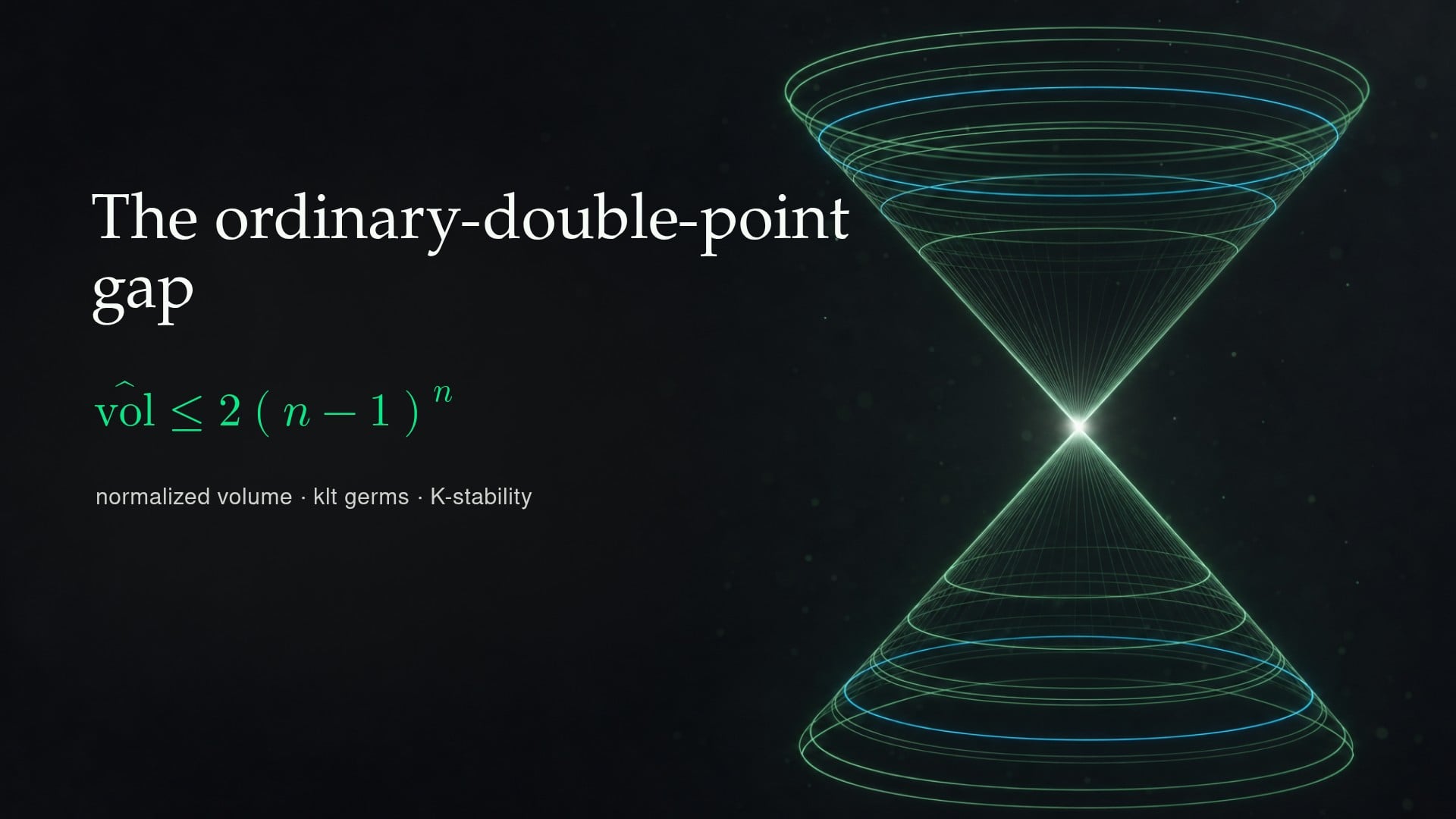
- The threshold is t_P = min over divisors over P of (log discrepancy) / (multiplicity), and P enters B with coefficient 1 − t_P. For a double fiber with no boundary, t_P = 1/2 [1:04].
- Take a cyclic root τ of a generator of the relative plurivolume line. Its top Hodge eigenline is one-dimensional, and an iterated residue moves it to a pure deepest stratum [1:41].
- The key identity is ord_P^Hdg(τ) = t_P − 1 [2:21]. In other words, the Hodge order equals minus the discriminant coefficient. So the canonical Hodge extension is Q − B = M, and since canonical extensions pull back, (a) follows.
- Practice [3:00]: components with ratios 1/2 and 1/3 give t_P = 1/3, order −2/3, b_P = 2/3. Take the minimum, never the average.
Conclusion (b): products and Baily–Borel
- On the klt fibers over a deepest stratum, a theorem of Matsumura–Wang–Wu–Zhang gives finite covers that split as products. A split fiber by fiber is not enough, so a marked family and Douady components give a compact P → S carrying the product [3:39].
- The projective log Calabi–Yau factor goes to the algebraic theorem. For the weight-one and weight-two factors, a flat change of filtration makes the polarization rational. The period map then extends to a Baily–Borel compactification, and pulled-back ample sections give global generation [4:37].
- Two-sided logarithmic bounds glue the factors and rule out a flat twist. Stein factorization and norms then carry the result down to S [5:13].
Reading rule [5:31]: for each conclusion, ask what delivers it. Stability comes from an exact order identity. Sections come from a compactification that already has an ample bundle.