Recursos
Resumen
When a compact hyperkähler manifold carries a line bundle whose class is nonzero, nef and isotropic, you should be able to say what fibration it predicts, and why the paper we follow claims that fibration really exists.
What the class predicts
- The numbers alone (nef, q = 0) give no sections. [0:20]
- Fujiki's relation with q(ℓ) = 0 makes ∫ ℓ^k κ^{2n−k} positive up to k = n and zero beyond. So ℓ has numerical dimension n, while a nef class with positive square has numerical dimension 2n. [0:45]
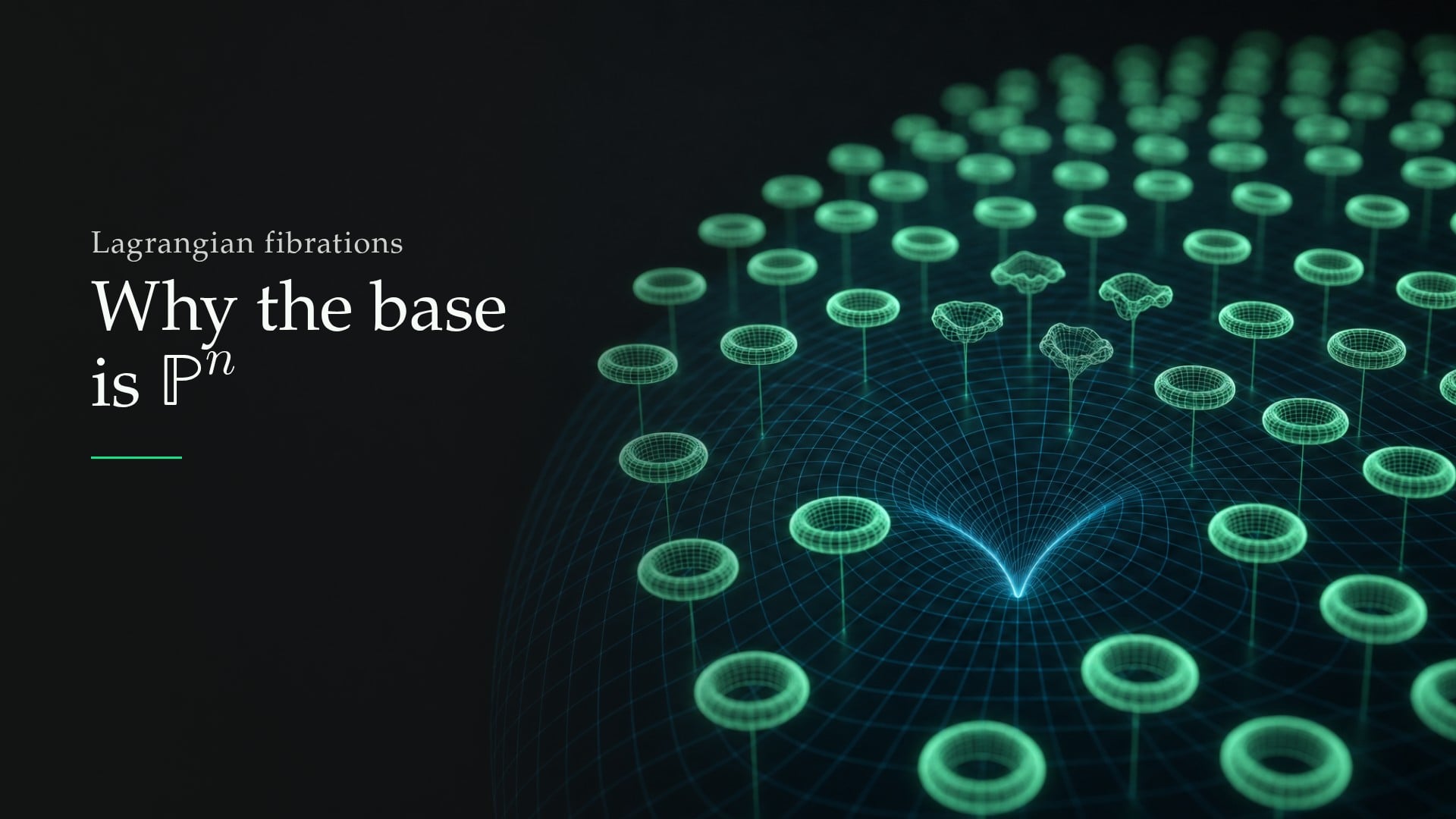
- The claim is semiampleness: some power L^m equals f*A for a map f: X → B with dim B = n, and every fiber component is n-dimensional and Lagrangian. On a fourfold that means a surface base with 2-dimensional fibers. [1:26]
How the paper claims to get there
- Reduction [2:23]: by Soldatenkov–Verbitsky, one semiample point in the class's deformation component is enough. By Greb–Lehn–Rollenske, a holomorphic Lagrangian torus on a nonprojective manifold gives a fibration.
- Degenerate [3:05]: keep the primitive class e in the monodromy of a polarized family degenerating toward the cusp ℚe.
- Torus: near a maximal crossing the rescaled Ricci-flat metric converges to a flat cylinder. An angular torus there is perturbed to a special Lagrangian torus and keeps its isotopy class.
- Rotate [3:50]: the restriction i*[ω_K] vanishes, so the torus is a complex Lagrangian torus for J. Then GLR fibers the nonprojective Y′.
- Return [4:47]: Soldatenkov–Verbitsky carries semiampleness back to X. Fujiki and Matsushita then give the dimensions.
Rule to keep: read a nonzero nef isotropic class as a promised Lagrangian fibration over an n-dimensional base. Then check which link (degenerate, torus, rotate, return) each cited theorem supplies.